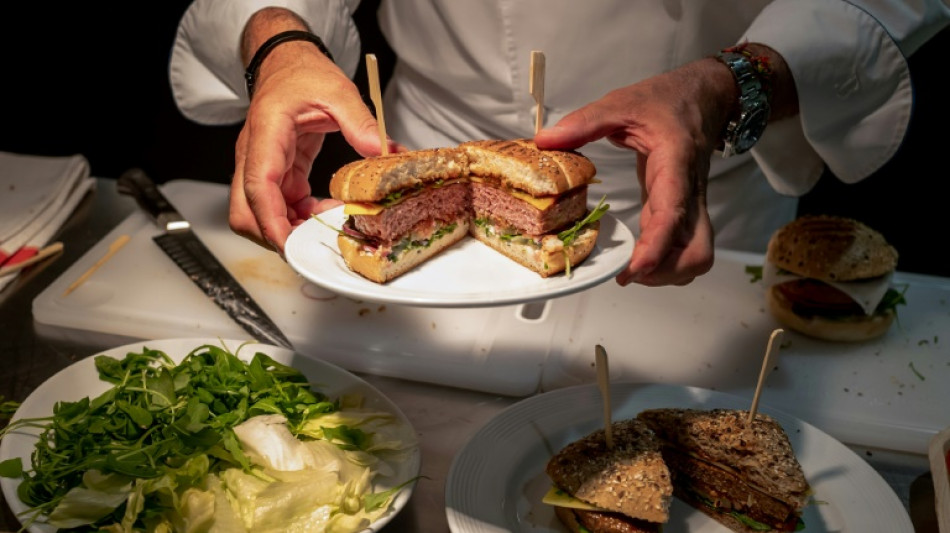
Microbe-based faux beef could save forests, slash CO2 / Photo: Fabrice COFFRINI - AFP/File

 Forex Expo Dubai to Take Place as Scheduled on 22–23 September 2026

 Russia pounds Kyiv, ending three-day halt for US talks

 Flights resume gradually in Indonesia after volcanic eruption
 French AI firm Mistral valued at 21 bn euros after latest funding

 Sweden heads to the polls in close election race

 Australia's Big Bash T20 teams face sale to private investors

 Russia resumes strikes on Kyiv after three-day halt

 Canada's counter-tariffs take effect on various US goods

 China's trade booms as focus turns to expected Trump-Xi summit

 Is Champions League three-peat really possible for PSG?
 Russia pummels Kyiv after three-day halt

 Mongolians wait hours for fuel as reliance on Russia bites

 Blockx first Belgian man to reach US Open quarter-finals

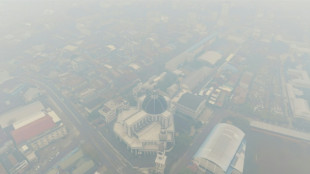 Praying for rain as fires, haze plague Indonesian Borneo

 Rybakina tops Osaka, sets US Open quarter-final clash with Zheng

 Apex Expands Trinity Zone with Step-out Hole Returning 197.5 m Interval of 2.12% REO at the Rift Rare Earth Project in SE Nebraska
 BioNxt Advances Sublingual Everolimus ODF for Organ Transplant Rejection with Initiation of Large-Animal Pharmacokinetic Study
 Genflow Biosciences PLC Announces Primary Endpoint in SLAB Clinical Trial Met

 Gaming Realms PLC Announces Interim Results

 Panama Canal considering more cuts in transits due to El Nino

 Maresca agrees with Haaland that players started season jaded

 Hurricane warning issued for westernmost Hawaiian islands

 UK PM denounces 'politics of poison' after anti-migrant protests

 Comeback queen Zheng strikes again for US Open quarter-final berth

 Third absence for injured Hadjar as Lawson fills in again in Spain

Gradually replacing 20 percent of global beef and lamb consumption with meat-textured proteins grown in stainless steel vats could cut agriculture-related CO2 emissions and deforestation in half by 2050, researchers reported Wednesday.
Compared to a current-trends projection for population growth and food demand, swapping half of red meat consumption for so-called microbial proteins would see reductions in tree loss and CO2 pollution of more than 80 percent, they reported in the journal Nature.
"With a relatively small change in the consumption of ruminant meat, greenhouse gas emissions from tropical deforestation can be strongly reduced," lead author Florian Humpenoder, a scientist at the Potsdam Institute for Climate Impact Research (PIK), told AFP.
"This is an important contribution to reaching the Paris Agreement climate targets, with additional co-benefits for other sustainability goals."
A trio of landmark UN climate science reports since August have made it alarmingly clear that the Paris treaty's cornerstone target -- capping global warming "well below" two degrees -- is in serious jeopardy.
The global food system accounts for roughly a third of all carbon pollution, and beef production is the main culprit within the agricultural sector, according the UN's climate science advisory panel.
The cattle industry is a double threat.
It not only destroys CO2-absorbing tropical forests to make room for grazing pastures and cattle feed crops. In addition, belching livestock are a major source of methane, 30 times more potent as a greenhouse gas than CO2 on a 100-year timescale.
Microbe-based meat alternatives have been on supermarket shelves for decades.
But as the world scrambles for climate solutions, these and other "novel foods" are poised to grow into a major industry within decades, according market forecasts.
- Co-benefits -
Faux meat derived by culturing microbial or fungi-based cells undergoes a fermentation process, analogous to that for wine or beer.
The cells feed off of glucose -- from sugar cane or beets, for example -- to produce proteins, which means some cropland is needed for production.
But far less than for red meat, according to the study.
Assuming current agricultural methods and meat consumption patterns continue over the next 30 years, global pasture area is set to increase by nearly one million square kilometres (390,000 square miles).
If, however, 20 percent of that meat is replaced with microbe-based protein, pasture area is decreased even below current levels.
"About 1.2 million sq km less agricultural land is required for the same protein supply," said senior author Alexander Popp, also from PIK.
The benefits of protein made from microbes or fungi extend beyond climate and environmental impact, according to Hanna Tuomisto, a researcher at the University of Helsinki who did not take part in the study.
"Mycoprotein is an ideal substitute for meat because it is rich in protein and contains all the essential amino acids," she said in a comment, also in Nature.
Agricultural water use, along with the emissions of yet another greenhouse gas, nitrous oxide, would also be reduced.
"The efficiency of biotech-enabled alternatives offer huge future potential for more sustainable food provision," said Tilly Collins, deputy director of Imperial College London's Centre for Environmental Policy.
"Governments and the food production business need to coordinate to develop appropriate standards and thus future public confidence," she told the London-based Science Media Centre. "Our nuggets may never be the same again."
What remains uncertain, however, is whether enough meat lovers will give up their burgers and steaks for an alternative that shares the texture of meat more than the taste.
Only one of the six co-authors of the study had actually tasted the microbe-based meat substitute, according to Humpenoder.
"He likes it," he said.
H.Romero--AT