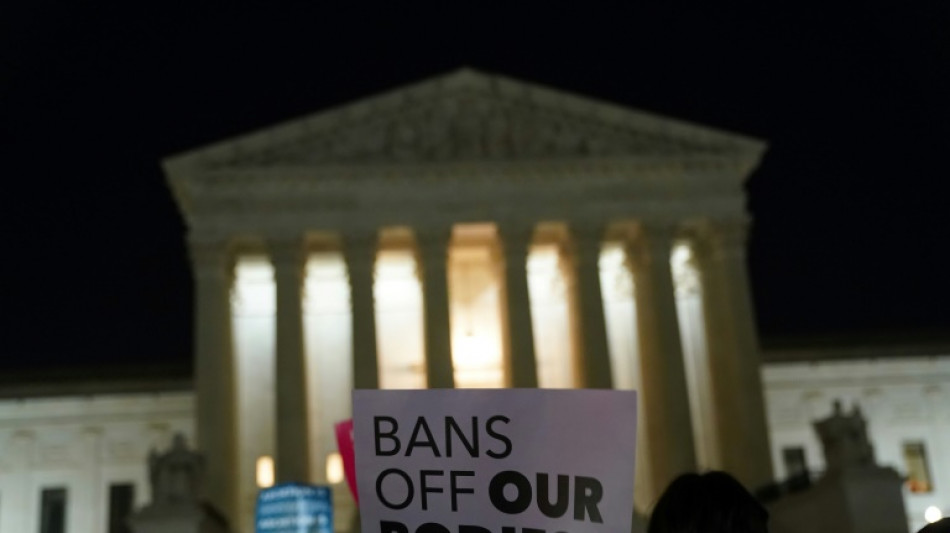
Roe v. Wade: 1973 case that enshrined US abortion rights / Photo: Stefani Reynolds - AFP

 South Africa economy shrinks ahead of local elections

 CapTLX Expands Institutional-Oriented Platform for Access to U.S. Capital Markets

 UK's Prince George starts at Eton College

 French far right keeps guarded silence over AfD Germany triumph

 Russia-Ukraine talks possible this month, Zelensky says, as Moscow pounds Kyiv

 Turkish Airlines will be new Liverpool shirt sponsor in £300 mn deal

 On London's Brick Lane, a data centre sparks local battle

 Nepal flood death toll rises as rescuers scour tunnels

 France's Mistral sees value soar with 3 bn euro cash infusion

 Nepal glacier saw exceptional heat before collapse caused deadly floods: researcher

 Ethiopia boosts drone production to fight rebels

 Yemen rebels hit Saudi Arabia with wave of strikes, wounding 73

 Nepalis mark a year since deadly protests that toppled government

 Rubio launches Latin America tour to cement US influence

 France tries 14 over deadliest Channel migrant crossing disaster

 Australia threatens hefty fines if big tech fails 'duty of care'

 Zverev romps into quarter-finals as Darderi downed

 Kauai on tornado watch as Hurricane Lowell nears Hawaiian islands

 Pakistan roll the dice in search of consolation win over England

 Yen extends gains as traders eye rate hike, tech rallies again

 'The ber months': Christmas arrives early in the Philippines

 N. Korea calls Russia bridge a sign of tighter ties

 US sanctions threaten to crush Iranian students' dreams

 Former champ Gauff holds off Jovic to reach US Open quarter-finals

 Formation Metals Extends A-Zone 200 Metres to the South and Identifies a New Vein Set, Returning 2.53 g/t Au over 11.8 Metres and 1.41 g/t Au over 20.6 Metres at the Advanced N2 Property

A US Supreme Court draft opinion leaked to the press on Monday suggests a majority of justices are ready to overturn the landmark Roe v. Wade, shredding nearly 50 years of constitutional protections on abortion rights.
Here is how the original 1973 court case played out.
- Right to privacy -
On January 22, 1973, the court decided that the constitutional right to privacy applied to abortion.
Roe was "Jane Roe," a pseudonym for Norma McCorvey, a single mother pregnant for the third time, who wanted an abortion.
She sued the Dallas attorney general, Henry Wade, over a Texas law that made it a crime to terminate a pregnancy except in cases of rape or incest, or when the mother's life was in danger.
Filing a complaint alongside her was Texas doctor James Hallford, who argued the law's medical provision was vague, and that he was unable to reliably determine which of his patients fell into the allowed category.
The "Does," another couple, childless, also filed a companion complaint, saying that medical risks made it unsafe but not life-threatening for the wife to carry a pregnancy to term, and arguing they should be able to obtain a safe, legal abortion should she become pregnant.
The trifecta of complaints -- from a woman who wanted an abortion, a doctor who wanted to perform them and a non-pregnant woman who wanted the right if the need arose -- ultimately reached the nation's top court.
The court heard arguments twice, and then waited until after Republican president Richard Nixon's re-election, in November 1972.
- 'Sensitive and emotional' controversy -
Only the following January did it offer its historic seven-to-two decision -- overturning the Texas laws and setting a legal precedent that has had ramifications in all 50 states.
Justice Harry Blackmun, writing for the majority, said the court recognized the "sensitive and emotional nature of the abortion controversy, of the vigorous opposing views, even among physicians, and of the deep and seemingly absolute convictions that the subject inspires."
But he argued that the "right of privacy... is broad enough to encompass a woman's decision whether or not to terminate her pregnancy."
"A state criminal abortion statute of the current Texas type, that excepts from criminality only a lifesaving procedure on behalf of the mother, without regard to pregnancy stage and without recognition of the other interests involved, is violative of the Due Process Clause of the Fourteenth Amendment," the ruling read.
But the top court agreed with lower court rulings that the right to privacy with regard to pregnancy "is not absolute, and is subject to some limitations."
"At some point, the state interests as to protection of health, medical standards and prenatal life become dominant," Blackmun wrote.
The top court thus ruled partially against the doctor and the Does, but in favor of Jane Roe, who has since become a pro-life activist.
On the same day, the justices ruled in the separate "Doe v. Bolton" case, which authorized each state to add restrictions to abortion rights for later-term pregnancies.
The constitutional right to abortion was later confirmed in a number of decisions, including "Webster v. Reproductive Health Services" in 1989, "Planned Parenthood v. Casey" in 1992 and Stenberg v. Carhart" in 2000.
P.A.Mendoza--AT