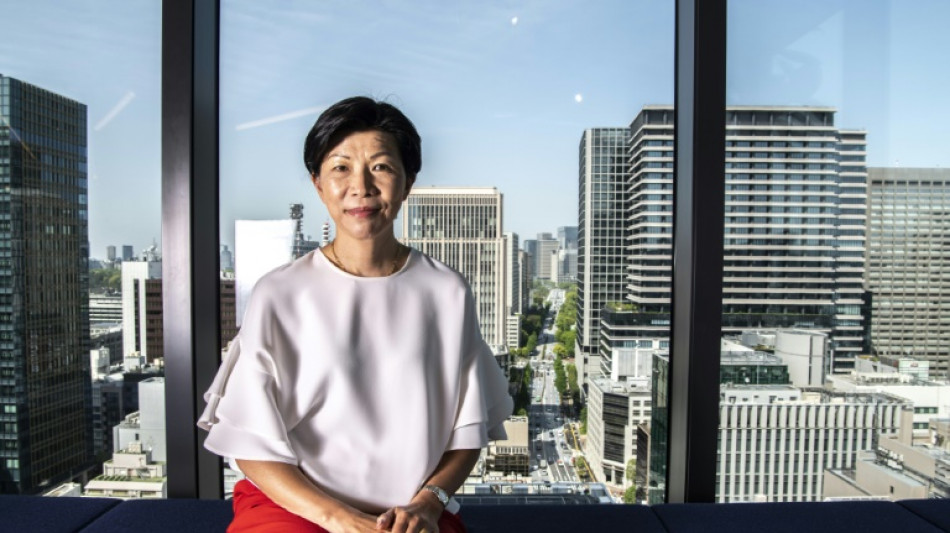
Japan's 'womenomics' pioneer says mindsets must change / Photo: Charly TRIBALLEAU - AFP

 South Africa economy shrinks ahead of local elections

 CapTLX Expands Institutional-Oriented Platform for Access to U.S. Capital Markets

 UK's Prince George starts at Eton College
 French far right keeps guarded silence over AfD Germany triumph

 Russia-Ukraine talks possible this month, Zelensky says, as Moscow pounds Kyiv
 Turkish Airlines will be new Liverpool shirt sponsor in £300 mn deal

 On London's Brick Lane, a data centre sparks local battle

 Nepal flood death toll rises as rescuers scour tunnels

 France's Mistral sees value soar with 3 bn euro cash infusion

 Nepal glacier saw exceptional heat before collapse caused deadly floods: researcher

 Ethiopia boosts drone production to fight rebels

 Yemen rebels hit Saudi Arabia with wave of strikes, wounding 73

 Nepalis mark a year since deadly protests that toppled government
 Rubio launches Latin America tour to cement US influence
 France tries 14 over deadliest Channel migrant crossing disaster

 Australia threatens hefty fines if big tech fails 'duty of care'

 Zverev romps into quarter-finals as Darderi downed

 Kauai on tornado watch as Hurricane Lowell nears Hawaiian islands

 Pakistan roll the dice in search of consolation win over England

 Yen extends gains as traders eye rate hike, tech rallies again

 'The ber months': Christmas arrives early in the Philippines

 N. Korea calls Russia bridge a sign of tighter ties

 US sanctions threaten to crush Iranian students' dreams

 Former champ Gauff holds off Jovic to reach US Open quarter-finals

 Formation Metals Extends A-Zone 200 Metres to the South and Identifies a New Vein Set, Returning 2.53 g/t Au over 11.8 Metres and 1.41 g/t Au over 20.6 Metres at the Advanced N2 Property

Three million women joined Japan's workforce in the past decade, and it's at least partly thanks to top executive Kathy Matsui, who coined the "womenomics" catchphrase that inspired government policy.
But with many women holding precarious part-time jobs, often in sectors hit hard by Covid-19, she says the world's third largest economy must try harder to tap underused talent.
That means chipping away at managers' sexist attitudes and challenging Japan's long-hours work culture, as well as encouraging start-ups with "more diverse founders".
"We have a very low ratio of female entrepreneurs in this country," Matsui, the former vice-president of US investment bank Goldman Sachs in Japan, told AFP.
"But if you want to be driving your own destiny, becoming an entrepreneur is one of the best ways to do that."
Matsui, 57, is one of the few women at the top of Japan's male-dominated business world, as co-director of a firm founded last year that invests in ethically minded young companies.
The Japanese-American was at Goldman Sachs in 1999 when she began publishing studies on the economic benefits of boosting female participation in the Japanese workforce, which she dubbed "womenomics".
To her surprise, the ideas were adopted by former prime minister Shinzo Abe in 2012 as part of his signature plan to revive the ailing Japanese economy.
Since then, the proportion of women in Japan who work has risen from 60 percent to over 70 percent, equivalent to around three million people, according to OECD figures.
But even now, only 15 percent of managers at Japanese companies are women, compared to around 40 percent in the United States.
- Pandemic problems -
"Trying to change the mindset and behaviour of very established organisations... is not impossible, but it just takes a long time," unlike start-ups which can be more flexible, Matsui said.
Recent progress has been so slow that Japan's government was forced to postpone its 30-percent target for women in management positions by a whole decade in 2020.
And like in other countries, the Covid crisis has not helped.
Worldwide, women were more likely than men to report a loss of employment in the pandemic's first 18 months, according to a University of Washington study published this year in the Lancet that analysed data from 193 countries.
In Japan, many women juggle looking after children or elderly relatives while working part-time, often in the Covid-hit service industries, Matsui said.
She thinks helping women into full-time roles where they are more likely to be promoted is not just the government's responsibility, but also that of managers.
Evaluations should be "much more focused on output and performance, as opposed to the time factor", and managers should undergo training to tackle prejudices.
"A lot of times I come across women who are passed over for promotion, because they just got married" and their boss doesn't want to "risk" them taking maternity leave, she said.
And it's urgent -- as Japan's rapidly ageing population causes its workforce to shrink, "the fastest thing you can do is try to tap into the talent that is staring you in the face."
- New perspectives -
Matsui grew up in California as the daughter of Japanese immigrants who ran a flower-growing business, which taught her the "value of work".
She studied at Harvard, where she majored in social studies. After graduation, she won a scholarship to study in Japan -- her first time in her parents' home country -- and stayed to build a career in finance.
Her "womenomics" argument struck a chord with ministers because it offered a new perspective on the benefits of equality, she believes.
As well as targets and requirements for large companies to disclose data on gender balance, Matsui has also seen a shift in how the issue is viewed in Japan, from a niche issue to a "daily topic of conversation".
But she remains committed to her original principles of crunching data and finding solutions, rather than just talking about the problems faced by women in the workforce.
"You cannot manage what you don't measure," she said.
Now, as co-director of the venture capital company MPower Partners, which invests in businesses that prioritise environmental, social and corporate governance (ESG), Matsui wants to grow Japan's relatively small start-up scene.
"Part of why it's so small is because there's not enough diversity, or because (the companies) don't think globally enough. Those are two angles where we at MPower really want to help change," she said.
But firms seeking investment should beware of resorting to superficial tactics like so-called greenwashing: "We're not so interested in companies just trying to tick the box."
J.Gomez--AT