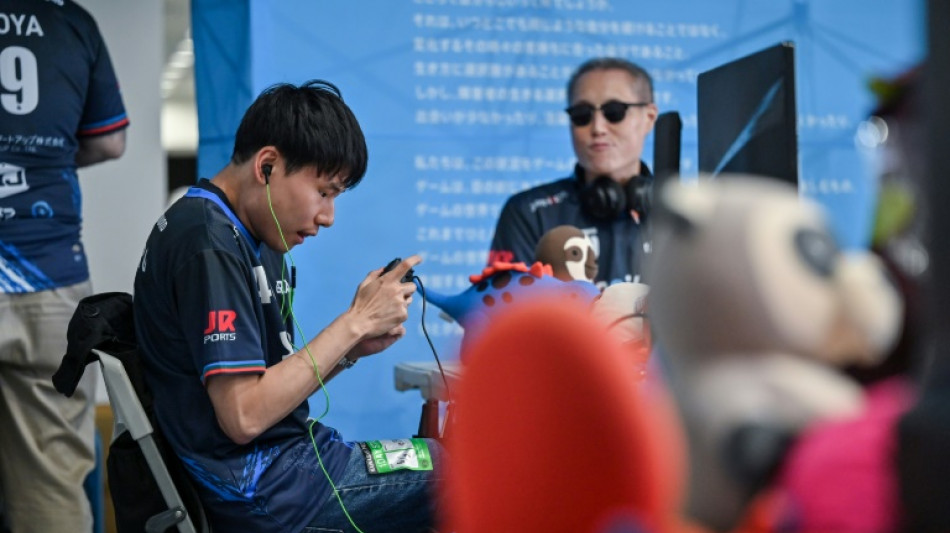
AI accessibility? Blind gamer puts ChatGPT to the test / Photo: Richard A. Brooks - AFP

 Sabalenka edges Noskova, keeps US Open treble bid alive

 Real Madrid win Champions League opener as Haaland stars for Man City

 Gambian leader vows power boost after violent blackout protests

 Newcastle battle past Millwall to reach League Cup fourth round

 Mourinho's Real Madrid make winning start against Inter Milan

 Villa take 'big step forward' with win over Brugge
 Yaya Toure hails 'new era' for African coaches ahead of Champions League bow

 Lawes and Marchant told to prove themselves in quest for England recalls
 Smithsonian secretary to retire as Trump exerts control over institution

 Atletico have work to do to reach home Champions League final: Simeone

 Villa end goal drought to beat Brugge in Champions League opener
 McIlroy says 'we'll keep our heads down and play' in event of Trump golf visit
 Sabalenka holds of Noskova to reach US Open semi-finals

 Netanyahu under fire over report UAE warned of October 7 attack

 Wasim Akram urges 'fair treatment' for jailed Imran Khan

 No. 1 in reach as Rybakina battles for US Open semi-final spot

 Putin and Trump discuss Ukraine in 'extremely frank' call

 French police hunt Renoir thieves after lightning museum heist

 World Cup final scorer Torres leads Ballon d'Or nominees

 Carney touts Canada 'pivot' away from US as tariffs rise

 Spanish stars Cruz, Bardem play strained on-screen couple in new film

 The "Everlasting Battery" Inside Your Joints:UConn Professor's Self-Powered Healing Material just Got Acquired

 Visionary or conman? Elon Musk enigmatic star of Venice documentary

 Trial opens in France over deadliest Channel migrant crossing disaster

 England skipper Root says it's wrong to accuse Pakistan of lacking fight

Japanese eSports gamer Mashiro is blind and often relies on a companion to get around Tokyo -- but he hopes that artificial intelligence, hailed as a promising tool for people with disabilities, can help him travel alone.
The 26-year-old "Street Fighter" player put the latest version of AI chatbot ChatGPT to the test on his way to a stadium for a recent Para eSports meet-up.
"I can't participate in an event like this without someone to rely on," he told AFP. "Also, sometimes I just want to get around by myself without speaking to other people.
"So if I can use technology like ChatGPT to design my own special needs support, that would be great."
This year, the US firm OpenAI released GPT-4o, which understands voice, text and image commands in several languages.
The generative gadget, along with others such as Google's Gemini, is part of a fast-growing field that experts say could make education, employment and everyday services more accessible.
Following the streets' tactile paving, Masahiro Fujimoto -- who goes by his online handle Mashiro -- used his stick adorned with a small monkey mascot to find his way from the station.
As he went, he spoke to GPT-4o like a friend, receiving its answers through an earpiece in one ear, leaving the other side free to listen out for cars.
Having asked for basic directions, he added: "In fact, I am blind, so could you give me further details for blind people?"
"Of course," the bot replied. "You might notice an increase in crowd noise and the sound of activities as you get closer."
The journey, 20 minutes for sighted people, took Mashiro around four times as long with several U-turns.
When it started to rain heavily, he requested help from his friend, who is partially sighted, to finish the journey.
"Arrival!" finally shouted Mashiro, who has microphthalmos and has been blind since birth, using only sound to demolish his opponents on "Street Fighter 6".
- 'Enormous potential' -
AI can cater to specific needs better than "one-size-fits-all" assistive products and technologies, said Youngjun Cho, an associate professor in computer science at University College London (UCL).
"Its potential is enormous," said Cho, who also works at UCL's Global Disability Innovation Hub.
"I envisage that this can empower many individuals and promote independence."
People with hearing loss can, for example, use AI speech-to-text transcription, while chatbots can help format a resume for someone with learning disabilities.
Some tools for visually impaired people, such as Seeing AI, Envision AI and TapTapSee, describe phone camera images.
Danish app Be My Eyes, where real-life volunteers help via live chat, is working with OpenAI to develop a "digital visual assistant".
But Masahide Ishiki, a Japanese expert in disability and digital accessibility, warned it can be "tricky" to catch mistakes from ChatGPT, which "replies so naturally".
"The next objective (for generative AI) is to improve the accuracy of real-time visual recognition, to ultimately reach capabilities close to that of a human eye," said Ishiki, who is blind.
Marc Goblot of the Tech for Disability group also cautioned that AI is trained on "very mainstream datasets" which are "not representative of the full spectrum of people's perceptions and especially the margins".
Mashiro said ChatGPT's limited recognition of Japanese words and locations made his AI-assisted journey more challenging.
Although the experiment was "a lot of fun", it would have been easier if ChatGPT was connected to a map tool, said the gamer, who travelled around Europe last year using Google Maps and help from those around him.
He has already decided on his next travel destination: Yakushima rainforest island in southern Japan.
"I want to experience whatever happens when travelling somewhere like that," he said.
E.Rodriguez--AT