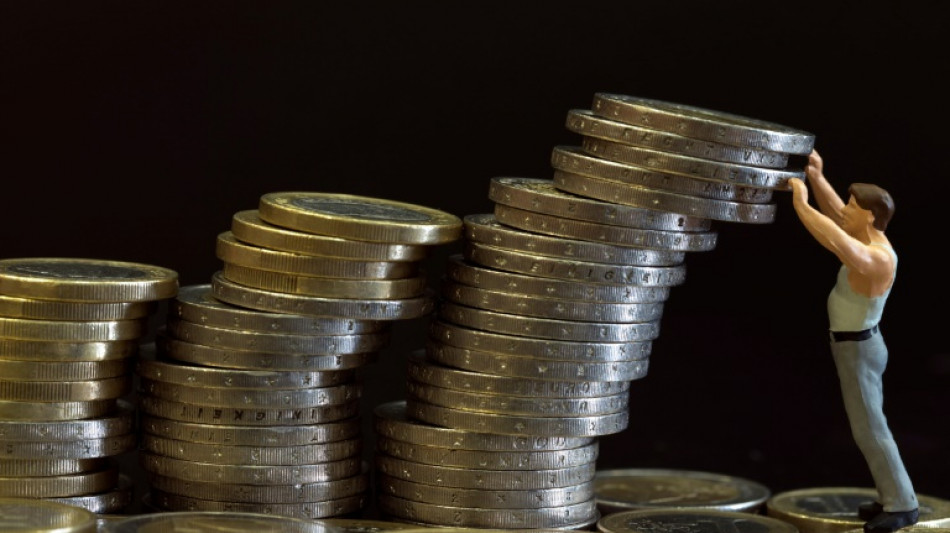
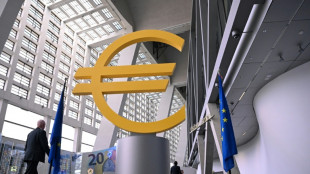
EU to warn France, Italy and more over unruly budgets / Photo: JOEL SAGET - AFP/File

 Iran, US trade blows as Hormuz impasse deepens

 The round-the-clock monitors protecting Bhutan from glacier risk

 'Hell': Father of surfers killed in Mexico testifies at trial

 Travellers in UK face more chaos after air traffic control glitch

 Crude pushes towards $100 on Mideast flare-up, fanning inflation fears

 Record rain forces Asian Games athletes to evacuate accommodation
 Amusing or addictive? The algorithms powering our social feeds
 Norway bids farewell to King Harald V, 'grandfather' of the nation

 NFL breaks new ground as 100,000 set to pack MCG in Australia

 EU faces revolt over social media ban for children

 Canada eyes researchers looking to leave 'hostile' US

 Tiafoe escapes Michelsen to reach US Open semi-finals

 Sabalenka edges Noskova, keeps US Open treble bid alive

 Real Madrid win Champions League opener as Haaland stars for Man City

 Gambian leader vows power boost after violent blackout protests

 Newcastle battle past Millwall to reach League Cup fourth round

 Mourinho's Real Madrid make winning start against Inter Milan

 Villa take 'big step forward' with win over Brugge

 Yaya Toure hails 'new era' for African coaches ahead of Champions League bow

 Lawes and Marchant told to prove themselves in quest for England recalls

 Smithsonian secretary to retire as Trump exerts control over institution
 Atletico have work to do to reach home Champions League final: Simeone

 Villa end goal drought to beat Brugge in Champions League opener

 McIlroy says 'we'll keep our heads down and play' in event of Trump golf visit

 Sabalenka holds of Noskova to reach US Open semi-finals

The European Union is expected on Wednesday to rebuke nearly 10 governments, including France and Italy, over their excessive spending after new budget rules entered into force this year.
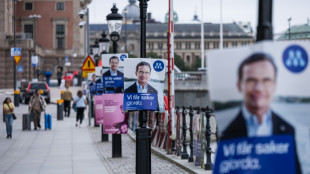
It comes at a particularly difficult moment for France, where both the far left and far right are piling up spending promises ahead of snap polls triggered by President Emmanuel Macron's crushing EU election defeat.
This will be the first time Brussels reprimands nations since the EU suspended the rules after the 2020 Covid pandemic and the energy crisis triggered by the Ukraine war, as states propped up businesses and households with public money.
The EU spent two years during the suspension overhauling the budget rules to make them more workable and give greater leeway for investment in critical areas like defence.
But two sacred goals remain: a state's debt must not go higher than 60 percent of national output, with a public deficit -- the shortfall between government revenue and spending -- of no more than three percent.
The European Commission will publish assessments of the 27 EU states' budgets and economies on Wednesday, and will likely point out that some 10 countries including Belgium, France and Italy, have deficits higher than three percent.
The EU's executive arm has threatened to launch excessive deficit procedures, which kickstart a process forcing a debt-overloaded country to negotiate a plan with Brussels to get back on track.
Such a move would need approval by EU finance ministers in July.
Countries failing to remedy the situation can in theory be hit with fines of 0.1 percent of gross domestic product (GDP) a year, until action is taken to address the violation.
In practice, though, the commission has never gone as far as levying fines -- fearing it could trigger unintended political consequences and hurt a state's economy.
- Break with the past -
The EU countries with the highest deficit-to-GDP ratios last year are Italy (7.4 percent), Hungary (6.7 percent), Romania (6.6 percent), France (5.5 percent) and Poland (5.1 percent).
They will "likely" face the excessive deficit procedures, alongside Slovakia, Malta and Belgium, which also have deficits above three percent, according to Andreas Eisl, expert at the Jacques Delors Institute.
The picture is complicated for three other countries, Eisl said. Spain and the Czech Republic exceeded the three percent limit in 2023 but should be back in line this year.
Meanwhile, Estonia's deficit-to-GDP ratio is above three percent but its debt is around 20 percent of GDP, significantly below the 60 percent limit.
The commission will look at the states' data in 2023 but "will also take into account the developments expected for 2024 and beyond", the expert told AFP.
Member states must send their multi-annual spending plans by October for the EU to scrutinise and the commission will then publish its recommendations in November.
Under the new rules, countries with an excessive deficit must reduce it by 0.5 points each year, which would require a massive undertaking at a moment when states need to pour money into the green and digital transition, as well as defence.
Adopted in 1997 ahead of the arrival of the single currency in 1999, the rules known as the Stability and Growth Pact seek to prevent lax budgetary policies -- a concern of Germany -- by setting the strict goal of balanced accounts.
M.White--AT