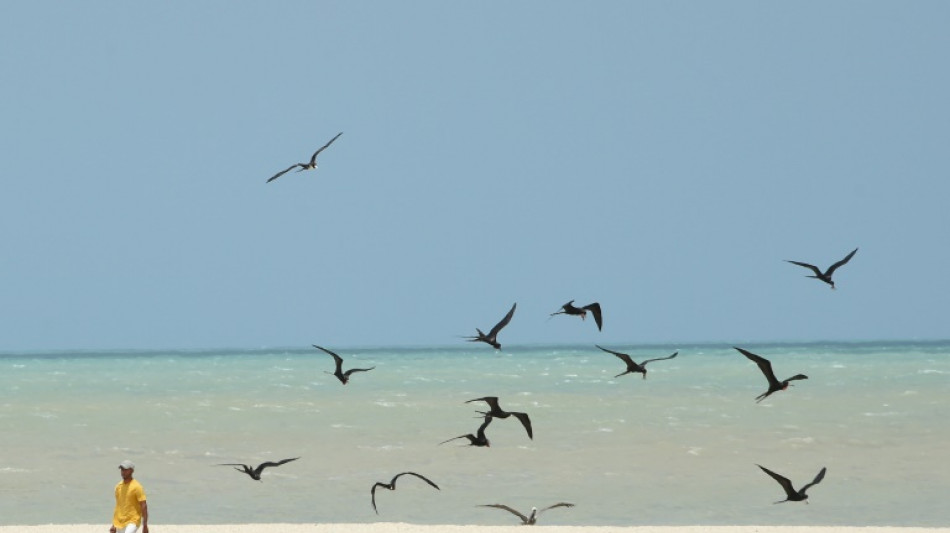
UN top court raps Colombia over sea row with Nicaragua / Photo: DANIEL MUNOZ - AFP

 England edge ahead in third Test after latest Pakistan collapse
 'Alarm bells ringing': US summer heat shatters record

 IAEA board refers Iran to UN Security Council

 Rubio pushes extraditions, anti-drug fight in Ecuador

 Amboss and Aureo Connect the Lightning Network to Mexico's Banking System

 Brent oil passes $100 on Mideast flare-up, stoking inflation fears

 Israeli settlement winemaker defiant after UK-led trade sanctions

 Josh Kerr: I pick my races and never get 'greedy'

 Carrick confident Man Utd can go far in 'magical' Champions League

 France far right expels policeman member over racist remarks

 Pakistan collapse to 133 all out against England in 3rd Test

 Heat forces French champagne makers to stiffen their drink
 Iran war drives oil prices to $100 per barrel as Tehran strikes ships

 Pakistan collapse to 100-7 against England in 3rd Test

 Workers, migrants focus of documentaries by Oscar winners at Venice

 Nepal seeks survivors two weeks after deadly floods

 Bangladesh measles crisis kills more than 1,000 children

 Pakistan collapse to 26-4 against England in 3rd Test

 EU helps cities tighten screws on Airbnb, holiday rentals
 Courtois to put Belgium career on hold
 RavenDB Launches Quill to Bring Production AI Agents to Enterprise SQL Systems, No Migration Required

 Affleck family affair at Venice for Casey's latest film 'Company'

 Yemen rebels report fresh Saudi strikes as conflict deepens

 'They're playing with our lives': AI researcher quits Anthropic

 Series finale of 'Babylon Berlin' offers dark mirror for today's Germany

The United Nations' top court on Thursday ordered the Colombian navy to stop interfering in Nicaraguan waters, ruling on a longstanding legal battle over maritime borders.
The International Court of Justice "finds that by interfering with fishing and marine research activities of Nicaraguan-flagged vessels ... in Nicaragua's exclusive economic zone ... Colombia's has violated Nicaragua's sovereign rights and jurisdiction," presiding judge Joan Donoghue said.
The court "finds by nine votes to six ... that the Republic of Colombia must immediately cease (this) conduct," she said, handing down the verdict at the ICJ's headquarters in The Hague.
In 2012 the ICJ, which rules in disputes between countries, awarded Nicaragua a swathe of disputed Caribbean Sea territory extending 200 nautical miles from its coastline.
But the following year, Nicaragua lodged a fresh case, accusing Colombia of ignoring the ruling.
It alleged Bogota had threatened to use force to back up its claims in the oil- and fish-rich region.
Nicaragua's lawyers also asked the ICJ make Colombia pay compensation for "the threat or use of force by the Colombian navy against Nicaraguan fishing boats".
Colombia denied the accusations, saying its presence in the region was "due to other imperatives", including international maritime rescue and the fight against drug trafficking.
Speaking outside court after the judgement, Colombia's representative, Carlos Gustavo Arrieta Padilla, said he still believed "the ruling is mainly in favour of Colombia".
"They (the judges) did not ask us to cease our presence in Nicaraguan waters... They never ordered us to leave ... the area," Arrieta said.
"The court has maintained the possibility of the Colombian navy being there and doing operations in the fight against organised crime in the area," he said.
- Legal ping-pong -
In a game of legal ping-pong, Bogota accused Managua of interfering with indigenous fishing rights.
The loss of fishing grounds because of the ICJ's 2012 ruling particularly affected the Raizal people, an English- and Creole-speaking community who are mainly descendants of slaves taken from Africa, Colombia's lawyers said.
However, Judge Donoghue said Colombia "failed to establish that the inhabitants of the San Andres archipelago, in particular the Raizales, enjoy fishing rights in waters now within Nicaragua's exclusive economic zone".
The court nonetheless "noted Nicaragua's willingness ... to negotiate with Colombia an agreement regarding access by members of the Raizales community to fisheries within Nicaragua's exclusive economic zone".
The best way to do this was through a bilateral agreement, Donoghue said.
The judges rejected Nicaragua's claim for compensation.
- Strained relations -
Although there are no land borders between Nicaragua, located in Central America, and Colombia, in South America, diplomatic relations have been strained for almost a century over disputed maritime limits.
Nicaragua finally took Colombia to the ICJ in 2001, and in 2012 it won several thousand square kilometres (miles) of territory in the southwestern Caribbean that had previously been Colombian.
Colombia, which was left with only seven islets, said at the time it would no longer recognise the court's jurisdiction on border disputes.
Nicaragua then went back to the court in 2013, alleging violations of the judgement by Colombia.
Judges at the ICJ ruled in 2016 that they had jurisdiction in the dispute, brushing aside Colombian objections that the court was not competent to hear the cases.
Countries are obliged to implement judgements by the Hague-based ICJ, which are final and cannot be appealed.
In rare situations where a country refuses, the matter can be referred to the UN Security Council by the complainant country for further action.
G.P.Martin--AT