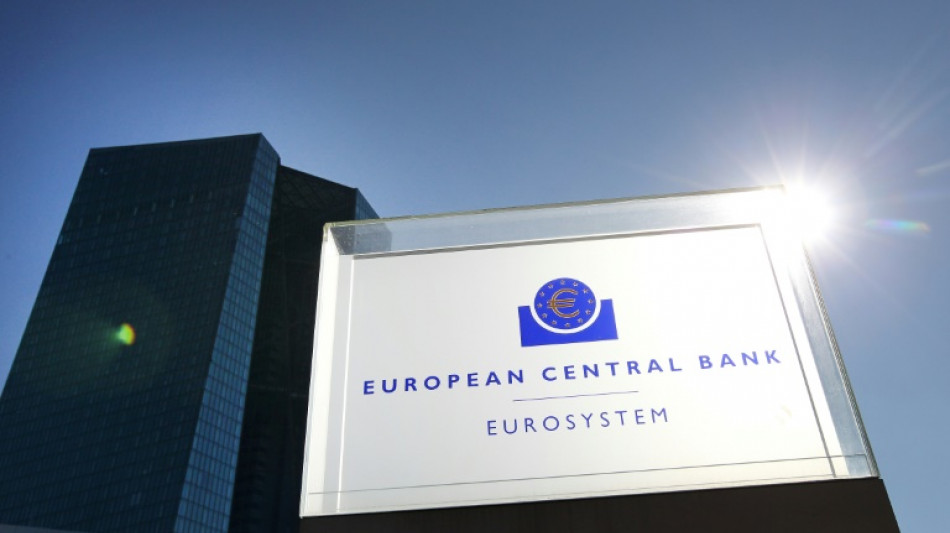
ECB holds tight as inflation tide rises / Photo: Daniel ROLAND - AFP/File

 'Personality' the key for Celtic boss Nancy when it comes to new signings

 Nigeria signals more strikes likely in 'joint' US operations
 Elusive wild cat feared extinct rediscovered in Thailand
 Malaysia's Najib convicted of abuse of power in 1MDB graft trial

 History-maker Tongue wants more of the same from England attack
 Asia markets edge up as precious metals surge
 'No winner': Kosovo snap poll unlikely to end damaging deadlock

 Main contenders in Kosovo's snap election
 Boys recount 'torment' at hands of armed rebels in DR Congo
 Bondi victims honoured as Sydney-Hobart race sets sail
 Palladino's Atalanta on the up as Serie A leaders Inter visit

 Shanghai's elderly waltz back to the past at lunchtime dance halls
 US launches Christmas Day strikes on IS targets in Nigeria
 Too hot to handle? Searing heat looming over 2026 World Cup

 Guinea's presidential candidates hold final rallies before Sunday's vote

 Aptevo Therapeutics Announces 1-for-18 Reverse Stock Split

 IRS Can Freeze Installment Agreements After Missed Filings - Clear Start Tax Explains Why Compliance Comes First
 A Christmas Message to the DEA's Diversion Anti Marijuana Cabal
 BondwithPet Expands B2B Offering with Custom Pet Memorial Product

 Eon Prime Intelligent Alliance Office Unveils New Brand Identity and Completes Website Upgrade

 Spurs extend domination of NBA-best Thunder
 Russia makes 'proposal' to France over jailed researcher
 Brazil's jailed ex-president Bolsonaro undergoes 'successful' surgery

 New Anglican leader says immigration debate dividing UK

 Bangladesh PM hopeful Rahman returns from exile ahead of polls

The European Central Bank on Thursday stood still in the face of record inflation, keeping its stimulus plans and rates unchanged, as the war in Ukraine cast a pall over the eurozone economy.
Meeting for the second time since the outbreak of the conflict, the bank's 25-member governing council stuck to a plan that "should" see its bond-buying scheme come to an end in the third quarter.
An interest rate hike would follow "some time" after the stimulus programme comes to an end, and any increases "will be gradual".
The decision leaves the ECB further out of step with many of its peers. Central banks such as the Bank of England, US Federal Reserve and the Bank of Canada have already triggered their first interest rate rises in response to soaring inflation.
Calls for the ECB to follow suit as soon as possible from within the governing council have grown stronger as price rises in the eurozone have taken off.
Year-on-year inflation hit 7.5 percent in March, an all-time high for the currency bloc and well above the bank's own two-percent target.
The surge owes a great deal to the take off in prices for energy, commodities and food as a result of Russia's invasion of Ukraine. At the same time, the high cost of oil and gas, as well as added confusion in supply chains threaten to deliver a blow to the economy.
- 'Lively debate' -
Thursday's meeting probably saw "a lively debate", said Holger Schmieding, an economist at Berenberg Bank, but it was still too soon for the ECB to reach a "major decision".
Attention now turns to ECB President Christine Lagarde's press conference at 1230 GMT for clues as to how the institution intends to plot its way forward through uncertainty.
Among the things observers will be listening for is "a further hint that the ECB may raise rates later this year", Schmieding said, with more "hawkish" governing council members pushing for a hike sooner rather than later.
Central bankers use interest rate rises as a tool to try and tame inflation, but pulling the trigger too soon risks hurting economic growth.
Minutes from the last ECB meeting revealed that many members of the governing council wanted "immediate further steps" despite the darkening economic picture.
Joachim Nagel, the head of Germany's traditionally conservative central bank, has previously cautioned against "acting too late".
Any hike would be the ECB's first in over a decade and would lift rates from their current historic low levels.
The Frankfurt-based institution even set a negative deposit rate of minus 0.5 percent, meaning banks pay to park excess cash at the ECB.
Carsten Brzeski, head of macro at ING bank, said he saw the ECB's rates exiting negative territory "at the latest around the turn of the year".
- Old predictions -
The ECB's prediction that inflation would even out at 5.1 percent over the course of 2022 was "already outdated", Brzeski said.
The persistence of high energy costs and the potential for new sanctions that could further limit supplies from Russia could drive the monthly figure into "double-digit" territory.
Soaring energy prices would also saddle businesses and consumers with higher bills and "weigh on economic activity in the coming months", Brzeski said.
Over recent years, the ECB has hoovered up billions of euros in government and corporate bonds each month to stoke the economy and keep credit flowing in the 19-nation currency club.
While the stimulus is being phased out, the advent of a fresh crisis has some speculating about the possibility of the ECB designing a new tool to contain the impact of the war.
The "geostrategic" programme would counter the risk of borrowing costs rising for certain countries in the eurozone that would make it harder for them to finance their response to the war, said Eric Dor, a director at the IESEG business school.
Signalling a willingness to use the new tool could be "sufficient" to keep costs low, Dor said, though it was probably "too early" for it to be launched.
W.Nelson--AT