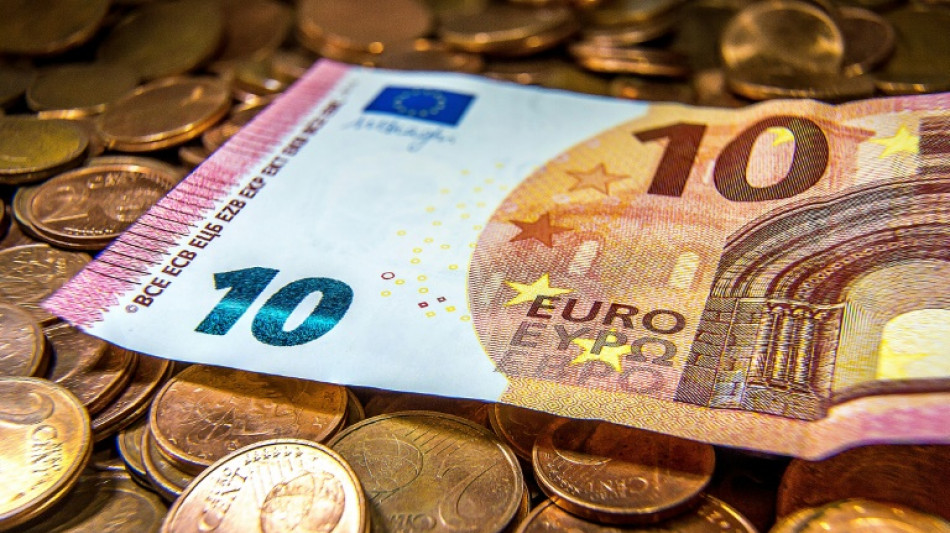
ECB wrestles with record inflation and war risk / Photo: PHILIPPE HUGUEN - AFP/File

 Sweden ready for 'game of our lives' in France World Cup clash

 MLS Chicago Fire announce signing of Poland's Lewandowski

 Tech rebound lifts Dow to record, yen hits 40-year low against dollar

 US Supreme Court rules on dragnet searches of cellphone location data

 South Korea fans target coach Hong with boos as World Cup squad returns

 Vaughan calls for England change after Stokes bows out with defeat

 Europe's deadly heatwave scorches east, Slovakia hits record
 French Open champ Andreeva sails into Wimbledon second round

 Shooter in custody dispute kills six at German family shelter

 Sinner survives scare and fall to reach Wimbledon second round

 Serena set for much-anticipated Wimbledon return
 Ex-NBA stars Malik Beasley, Ed Davis indicted in betting case

 EU, China bet on talks to avoid trade war
 Pyjamas and bets: Brazil YouTube channel reshapes World Cup viewing

 Queueing, strawberries and all white: it must be Wimbledon
 Stokes backs Brook '100 percent' to succeed him as England Test captain

 Ebola outbreak in DR Congo spreads to fourth province

 Czech Republic coach Koubek quits after World Cup flop

 French parliament adopts bill to regulate fast fashion

 Supreme Court boosts Trump's power to fire officials, but protects Fed
 Three things we learned from the Austrian F1 Grand Prix

 Burnham pledges radical devolution of UK govt if PM

 Polish businesses press Warsaw, Kyiv to end political rift

 Hovland beats Scheffler in playoff for PGA Travelers title
 New Zealand thrash England for series win as Stokes bows out
European Central Bank policymakers meet on Thursday faced with the challenge of threading a response between record-high inflation figures and weak growth due to the war in Ukraine.
The bank's 25-member governing council gathers for the second time since Russia launched its invasion at the end of February, with the outlook for the eurozone economy still murky.
At its meeting in March, the ECB sped up the wind-down of its bond-buying programme, raising the possibility of a complete stop as soon as July.
A move towards interest rate rises would follow "some time" after that -- a time frame which could be a "week after" or "months later", according to ECB President Christine Lagarde.
But calls for the ECB to act faster have grown louder as prices have continued to spiral, with the war in Ukraine sending the costs for energy, commodities and food upwards.
Inflation in the eurozone hit 7.5 percent in March, an all-time high for the currency bloc and well above the central bank's own two-percent target.
Meanwhile, surging prices for oil and gas, as well as the added disruption for supply chains, threaten to drag on the economy.
The high degree of uncertainty means the ECB will likely tread carefully. Thursday's meeting would not produce an "Easter egg", said Holger Schmieding, economist at Berenberg Bank.
"Expect a lively debate but no major decision yet."
- 'Further steps' -
Observers will be listening closely to Lagarde's press conference at 1230 GMT for clues as to how the ECB might respond next.
Among the things they will be listening for are "a further hint that the ECB may raise rates later this year", Schmieding said, a policy pushed for by more "hawkish" governing council members.
Joachim Nagel, the head of Germany's traditionally conservative central bank, has cautioned against "acting too late".
Any hike would be the ECB's first in over a decade and would lift rates from their current historic low levels.
The Frankfurt-based institution even set a negative deposit rate of minus 0.5 percent, meaning banks pay to park excess cash at the ECB.
Central bankers use interest rate rises as a tool to tame inflation, but pulling the trigger too soon risks hurting economic growth.
Minutes from the last ECB meeting revealed that many members of the governing council wanted "immediate further steps" to tackle inflation despite the darkening economic picture.
The Bank of England, the US Federal Reserve and the Bank of Canada have already moved on rate hikes, leaving the ECB looking out of step.
Carsten Brzeski, head of macro at ING bank, said he saw the ECB's rates exiting negative territory "at the latest around the turn of the year".
- Old predictions -
The ECB's prediction that inflation would even out at 5.1 percent over the course of 2022 was "already outdated", Brzeski said.
The persistence of high energy costs and the potential for new sanctions that could further limit supplies from Russia could drive the monthly figure into "double-digit" territory.
Soaring energy prices would also saddle businesses and consumers with higher bills and "weigh on economic activity in the coming months", Brzeski said.
Over recent years, the ECB has hoovered up billions of euros in government and corporate bonds each month to stoke the economy and keep credit flowing in the 19-nation currency club.
While the stimulus is being phased out, the advent of a fresh crisis has some speculating about the possibility of the ECB designing a new tool to contain the impact of the war.
The "geostrategic" programme would counter the risk of borrowing costs rising for certain countries in the eurozone that would make it harder for them to finance their response to the war, said Eric Dor, a director at the IESEG business school.
Signalling a willingness to use the new tool could be "sufficient" to keep costs low, Dor said, though it was probably "too early" for it to be launched.
J.Gomez--AT