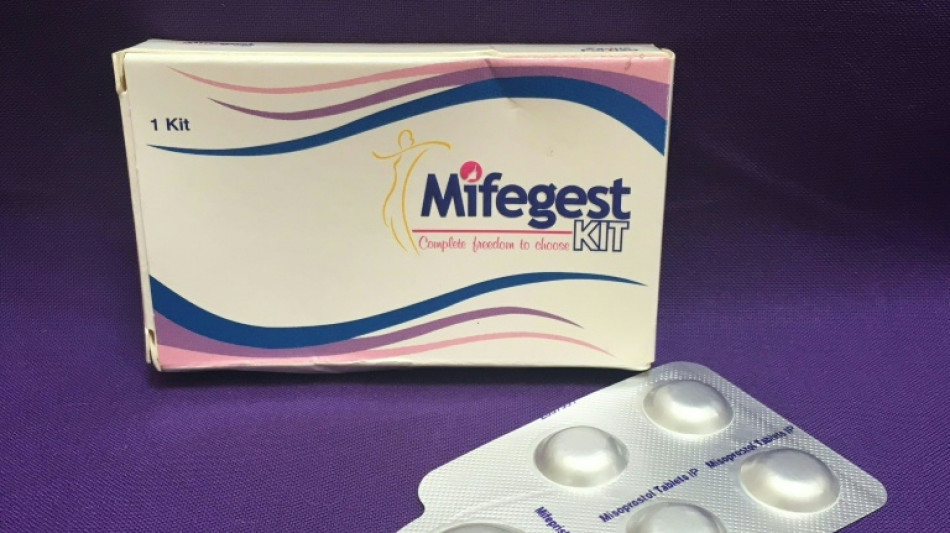
Abortion pill at the center of US Supreme Court case / Photo: Handout - PLAN C/AFP/File

 Ukraine, Russia vow escalation as strikes on Kyiv kill 27

 Messi meeting the "game of our lives", says Cape Verde coach

 Do not open until 2276: US burying time capsule to mark July 4

 Scaloni warns Argentina that Cape Verde success 'no accident'

 Spain ease past Austria with 3-0 World Cup win

 Endrick says versatility could help Brazil against Norway

 Ghana have 'duty to Africa' to progress at World Cup, says Queiroz

 Former Celtics star Brown in shock over trade to 76ers

 Progress, further delay risk for Boeing Air Force One: report

 US coach Pochettino '200% Argentine' but embraces Americana

 Ukraine, Russia vow escalation after Moscow strikes on Kyiv kill 25

 Prosecutors can review Woods medical records in DUI case: judge

 Japan deploys bear cameras in mountains as attacks surge

 Djokovic has history in his sights at Wimbledon

 Ovechkin returning to Caps for 22nd NHL season

 Faster than Mbappe: Australia flyer Bos races into World Cup conversation

 Trump wants 'senseless killing' in Ukraine to end: US official

 Eala writes history for Philippines in 'electric' Wimbledon atmosphere

 Wolff urges 'perspective' as Russell chases Mercedes' teammate Antonelli

 Superb Swiatek, Zverev cruise into Wimbledon last 32

 Ukraine, Russia vow escalation after Moscow attack kills 21 in Kyiv

 Slowing US job growth poses midterms challenge for Trump

 Klopp poised to replace Nagelsmann as Germany coach: reports

 More than 400 dead in DR Congo's spreading Ebola outbreak

 Hot spell roasts eastern US as holiday weekend approaches

A widely used pill is at the center of the latest legal battle in America's ongoing debate over abortion.
The US Supreme Court heard arguments on Tuesday about restrictions placed by a lower court on mifepristone, which is used for medication abortions.
Here is background on the drug and its use:
- How widespread is abortion pill use? -
According to the Guttmacher Institute, the pill accounted for 63 percent of the abortions in the United States last year, up from 53 percent in 2020.
While the number of medication abortions has gone up dramatically in the United States in recent years, it is still not as prevalent as in several European nations.
In France, for example, medication abortions accounted for 70 percent of the total number of abortions in 2020.
- How does it work? -
The abortion pill is different from the "morning after" pill, which is taken by a woman after sexual intercourse to prevent becoming pregnant.
The abortion pill is taken to induce an abortion once a woman confirms that she is pregnant.
The process in fact involves more than one pill.
The first, mifepristone, also known as RU 486, stops a pregnancy from proceeding normally by blocking production of the hormone progesterone.
Another drug, misoprostol, is taken up to 48 hours later and causes cramps, bleeding and the emptying of the uterus.
Abortion pills can be used at home and a medical setting is not required.
- When was the abortion pill approved? -
The US Food and Drug Administration (FDA) gave the green light to mifepristone and misoprostol in 2000 for use up to seven weeks of pregnancy.
Mifepristone was later approved by the FDA for use up to 10 weeks of pregnancy, after which a woman would need to undergo an abortion through other means, such as vacuum aspiration.
The average cost of a medication abortion at Planned Parenthood is $580, but it can cost up to $800.
- Is it safe and effective? -
Use of the abortion pill during the specified time period is considered to be safe and effective by medical experts.
Pregnancies are successfully terminated in more than 95 percent of cases where the pill is used, according to studies.
Serious complications -- excessive bleeding, fever, infection or allergic reaction -- which require a medical consultation, are rare.
The abortion pill does not work for ectopic pregnancies, which account for around two percent of all pregnancies and occur when a fertilized egg grows outside the uterus.
- Where is the pill available? -
Some 20 US states have banned or restricted access to abortion, including medication abortion, since the Supreme Court's ruling in June 2022 overturning the constitutional right to the procedure.
Anti-abortion groups are seeking to restrict access to mifepristone nationwide, including in states where abortion has remained legal, but the Supreme Court appeared reluctant on Tuesday to endorse such a move.
The case before the court concerns limiting the use of mifepristone to the first seven weeks of pregnancy, instead of 10, blocking it from being distributed by mail, and requiring it to be prescribed and dispensed by a doctor.
T.Wright--AT