Future in balance for German refinery fed on Russian oil

 Morocco overcome historic Haiti goals to roll into World Cup last 32

 Twin earthquakes in Venezuela destroy buildings, sow panic

 Vinicius Junior sparkles as Brazil beat Scots to reach World Cup last 32

 Two powerful earthquakes strike Venezuela, destroying buildings
 Australia teen social media ban has little impact: research

 Modigliani nude sets European record at London auction

 Trump seeks $88 bn in extra funding, mostly for Iran war

 Wyatt-Hodge stars as England ease into Women's T20 World Cup semi-finals

 Switzerland down World Cup co-hosts Canada to top Group B, both progress
 'New rules': life in world epicentre of jihadist terror

 Trump clashes with Republicans in testy Capitol visit

 Scheffler says PGA Tour headed 'in right direction' with two-tier system

 Mamdani-backed leftist candidates win New York Democratic primaries
 Britain's Draper continues promising start under Andy Murray

 Laporte wary of Uruguay will to avoid World Cup exit against Spain

 Major Nigeria police reform edges forward with senate approval

 Trump consolidates rightward shift in Latin America

 Olympics to offer all Games competitors $10,000 grants

 Left-wing candidate concedes tight Colombia election

 Stocks rebound after tech rout, Brent falls below $75
 Berlin unveils monument to Jehovah's Witnesses murdered by Nazis

 'Fingerprints' of black hole's event horizon detected for first time

 Verstappen seeking home boost with Red Bull upgrades

 'You have to work': Riders brave Rome heat for survival

 France detects first Ebola case outside Africa in current outbreak

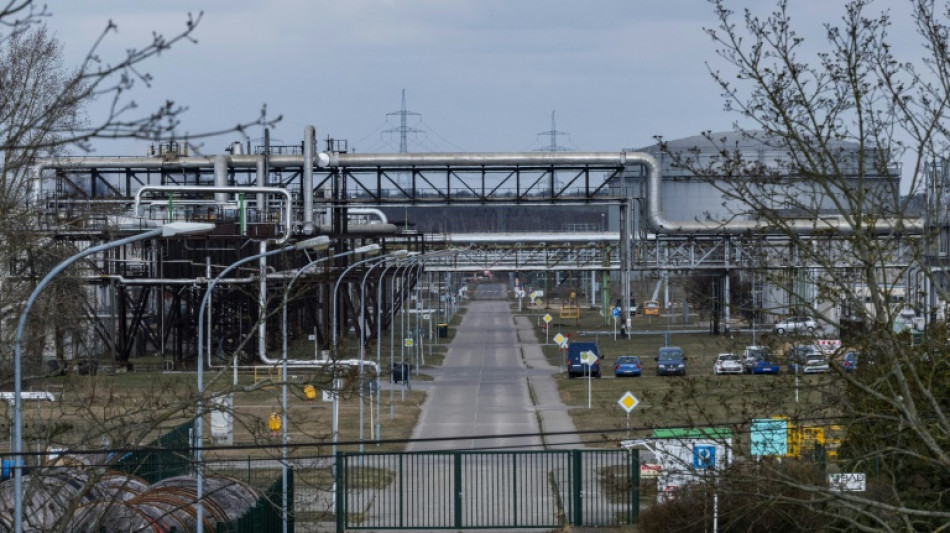
The PCK refinery in the German town of Schwedt has been processing crude oil from Russia since before reunification, but with a ban on Russian oil looming its future could be in doubt.
The mass of metal tubes and canisters in the former East Germany near the border with Poland employs 1,200 people, and many local businesses depend on the custom it brings to the area.
"The sense of not knowing what will happen tomorrow is very similar to how it felt after the fall of the Wall," said Buckhard Opitz, 60, who has worked at the plant since 1977 and is a member of the local energy workers' union.
Opitz has not forgotten the economic turbulence that came with reunification in 1990 -- the dismantled industrial sites and painful wave of privatisations.
The Schwedt refinery survived, after a drastic restructuring, because "it was one of the most modern, because we were always on top", Opitz said.
But since Russia invaded Ukraine on February 24, uncertainty has once again descended on the plant.
Although the PCK refinery supplies around 90 percent of the oil consumed in Berlin and the surrounding region, including Berlin Brandenburg airport, doubts still remain.
And the situation is complicated by the fact that Russian oil giant Rosneft, controlled by the Kremlin, is a majority shareholder in the site.
- 'Friendship' -
Though the EU's latest package of sanctions agreed on Thursday was focused on coal, European Council President Charles Michel has said that the EU will have to impose oil and gas sanctions "sooner or later".
Germany has ruled out an immediate embargo on all Russian energy, especially gas. But it aims to end Russian oil imports by the end of this year.
Oil pumped in from Russia is the lifeblood of the Schwedt refinery, which is serviced by a branch of the Druzhba pipeline, the world's longest oil pipeline.
The Druzhba project was commissioned in the 1960s to transport oil from the Soviet Union to Eastern Europe and remains a vital source of crude for many central European refineries.
"Druzhba" means "friendship" in Russian.
In late 2021, Rosneft announced plans to increase its stake in the PCK refinery from 54 to 92 percent by buying shares from Shell.
Germany's Federal Cartel Office approved the transaction a few days before the outbreak of the war but the Economy Ministry is examining whether it can still be stopped.
Rosneft is chaired by Igor Sechin, an oligarch close to President Vladimir Putin and who has been the target of Western sanctions.
"The world was still normal then. There was no reason to refuse Russian involvement, just as there was German involvement in Russia," Alexander von Gersdorff, a spokesman for the German oil industry association En2x, told AFP.
- 'Pure speculation' -
But Von Gersdorff now has a stark prediction: "Without oil from Russia, the Schwedt refinery would have to be shut down. There would be no petrol or diesel for Berlin, the surrounding region and western Poland."
A spokeswoman for the refinery told AFP it was still examining the "feasibility of different logistical and technological scenarios as well as their operational feasibility".
Some media reports have proposed that Berlin temporarily take control of the plant -- a measure applied recently to Russian gas giant Gazprom's German subsidiary.
But Opitz is convinced that alternatives to Russian oil can be found to keep the refinery alive.
Another pipeline ending in the German port city of Rostock could receive crude oil from other parts of the world, he said, and Poland could supply more via the port of Gdansk.
Von Gerstoff believes this is "unrealistic".
Rostock cannot accommodate large enough tankers, he said, while Poland needs all its capacity to service its own energy needs. Plus the refineries in eastern Germany were specifically designed to operate with Russian crude oil.
But Opitz still has hope. "All this is pure speculation," he said. "The final decision will be political."
R.Garcia--AT