As pandemic fades, Spain Easter traditions resurrected

 Australia teen social media ban has little impact: research

 Modigliani nude sets European record at London auction

 Trump seeks $88 bn in extra funding, mostly for Iran war

 Wyatt-Hodge stars as England ease into Women's T20 World Cup semi-finals

 Switzerland down World Cup co-hosts Canada to top Group B, both progress
 'New rules': life in world epicentre of jihadist terror

 Trump clashes with Republicans in testy Capitol visit

 Scheffler says PGA Tour headed 'in right direction' with two-tier system

 Mamdani-backed leftist candidates win New York Democratic primaries
 Britain's Draper continues promising start under Andy Murray

 Laporte wary of Uruguay will to avoid World Cup exit against Spain

 Major Nigeria police reform edges forward with senate approval
 Trump consolidates rightward shift in Latin America

 Olympics to offer all Games competitors $10,000 grants

 Left-wing candidate concedes tight Colombia election
 Stocks rebound after tech rout, Brent falls below $75
 Berlin unveils monument to Jehovah's Witnesses murdered by Nazis
 'Fingerprints' of black hole's event horizon detected for first time
 Verstappen seeking home boost with Red Bull upgrades

 'You have to work': Riders brave Rome heat for survival

 France detects first Ebola case outside Africa in current outbreak

 'GTA VI' preorders mark first test for biggest game of 2026

 Stocks rebound after tech rout, oil prices drop

 Australia spy chief warns of Iran terror threat
 Heatwave-hit Europe must adapt healthcare: WHO

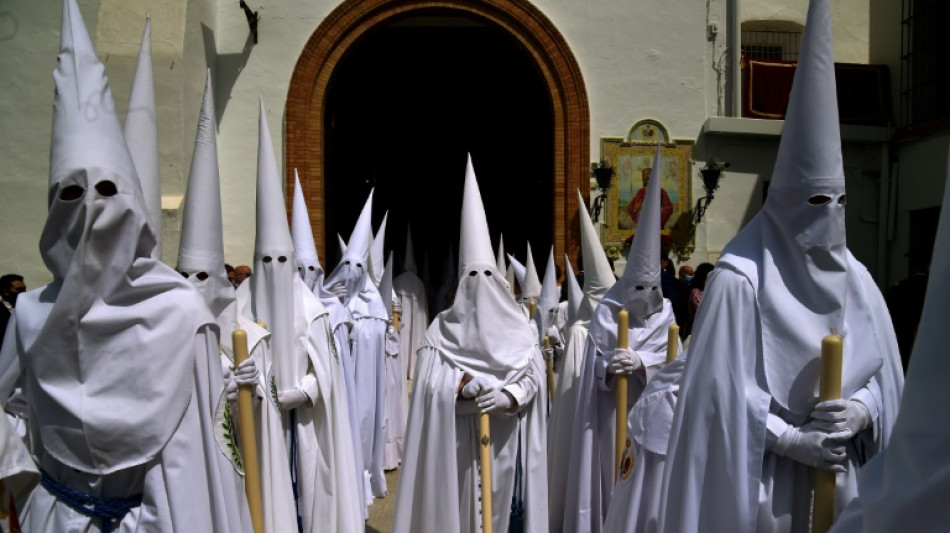
With Easter processions cancelled for the past two years due to the coronavirus pandemic, Spain's colourful Holy Week marches made their eagerly awaited return to the streets on Sunday.
The holiday, which runs until Easter Day on April 17, is a time when huge crowds traditionally gather to watch the elaborate processions in this deeply Catholic country.
Organised by brotherhoods, the parades feature dozens of people dressed in religious tunics and distinctive pointy hoods and elaborate floats topped with statues of Jesus and the Virgin Mary.
Some of the processions date back hundreds of years.
"We're very excited after two years" of being unable to celebrate Holy Week, said Rafael Perez of the Work and Light Brotherhood that stages one of the processions in the southern city of Granada.
In Seville -- whose 680,000-strong population doubles during Holy Week -- people played traditional procession music over loudspeakers or sang mournful saetas from balconies, a capella ballads about the death of Jesus and the grief of his mother.
Everything was thrown up in the air in mid-March 2020 when the country went into lockdown as the virus took hold a month before Easter, hitting Spain badly as it spread like wildfire.
In one of the world's strictest lockdowns, Spain cancelled all religious celebrations, prompting some to improvise festivities at home on their balconies, mostly in the south where Easter processions have been held for centuries.
The situation improved slightly last year, although with memories still fresh of the explosion of virus cases after Christmas the authorities imposed curfews and a ban on travel between regions that clouded the festivities.
The southern city of Seville's impressive Holy Week parades, which had never been cancelled since 1933, were called off for a second year running in a move mirrored across Spain.
- Return of the tourists -
This year, Spaniards want to make up for lost time and enjoy an Easter week as in times before the pandemic, when they made an average of seven million trips across the country to visit family or hit the beach, Statistica figures show.
"Tourism and business prospects for Holy Week 2022, the first after two years of not being able to celebrate due to the pandemic, are close to 90 percent of the sales levels registered in 2019," the Exceltur tourism association said on Thursday.
In April 2019, a total of seven million foreign tourists visited Spain. Tourism Minister Reyes Maroto said she hoped to see 80 percent of that figure, which would bring much-needed relief to the country's badly hit tourism sector.
Before the pandemic, Spain was the world's second most popular tourist destination after France.
With more than 92 percent of its 47 million residents fully vaccinated, Spain last month embarked on a new strategy to treat the virus as an endemic illness like flu, dropping a requirement for people with mild cases of Covid-19 to self-isolate.
In February it ended a rule requiring people to wear masks outdoors and on April 20, just after Easter, it will also drop an indoor mask mandate, except in hospitals and on public transport.
Seville's City Hall says it is expecting "a large turnout after two years without celebrations" with more than 70 brotherhoods ready to conduct their traditional marches through the city.
With hundreds of thousands of visitors expected, Andalusia's regional government has recommended all participants wear masks and that testing be carried out on the many teams carrying the huge religious floats bearing statues of the Virgin Mary and Christ.
Th.Gonzalez--AT