Cuba's currency conundrum: four ways to pay / Photo: YAMIL LAGE - AFP

 Klopp poised to replace Nagelsmann as Germany coach: reports
 More than 400 dead in DR Congo's spreading Ebola outbreak

 Hot spell roasts eastern US as holiday weekend approaches

 Superb Swiatek storms into Wimbledon last 32, Zverev waits

 Russian strikes kill 21 in biggest ever attack on Kyiv, mayor says

 Swiatek sees off Pliskova to race into Wimbledon third round

 Dollar down, stocks shine after disappointing US jobs data

 US job growth slows, posing questions for Trump before midterms
 Chanel eyes menswear with Charvet shirtmaker takeover

 Chanel eyes menswear with Charvet shirtmaker takevoer
 'I grabbed my child': Kyiv residents face devastation of biggest Russian barrage of war
 Former top jockey Dettori breaks ribs in car crash

 Rees-Zammit returns to wing as Wales face Fiji
 Renovations on historic Paris Opera house extended by three years
 Thailand denies viral claim Macron knelt before king

 Spain, Portugal eye World Cup last 16

 Russian strikes kill 17 in biggest ever attack on Kyiv, mayor says

 Uruguay veteran Cavani quits Boca Juniors

 West Ham's Fernandes joins Spurs

 Bones of contention: More research needed on 'd'Artagnan corpse'

 Coffee with a view: tourists flock to Starbucks overlooking North Korea

 German coalition agrees on reform package in key breakthrough

 France recall record try scorer Penaud for All Blacks Test

 Seoul's Kospi tanks as Asia tech firms suffer another blow
 'Outstanding' Love to start at fly-half for All Blacks against France

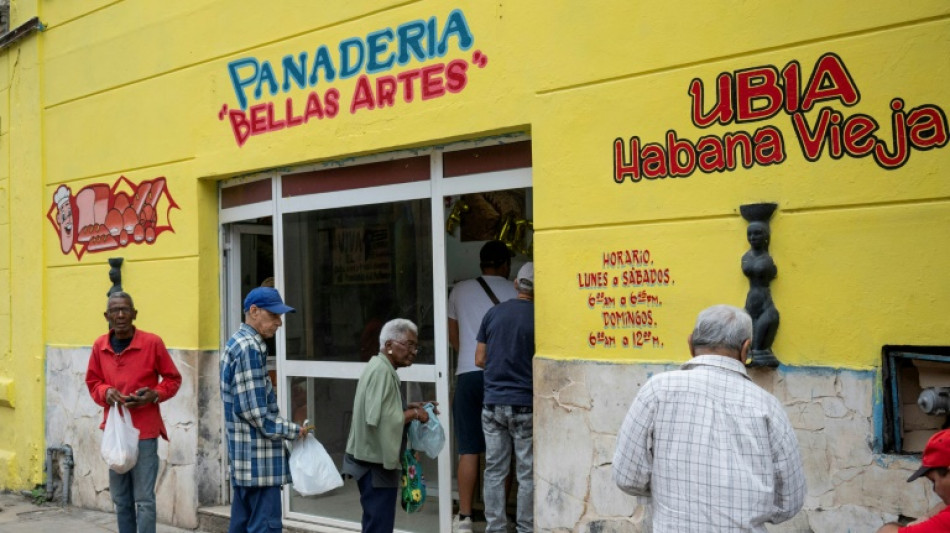
"How can I pay you?": In Cuba, the question goes beyond cash or card as citizens grapple with four different currencies, turning them into amateur traders as they try to squeeze the most value out of their money.
Pedro Gonzalez, a 68-year-old engineer who stepped back from retirement due to the country's dire economic crisis and inflation, describes a simple shopping trip as "tortuous."
He has to ask himself: "Where am I going to buy? What is the exchange rate? Is it worth it for me to make the exchange?"
In 2021, the Communist government merged the two national currencies that had been circulating in the country: the Cuban peso and a convertible peso which had been artificially aligned with the dollar and could also be exchanged into other foreign currencies.
The idea was to make the island's economy -- long limited under heavy state control, with the government owning and managing most businesses -- more appealing to foreign investors.
Instead, four currencies came into play, which is further weakening the economy because they "distort prices" in relation to each other, said Pavel Vidal, a professor at Javeriana University in Cali, Colombia.
Depending on the restaurant, store, or service, one might pay with the Cuban peso, the dollar, the euro, or the MLC, a virtual currency launched in 2019 by the government.
- 'Make the most of our money' -
The MLC is used by loading dollars onto a magnetic card which can only be used to buy goods in state-owned stores. However, they can not be exchanged back for cash dollars.
And the Cuban peso is subject to two different official exchange rates, one for businesses and one for individuals, and a third informal rate in which dollars can buy many more pesos on the street.
"No economy can grow and develop under these monetary and exchange rate conditions," said Vidal.
With widespread shortages of fuel, food and medicine, "we must be very attentive to these (currency) mechanisms" to "make the most of our money," said Gonzalez.
He told AFP he has seen his pesos "evaporate like water" during Cuba's worst economic crisis in 30 years.
The island nation has been battered by the fallout from the coronavirus pandemic on the key tourism industry, the tightening of US sanctions in recent years, and structural economic weaknesses.
According to official estimates, the Cuban economy shrank by two percent in 2023. Inflation stood at 30 percent in 2023, a figure experts believe is an underestimation.
The bleak circumstances have pushed some five percent of the population to flee, mostly to the United States, in the biggest wave of emigration since Fidel Castro's revolution.
Pedro Gonzalez said he would not get by without the help of his son, who emigrated to the United States and who sends him dollars.
He places some of these on his MLC card and then exchanges others for pesos, to buy at the small private businesses which have been allowed to open since 2021.
While these shops offer many more products, prices are often way past what most citizens can afford in a country where the average salary is 4,200 pesos ($35).
- 'That's how we get by'-
Anna Valls, 80, rents out a room in her home in Havana for pesos, which she then gives to a friend who will transfer some of their MLC onto her card.
"That's how we get by," she told AFP outside a state grocery shop.
Tourists can pay for guesthouses and restaurants in pesos, euros or dollars.
The demand for foreign currency has grown. On the one hand, because Cubans hoard dollars to finance their plans to leave the country. On the other, private businesses need dollars to import goods, and access to the greenback is restricted.
In December, the government announced an upcoming "intervention" on the foreign exchange market, as part of an economic recovery plan which included a 400 percent increase in the fuel price.
A.Williams--AT