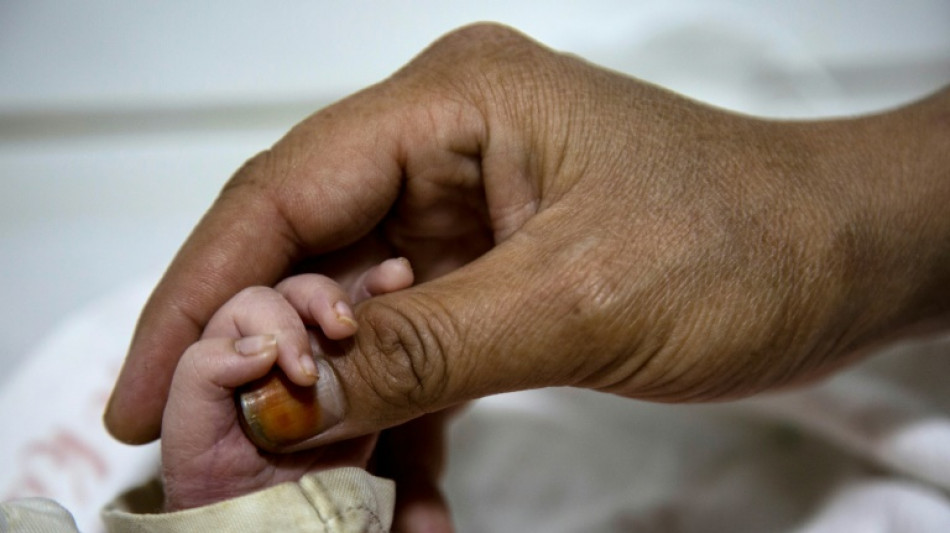
Childhood deaths at record low, but progress 'precarious': UN / Photo: Kobra Akbari - AFP/File

 Klopp poised to replace Nagelsmann as Germany coach: reports

 More than 400 dead in DR Congo's spreading Ebola outbreak

 Hot spell roasts eastern US as holiday weekend approaches

 Superb Swiatek storms into Wimbledon last 32, Zverev waits
 Russian strikes kill 21 in biggest ever attack on Kyiv, mayor says

 Swiatek sees off Pliskova to race into Wimbledon third round

 Dollar down, stocks shine after disappointing US jobs data

 US job growth slows, posing questions for Trump before midterms

 Chanel eyes menswear with Charvet shirtmaker takeover

 Chanel eyes menswear with Charvet shirtmaker takevoer

 'I grabbed my child': Kyiv residents face devastation of biggest Russian barrage of war

 Former top jockey Dettori breaks ribs in car crash

 Rees-Zammit returns to wing as Wales face Fiji

 Renovations on historic Paris Opera house extended by three years

 Thailand denies viral claim Macron knelt before king

 Spain, Portugal eye World Cup last 16

 Russian strikes kill 17 in biggest ever attack on Kyiv, mayor says

 Uruguay veteran Cavani quits Boca Juniors

 West Ham's Fernandes joins Spurs

 Bones of contention: More research needed on 'd'Artagnan corpse'

 Coffee with a view: tourists flock to Starbucks overlooking North Korea

 German coalition agrees on reform package in key breakthrough

 France recall record try scorer Penaud for All Blacks Test

 Seoul's Kospi tanks as Asia tech firms suffer another blow

 'Outstanding' Love to start at fly-half for All Blacks against France

The number of children worldwide who died before age five reached a record low in 2022, the United Nations said in a report published Tuesday, as for the first time fewer than five million died.
According to the estimate, 4.9 million children died before their fifth birthday in 2022, a 51 percent decrease since 2000 and a 62 percent drop since 1990, according to the report, which still warned such progress is "precarious" and unequal.
"There is a lot of good news, and the major one is that we have come to a historic level of under-five mortality, which... reached under 5 million for the first time, so it is 4.9 million per year," Helga Fogstad, director of health at the UN children's agency UNICEF, told AFP.
According to the report, prepared by UNICEF in conjunction with the World Health Organization (WHO) and the World Bank, progress was particularly notable in developing countries such as Malawi, Rwanda and Mongolia, where early childhood mortality has fallen by more than 75 percent since 2000.
"Behind these numbers lie the stories of midwives and skilled health personnel helping mothers safely deliver their newborns... vaccinating... children against deadly diseases, and (making) home visits to support families," UNICEF Executive Director Catherine Russell said in a statement.
But "this is a precarious achievement," the report warned. "Progress is at risk of stagnation or reversal unless efforts are taken to neutralize the numerous threats to newborn and child health and survival."
Researchers pointed to already worrying signs, saying that reduction in under-five deaths has slowed at the global level and notably in the sub-Saharan Africa region.
- Preventable deaths -
In total, 162 million children under the age of five have died since 2000, 72 million of whom perished in the first month of life, as complications related to birth are among the main causes of early childhood mortality.
Between the ages of one month and five years, respiratory infections, malaria and diarrhea become the main killers -- ailments which are all preventable, the report points out.
In order to reach the UN's goal of reducing under-five deaths to 25 per 1,000 births by 2030, 59 countries will need urgent investment in children's health, researchers warned. And without adequate funding, 64 countries will miss the goal of limiting first-month deaths to 12 per 1,000 births.
"These are not just numbers on a page; they represent real lives cut short," the report said.
The numbers also reveal glaring inequalities across the world, as the sub-Saharan Africa region accounted for half of all deaths of children under age five in 2022.
A baby born in countries with high early childhood mortality, such as Chad, Nigeria or Somalia, is 80 times more likely to die before their fifth birthday than a baby born in countries with low childhood mortality rates, such as Finland, Japan and Singapore.
"Where a child is born should not dictate whether they live or die," WHO head Tedros Adhanom Ghebreyesus said.
W.Moreno--AT