Norway salmon farms turn to veggie menu / Photo: Olivier MORIN - AFP

 LeBron James praises Balogun after 'Silencer' celebration

 Farrell names Leinster-heavy side to face Wallabies

 Most Asia markets down as tech firms take fresh blow

 South Korean school baseball team suspended over 'Tank Day' chants
 Ceuzany, Cape Verde's golden voice with volcanic emotion
 Balogun scores and sees red as US beat Bosnia 2-0

 EU top court to rule on record 4.1 bn euro Google fine

 'Job forever': trade schools are all the rage in the AI era
 Celtics reportedly trading Brown to Sixers in NBA blockbuster
 Kane saves England after DR Congo scare; Belgium comeback stuns Senegal

 Celtics to trade Jaylen Brown to 76ers for Paul George: report

 Streamex is making digital gold accessible

 Mixed US auto sales in Q2 amid high gas prices
 Pistons forward Harris reportedly headed to Spurs

 Jovial Djokovic dismantles Tsitsipas to reach Wimbledon third round

 US stocks retreat to open Q3 ahead of June jobs data

 'Gus' the T. rex presented in New York ahead of auction

 Kane saves England after DR Congo scare; US eye last 16

 Catholic society defies Vatican by consecrating new bishops

 New York prepares for Taylor Swift-Travis Kelce wedding

 Pair climb to top of Empire State Building for apparent proposal

 French Open champ Andreeva stunned by Krejcikova at Wimbledon

 Kane rescues England after DR Congo scare; US eye last 16
 Kane rescues England from DR Congo calamity to reach World Cup last 16

 'Iran, Iran!' Iranian World Cup squad serenaded on return home

Norway's fish farms are feeding their salmon an increasingly vegetarian diet in order to make their businesses more sustainable, but for these carnivorous pink-fleshed fish, all is not rosy.
In submerged cages at the Oksebasen fish farm, located at the crossing of two fjords in western Norway, the salmon are under constant watch on mobile underwater cameras.
At the first sign the fish are feeling a little peckish, employees at an operations centre 100 kilometres (60 miles) away turn on a "sub-feeder" which releases special pellets swiftly gobbled up by the hungry fish.
The small brown granules consist primarily of plant-based materials, 20 to 30 percent fish oil and meal, as well as vitamins, minerals and pigment to give the salmon's flesh its characteristic pink colour.
"Before, fish feed was made exclusively of marine ingredients," or in other words, wild fish, explains operations manager Magnulf Giske at the world's largest producer of Atlantic salmon, Mowi.
"But it's a less sustainable solution than replacing some of these marine ingredients with soy protein, for example. So that's the direction we've gone in," he said.
For the industry, avoiding overfishing is a question of sustainability, but also, and primarily, a way of ensuring that business can continue to grow.
With limited stocks of the small fish typically used in fish meal, such as anchovies, sprat and herring, fish farms have increasingly turned to cheaper plant-based materials to be able to ramp up production.
"There just wasn't enough fish meal in the world to supply the industry," said Erik-Jan Lock, a researcher at the Norwegian food research institute Nofima.
- Going against nature -
The use of wild fish in fish feed has decreased in recent years but still remains an ingredient, according to environmental organisations, concerned about the negative impact that the fishing of these fish has on aquatic birds and impoverished populations in places such as West Africa.
The fish in the feed, as well as the soy and plant protein, "could have been used directly for human consumption" but they are instead given to "salmon in order to make a more expensive, more well-paid product for the rich," lamented Truls Gulowsen, head of the Norwegian branch of Friends of the Earth.
"It is, globally speaking, a quite sad way of using scarce resources for a growing global population that needs food and needs protein," he said.
"We don't really need salmon fillet."
While Norwegian producers of animal feed agreed in 2015 to use only sustainably-produced soy, the growing use of plant-based materials has not been without its challenges.
"The more (of a) vegetarian diet the fish-eating salmon get, the more distant that is from its original life, and adds to the escalating difference between the original wild salmon and the domesticated farmed salmon," said Gulowsen.
Farmed salmon "grows faster, it develops differently, it acts differently," he said, adding: "We have frequent escapes of farmed salmon that sometimes pollute the natural wild salmon stocks."
"The more different the new salmon is, the riskier the genetic pollution of natural stocks becomes."
- Flies to the rescue? -
Nofima says fish farms need to find alternative methods in order to reduce their environmental footprint.
"Is salmon feed more sustainable than it was last year, or the year before? Yes," says Erik-Jan Lock. "Can it become even more sustainable? Yes, obviously."
Making better use of human food waste, or using little-used marine resources such as mussels and sea squirts or even insects are among the possible options that could be explored.
The Pronofa company is researching sustainable protein alternatives.
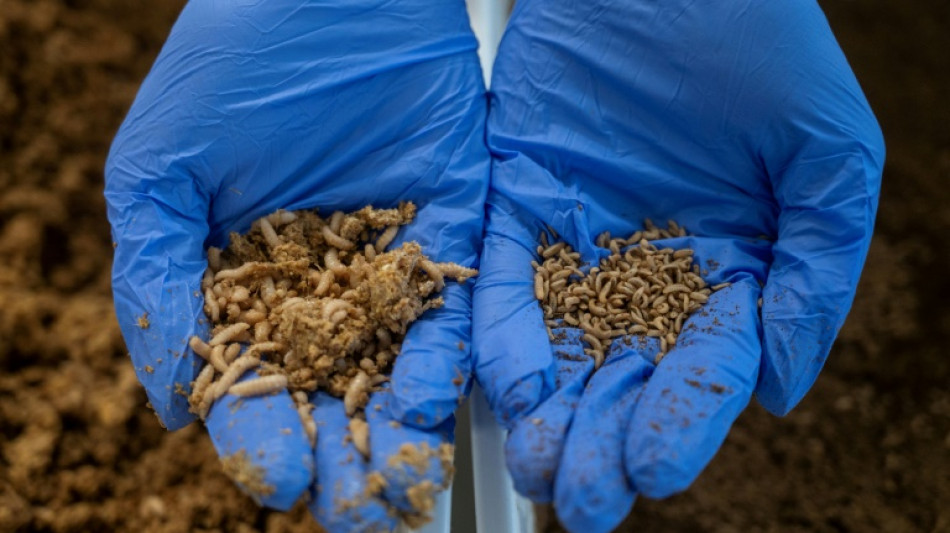
In containers at its site in the southeastern town of Fredrikstad, it is studying the black soldier fly, whose larvae increase their weight 7,000-fold in just two weeks.
"The fish industry in Norway gives human food to the salmon, to the fish, which is not actually a good thing to do. Here we have a good alternative to fish meal," says project manager David Tehrani.
Black soldier flies "are the best machines nature gives us: they eat all the time, they don't sleep, they don't take a coffee break."
"Apart from glass, concrete and steel, they eat everything".
The only catch? It's a pricier solution.
Fish farmers, for whom feed represents their biggest cost, have yet to take the bait.
N.Walker--AT