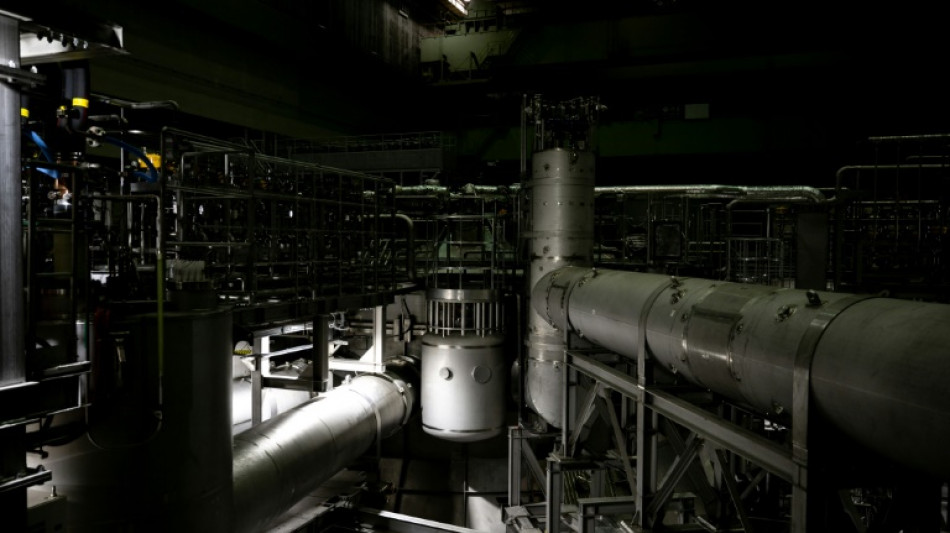
In a doughnut in Japan, unlocking the power of the Sun / Photo: Philip FONG - AFP

 LeBron James praises Balogun after 'Silencer' celebration

 Farrell names Leinster-heavy side to face Wallabies

 Most Asia markets down as tech firms take fresh blow

 South Korean school baseball team suspended over 'Tank Day' chants

 Ceuzany, Cape Verde's golden voice with volcanic emotion

 Balogun scores and sees red as US beat Bosnia 2-0
 EU top court to rule on record 4.1 bn euro Google fine

 'Job forever': trade schools are all the rage in the AI era

 Celtics reportedly trading Brown to Sixers in NBA blockbuster

 Kane saves England after DR Congo scare; Belgium comeback stuns Senegal

 Celtics to trade Jaylen Brown to 76ers for Paul George: report

 Streamex is making digital gold accessible

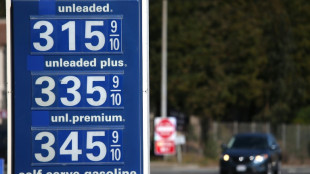 Mixed US auto sales in Q2 amid high gas prices

 Pistons forward Harris reportedly headed to Spurs

 Jovial Djokovic dismantles Tsitsipas to reach Wimbledon third round

 US stocks retreat to open Q3 ahead of June jobs data

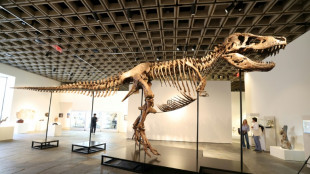 'Gus' the T. rex presented in New York ahead of auction

 Kane saves England after DR Congo scare; US eye last 16

 Catholic society defies Vatican by consecrating new bishops

 New York prepares for Taylor Swift-Travis Kelce wedding

 Pair climb to top of Empire State Building for apparent proposal

 French Open champ Andreeva stunned by Krejcikova at Wimbledon

 Kane rescues England after DR Congo scare; US eye last 16
 Kane rescues England from DR Congo calamity to reach World Cup last 16

 'Iran, Iran!' Iranian World Cup squad serenaded on return home
With its tangle of pipes and pumps leading to a metal pot the size of a five-storey building, Japan's JT-60SA machine looks to the untrained eye like a contraption from 1970s sci-fi.
But inside it is a doughnut-shaped vessel where experiments done at millions of degrees could help unlock a carbon-free, inexhaustible and safe power source for the future: nuclear fusion.
"Fusion energy, the power behind the Sun and the stars, has been a great prize for energy research for decades, ever since it was first attempted in the 1950s and 60s to find some way to reproduce this power of the Sun here on Earth," project leader Sam Davis told AFP on a recent tour.
"Not only is (fusion) free from greenhouse gases and free from long-lived nuclear waste, but it's compact, doesn't cover the whole landscape, and can generate industrially useful quantities of power," the British-German engineer said.
Unlike fission, the technique currently used in nuclear power plants, fusion involves combining two atomic nuclei instead of splitting one, generating vast amounts of energy.
The process is safe and there are no nasty by-products like fissile material for a nuclear weapon or hazardous radioactive waste that takes thousands of years to degrade, its proponents say.
- Swirling plasma -
Taking 15 years to build in Naka, northeast of Tokyo, the JT-60SA is 15.5 metres (51 feet) tall and 13.7 metres (45 feet) wide, comprising a so-called tokamak vessel able to contain swirling plasma heated to millions of degrees.
Inside the facility, which was inaugurated in December, the aim is to get nuclei of hydrogen isotopes to fuse into an atom of helium, releasing energy, and mimicking the process that takes place inside the Sun and stars.
"With only one gram (0.04 ounces) of a mixed fuel... we can obtain an energy equivalent to eight tonnes of oil," said Takahiro Suzuki, deputy project manager for the Japan side of the joint project with the European Union.
But despite decades of efforts, the technology remains in its infancy and is very expensive.
Currently the largest such facility in operation, the JT-60SA is the little brother and guinea pig of the International Thermonuclear Experimental Reactor (ITER) being built in France.
According to media reports, ITER -- a project run by six countries and the European Union -- is years behind schedule and could end up costing as much as 40 billion euros ($42.3 billion), far more than first projected.
The holy grail of both projects, as well as others around the world, is to develop technology that releases more energy than is needed to fuel it -- and at a large scale and for a sustained period.
The feat of "net energy gain" was managed in December 2022 at the National Ignition Facility at Lawrence Livermore National Laboratory in the United States, home to the world's largest laser.
- 'Flash in a can' -
But the US facility uses a different method from ITER and the JT-60SA known as inertial confinement fusion, in which high-energy lasers are directed simultaneously into a thimble-sized cylinder containing hydrogen.
"Magnetic confinement, and in particular, tokamaks, of the kind that JT-60SA is, are much more applicable to running a steady state power plant, to steady energy production as we would need," Davis said.
"This is not just a flash in a can."
But with the world record set by China for heating plasma to the required temperature -- 120 million degrees Celsius (216 million degrees Fahrenheit) -- currently just 101 seconds, there is still a long path ahead.
"Nuclear fusion can certainly contribute to a future energy mix. Exactly on what timescale is very hard to say. It will come down ultimately to how much is invested in the field (and) how much society wants to pursue this as a solution," Davis said.
A.Taylor--AT