
What to know about the NASA-funded commercial Moon fleet / Photo: KARIM JAAFAR - AFP/File

 LeBron James praises Balogun after 'Silencer' celebration

 Farrell names Leinster-heavy side to face Wallabies

 Most Asia markets down as tech firms take fresh blow

 South Korean school baseball team suspended over 'Tank Day' chants

 Ceuzany, Cape Verde's golden voice with volcanic emotion

 Balogun scores and sees red as US beat Bosnia 2-0

 EU top court to rule on record 4.1 bn euro Google fine

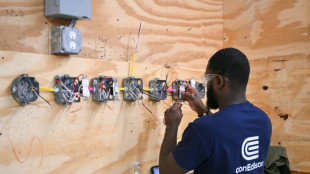 'Job forever': trade schools are all the rage in the AI era

 Celtics reportedly trading Brown to Sixers in NBA blockbuster

 Kane saves England after DR Congo scare; Belgium comeback stuns Senegal

 Celtics to trade Jaylen Brown to 76ers for Paul George: report

 Streamex is making digital gold accessible

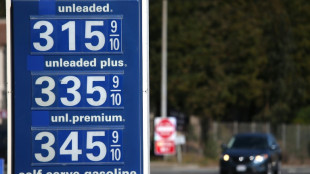 Mixed US auto sales in Q2 amid high gas prices

 Pistons forward Harris reportedly headed to Spurs

 Jovial Djokovic dismantles Tsitsipas to reach Wimbledon third round

 US stocks retreat to open Q3 ahead of June jobs data

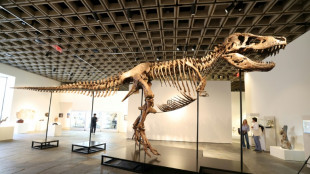 'Gus' the T. rex presented in New York ahead of auction

 Kane saves England after DR Congo scare; US eye last 16

 Catholic society defies Vatican by consecrating new bishops

 New York prepares for Taylor Swift-Travis Kelce wedding

 Pair climb to top of Empire State Building for apparent proposal

 French Open champ Andreeva stunned by Krejcikova at Wimbledon

 Kane rescues England after DR Congo scare; US eye last 16

 Kane rescues England from DR Congo calamity to reach World Cup last 16

 'Iran, Iran!' Iranian World Cup squad serenaded on return home
The year 2024 promises to be a busy one for American Moon landings, all under a new partnership between NASA and the space industry.
A first attempt under the Commercial Lunar Payload Services (CLPS) initiative ended in disappointing failure last month, but a second, led by Houston-based Intuitive Machines, will attempt on Thursday to return the United States to Moon for the first time in five decades.
NASA's thinking behind CLPS is to delegate the delivery of its science hardware to the private sector, reducing costs to taxpayers as it prepares to return astronauts to the surface under the flagship Artemis program later this decade.
- Purchasing services -
Established in 2018, CLPS operates on the principle of purchasing services from commercial partners, rather than buying their hardware.
Joel Kearns, a senior NASA official involved with CLPS, said it would allow the agency to be more cost effective and do more frequent trips, even if "we don't know how many of the early attempts will be successful."
But the space agency is offsetting that risk by contracting with multiple companies offering different technical solutions.
It also hopes those companies will in turn build up their own clientele, for example research institutions and others wanting to ship gear to the Moon, creating a wider lunar economy in which NASA is just one of many customers.
The approach is completely different from that used during the Apollo era, when NASA dictated its industrial contracts down to the last bolt.
"When you have unlimited funds, like in the Apollo days, yes, you can do incredible things," said Trent Martin of Intuitive Machines. "Now, can we find a way to do it for a lower cost? Can we find a way to do it, where there's a marketplace that is not driven solely by government funds?"
- Fledgling companies -
Fourteen companies have been pre-selected to be in the running for contracts, with eight firm missions so far planned.
Many of the companies involved are considered fledging, rather than legacy aerospace giants, reflecting the initiative's experimental nature.
The first attempt, led by Pittsburgh-based Astrobotic, failed to reach the Moon in January after developing an in-flight fuel leak shortly after separating from its rocket.
It could get another shot later this year, to carry an important water-seeking NASA rover to the south pole, but the green light will depend on the outcome of a detailed review of its first mission.
Intuitive Machines, founded in 2013, is also targeting a region near the south pole. It has two more missions set for this year.
Another Texas company, Firefly Aerospace, has two missions, including one in 2024, with its Blue Ghost lander.
Finally, Massachusetts-based Draper, which built the computer that ran the Apollo spaceships, will attempt to land on the far side of the Moon in 2025.
NASA paid both Astrobotic and Intuitive Machines around $100 million each for their respective first missions.
- Lasting presence -
CLPS deliveries serve the bigger goal of better understanding the environmental risks -- from radiation to lunar dust -- that face American astronauts when they touch down on the surface no sooner than 2026.
Unlike during Apollo, when the United States was driven by the Cold War to act fast and chose near the equator for five short trips, NASA is now taking its time to build a "sustained presence," involving habitats, on the south pole.
Here, it hopes to harvest ice for drinking water and rocket fuel, with an eye on using our cosmic neighbor as a waypoint for crewed missions to Mars.
T.Wright--AT