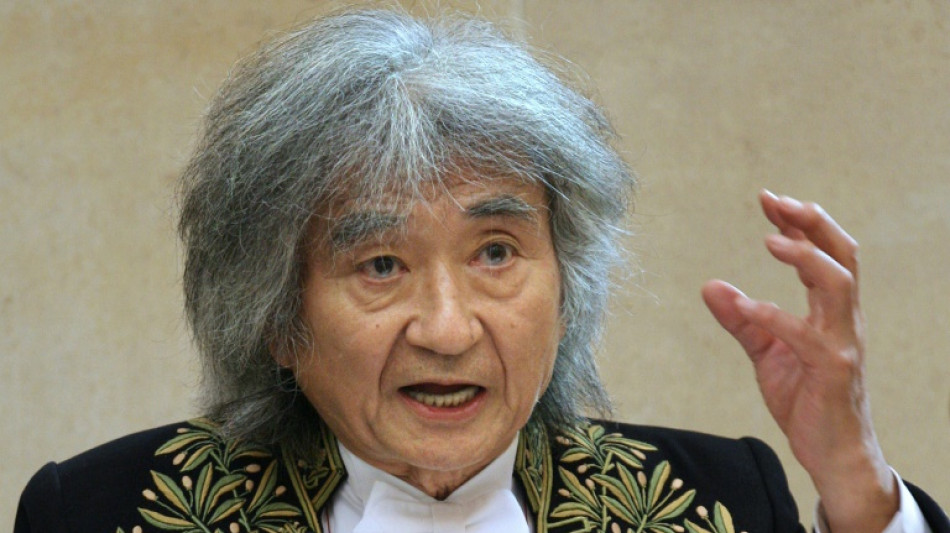
Magic touch: Japan's star conductor Seiji Ozawa / Photo: PIERRE VERDY - AFP/File

 Belgium late show floors Senegal at World Cup
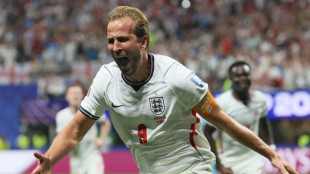
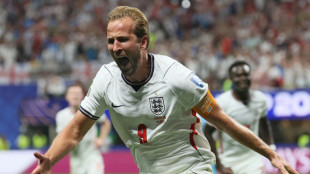
 Harry Kane: England's World Cup saviour

 US actor Danny Glover says he has Alzheimer's

 Trump sees progress as US, Iran hold Qatar talks
 Djokovic, Sinner into Wimbledon third round, Andreeva stunned
 Spurs agree club record £100 mn move for Newcastle's Tonali - reports

 Rain has final say in 1st England-India T20 as Sooryavanshi still awaits debut
 England refused to accept defeat in 'beautiful' DR Congo win, says Tuchel
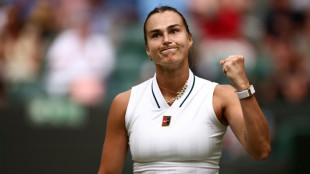 'Let the dogs in': Sabalenka wants Wimbledon to lift ban
 Oppressive heat broils US during World Cup, July Fourth
 Can anyone stop France at the World Cup?

 Sinner, Sabalenka into Wimbledon third round, Andreeva stunned

 England have 'hero moments', says Kane after double downs DR Congo
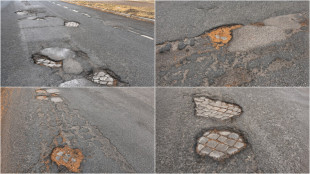 努莎·奧貝爾:為市民實施時速10公里限速,波茨坦的「坑洞政策」——是漠不關心還是無能為力?
 US refuses to extend North America trade pact in current form

 Mixed US auto sales in 2nd quarter amid high gas prices
 Swiatek, Zverev hoping to lay down Wimbledon markers

 Spray-painted letters spell tragedy for Venezuela quake victims
 'Everybody's profiting': Trump defends $1bn crypto earnings

 WTA Finals moved from Riyadh to Indian Wells
 Messi returns 'home' to lead Argentina World Cup charge in Miami

 England skipper Sciver-Brunt 'threw everything' at World Cup semi-final return
 Stocks mixed with eyes on US Fed

 Trial begins for suspected mastermind of Malta journalist killing
 Traditionalist Catholic society defies Vatican by consecrating new bishops

Two broken fingers in a rugby match changed everything for Seiji Ozawa, the celebrated Japanese conductor who blazed a trail in classical music, connecting Eastern traditions with the West.
Public broadcaster NHK and other Japanese media reported on Friday that Ozawa had died of heart failure at his home in Tokyo aged 88.
As a teenager, the maestro seemed destined for a career as a pianist. But he also had another passion -- rugby -- which his piano teacher mother banned him from playing.
Naturally, he defied her, and one day he broke his two index fingers in ruck during a game, abruptly ending all hope of ever becoming a concert pianist.
It was only then the idea of conducting was floated.
Years later US president Barack Obama would gently chide the diminutive conductor for his costly act of rebellion.
"Now I have to say, looking at you Seiji, I'm not sure that was a good idea" taking part in that rugby match, Obama said.
"But fortunately, for the rest of us, it opened up the door to a career as a conductor."
- Lawnmower -
Broken fingers were not the only obstacle Ozawa had to a musical career.
He would later sum up his childhood as, "No money, my house."
Born in northern China, which was then occupied by Imperial Japan, his family fled back to Tokyo as defeat in World War II loomed in 1944.
Although his father was a dentist, there was little cash to spare and Ozawa paid for his lessons by mowing his teacher's lawn.
After the life-changing accident in 1950, it was his piano teacher who suggested the 15-year-old try conducting, an unknown world for Ozawa at the time.
But after seeing his first orchestral concert -- Beethoven's Piano Concerto No. 5, he later recalled with typical precision -- he was hooked.
And Ozawa quickly shined.
- Bernstein and Von Karajan -
In 1958 he was named Japan's most exceptional talent and the following year he went abroad, a move that proved a game-changer.
He met some of the greatest luminaries of the classical music world, including the composer and conductor Leonard Bernstein, becoming his assistant at the New York Philharmonic in the 1961-1962 season.
The following year the great conductor Herbert von Karajan took him on as assistant at the Berlin Philharmonic.
Ozawa went on to lead orchestras in Chicago, Toronto, San Francisco, and had a 29-year stint as musical director of the Boston Symphony Orchestra, where they named a concert hall after him.
He left in 2002 to become chief conductor at the Vienna State Opera until 2010.
Although he enjoyed his glittering career in the West, Ozawa never lost sight of his roots, founding an orchestra and the Seiji Ozawa Festival that is now one of Japan's top classical music events.
- Baseball nut -
Sport may have dashed his early hopes of becoming a pianist, but Ozawa never fell out of love with it -- particularly baseball, Japan's most popular sport.
He was the proud owner of a gold lifetime pass to US Major League Baseball.
Recalling his days in Boston, he said he had been particularly fond of ending a performance night by catching the end of a Red Sox game.
At the "end of a concert, I look at the television -- and usually, baseball is longer than [the] concert so I ask Peppino, our driver, 'Okay, Peppino, let's go!' And then I go" to the baseball stadium, he said.
A long battle with cancer forced Ozawa to withdraw from performing in 2010, only returning to the podium in 2014 when he was 78.
B.Torres--AT