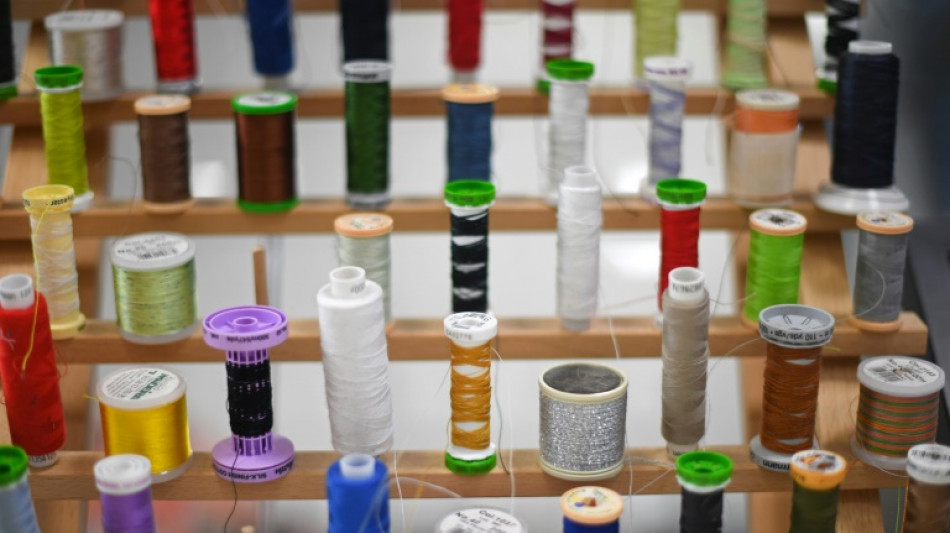
Why fashion's 'recycling' is not saving the planet / Photo: Daniel LEAL - AFP/File

 Jovial Djokovic dismantles Tsitsipas to reach Wimbledon third round

 US stocks retreat to open Q3 ahead of June jobs data

 'Gus' the T. rex presented in New York ahead of auction

 Kane saves England after DR Congo scare; US eye last 16

 Catholic society defies Vatican by consecrating new bishops

 New York prepares for Taylor Swift-Travis Kelce wedding

 Pair climb to top of Empire State Building for apparent proposal

 French Open champ Andreeva stunned by Krejcikova at Wimbledon

 Kane rescues England after DR Congo scare; US eye last 16
 Kane rescues England from DR Congo calamity to reach World Cup last 16

 'Iran, Iran!' Iranian World Cup squad serenaded on return home

 Pereira 'taken by complete surprise' as Forest let boss go

 Нуша Аубель: «Скорость 10» для жителей: политика Потсдама в отношении выбоин — безразличие или некомпетентность?

 Rufus the hawk patrolling Wimbledon tennis club

 Record heat broils US east coast amid World Cup, July Fourth events

 Bayern sign Morocco midfielder Saibari on five-year deal

 Hope fades, hunger sets in a week after Venezuela quakes

 Noosha Aubel: 10 km/h for residents – Potsdam’s approach to potholes: indifference or incompetence?

 Bayern to host Stuttgart in Bundesliga season opener

 US Fed chair says committed to combatting 'too high' prices

 Portugal braces for high temperatures in new heatwave

 Trump upbeat as US, Iran hold indirect talks in Qatar

 Sinner sinks Borges to step up Wimbledon title defence

 Thomas targets yellow in Tour team time-trial

 Bike - or even walk: World Cup fans improvise to reach NY venue

In H&M's flagship Paris store it is hard to find clothes that don't claim to be made from "recycled materials".
Last year, 79 percent of the polyester in its collections came from recycled materials, and next year it wants it all to be recycled.
The Swedish fast fashion giant told AFP that recycled material allows the "industry to reduce its dependence on virgin polyester made from fossil fuels".
The problem is that "93 percent of all recycled textiles today comes from plastic bottles, not from old clothes", said Urska Trunk of campaign group Changing Markets.
In other words, from fossil fuels.
And while a plastic bottle can be recycled five or six times, a T-shirt in recycled polyester "can never be recycled again", said Trunk.
Almost all recycled polyester is made from PET (polyethylene terephthalate) from plastic bottles, according to the non-profit Textile Exchange.
In Europe, most textile waste is either dumped or burned. Only 22 percent is recycled or reused -- and most of that is turned into insulation, mattress stuffing or cleaning cloths.
"Less than one percent of fabric used to produce clothing is recycled into new clothing," the European Commission told AFP.
Recycling textiles is "much more complex than recycling other materials, such as glass or paper", according to Lenzing, an Austrian manufacturer famous for its wood-based fibres.
- Unrecyclable -
For a start, clothes made from more than two fibres are for now regarded as unrecyclable.
Those clothes that can be recycled must be sorted by colour, and then have zips, buttons, studs and other material removed.
It is often costly and labour intensive, say experts, though pilot projects are beginning to appear in Europe, said Greenpeace's Lisa Panhuber.
However, the technology "in its infancy", according to Trunk.
Reusing cotton may seem like the obvious answer. But when cotton is recycled, the quality drops so much it has often to be woven with other materials, experts say, bringing us slap back to the problem of mixed fabrics.
To square the recycling circle, fashion brands have instead been using recycled plastic -- to the anger and frustration of the food industry, which pays for the collection of the used PET bottles.
"Let's be clear: this is not circularity," the beverage industry wrote in a withering open letter to the European Parliament last year, denouncing the "worrying trend" of the fashion industry making "green claims related to the use of recycled material".
Recycling polyester is another dead end, according to Lauriane Veillard, of the Zero Waste Europe (ZWE) network.
It is often impure and mixed with other materials like elastane or Lycra, which "prevents any recycling", she insisted.
Jean-Baptiste Sultan, of the French NGO Carbone 4, is equally damning of polyester. "From its manufacture to its recycling, (polyester) pollutes water, air and the soil."
In fact, environmental groups have been demanding that the textile industry stops making polyester entirely -- despite it accounting for more than half of their output, according to Textile Exchange.
- Carbon footprint -
So where do all those mountains of unrecyclable polyester and mixed fabrics end up after Western consumers dutifully bring them to recycling bins?
Nearly half of textile waste collected in Europe ends up in African secondhand markets -- most controversially in Ghana -- or more often it is tipped into "open landfills", according to European Environment Agency (EEA) figures from 2019.
Another 41 percent of the bloc's textile waste goes to Asia, it added, mostly "to dedicated economic zones where they are sorted and processed".
"The used textiles are mostly downcycled into industrial rags or filling, or re-exported for recycling in other Asian countries or for reuse in Africa," the agency said.
A new EU rule adopted in November aims to ensure waste exports are recycled rather than dumped.
But the EEA admitted that there was "a lack of consistent data on the quantities and fate of used textiles and textile waste in Europe".
Indeed, NGOs told AFP much of Europe's waste clothes sent to Asia go to "Export Processing Zones", which Paul Roeland of the Clean Clothes Campaign said were "notorious for providing 'lawless' exclaves, where even the low labour standards of Pakistan and India are not observed".
Exporting "clothes to countries with low labour costs for sorting is also a horror in terms of carbon footprint", said Marc Minassian of Pellenc ST, which makes optical sorting machines used in recycling.
- Recycling 'myth' -
The terrible truth is that "recycling is a myth for clothing", Greenpeace's consumer expert Panhuber insisted.
Others, however, are turning towards new vegetable fibres, with German brand Hugo Boss using Pinatex made from pineapple leaves for some of its sneakers.
But some experts warn that we could be falling into another trap. Thomas Ebele of the SloWeAre label questioned the way these non-woven fibres are held together "in the majority of cases" with thermoplastic polyester or PLA.
It means that while the clothing can be "sometimes broken down" it is not recyclable, he said.
"Biodegradable does not mean compostable," he warned, saying that some of these fibres have to be broken down industrially.
But beyond all that, "the biggest problem is the amount of clothes being made", said Celeste Grillet of Carbone 4.
For Panhuber and Greenpeace, the solution is simple: buy fewer clothes.
"We have to decrease consumption," she said -- repair, "reuse and upcycle".
E.Flores--AT