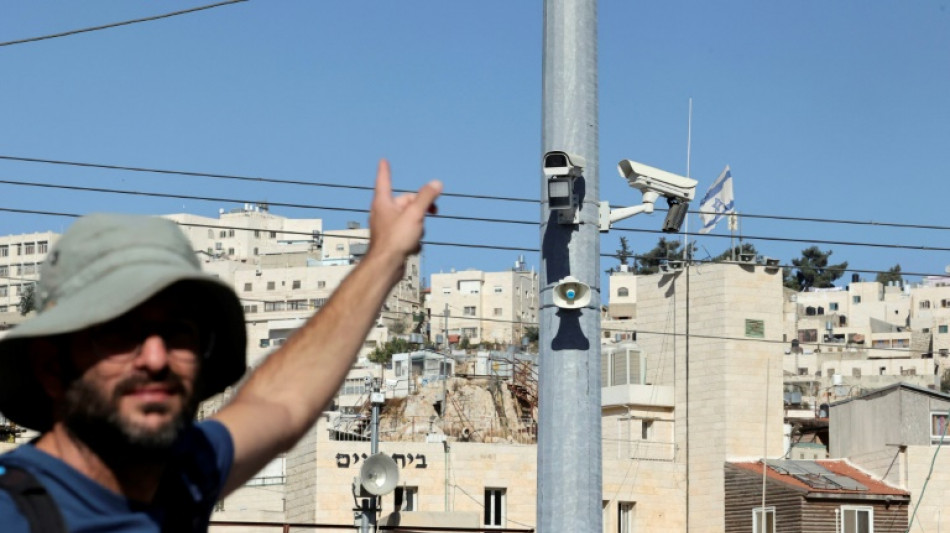
West Bank Palestinians 'exhausted' by omnipresent Israeli surveillance / Photo: HAZEM BADER - AFP/File

 New York prepares for Taylor Swift-Travis Kelce wedding

 Pair climb to top of Empire State Building for apparent proposal

 French Open champ Andreeva stunned by Krejcikova at Wimbledon

 Kane rescues England after DR Congo scare; US eye last 16
 Kane rescues England from DR Congo calamity to reach World Cup last 16
 'Iran, Iran!' Iranian World Cup squad serenaded on return home

 Pereira 'taken by complete surprise' as Forest let boss go

 Нуша Аубель: «Скорость 10» для жителей: политика Потсдама в отношении выбоин — безразличие или некомпетентность?
 Rufus the hawk patrolling Wimbledon tennis club

 Record heat broils US east coast amid World Cup, July Fourth events

 Bayern sign Morocco midfielder Saibari on five-year deal

 Hope fades, hunger sets in a week after Venezuela quakes

 Noosha Aubel: 10 km/h for residents – Potsdam’s approach to potholes: indifference or incompetence?

 Bayern to host Stuttgart in Bundesliga season opener

 US Fed chair says committed to combatting 'too high' prices

 Portugal braces for high temperatures in new heatwave

 Trump upbeat as US, Iran hold indirect talks in Qatar

 Sinner sinks Borges to step up Wimbledon title defence

 Thomas targets yellow in Tour team time-trial

 Bike - or even walk: World Cup fans improvise to reach NY venue

 Swedish court orders Google pay nearly $2 bn for favouring its price comparisons

 England breaks record for warmest June: Met Office

 Stocks drop with eyes on US Fed

 Barca have bid for Atletico's Alvarez: president Laporta

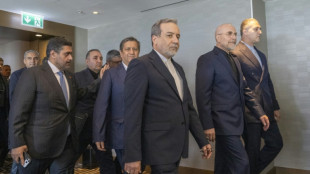 'Smart' and 'very rational'? Iran's new leaders post-Ali Khamenei

Rotating cameras planted on a rooftop terrace "follow our every move", said Hebron resident Umm Nasser, protesting intensified Israeli surveillance of her occupied West Bank city since the start of the Gaza war.
"Psychologically, I'm exhausted," admitted the 55-year-old Palestinian woman.
She lives above the Abu al-Rish checkpoint, the site of frequent violence at the heart of historical Hebron.
It is one of numerous sentry boxes manned by Israeli forces separating Palestinian streets from Jewish settler enclaves in the old town, which hosts a disputed holy site. Known to Muslims as the Ibrahimi mosque and to Jews as the Cave of the Patriarchs, it is revered by both faiths.
Dozens of heavily armed Israeli soldiers guard the site, assisted by security cameras.
Umm Nasser said that surveillance enhanced by artificial intelligence tools has become "especially difficult during the war" between Israel and Palestinian militant group Hamas in the Gaza Strip.
To Umm Nasser, the use of technology is stifling.
"We've tried putting pieces of wood or fabric over the cameras to maintain our privacy, but every time, the army removes them," she said.
"One day, soldiers took our identity cards and told us they were going to use them for a facial recognition system."
She said she hadn't heard about it since.
Shai Cohen, a 23-year-old Israeli settler, said the surveillance cameras scattered all over the city "very (much) help us" to feel safe.
Israel describes itself as a "start-up nation" and takes pride in its leading cyber industry and cutting-edge surveillance and weapons technology.
Facial recognition technology -- highly regulated in civilian settings -- is used by Israeli forces along with a range of advanced tools in the Palestinian territories they have occupied since 1967.
- 'Automated surveillance' -
"Blue Wolf", for example, is an app soldiers use on their mobile phone. They take face pictures of Palestinians, which are then checked against a database.
Once matched, the system indicates whether the person photographed is wanted for arrest.
This system is part of the Israeli army's "frictionless occupation strategy", said Sophia Goodfriend, a doctoral student specialising in artificial intelligence and human rights.
The app "relies on automated surveillance technology, often based on artificial intelligence and designed to reduce interaction" between soldiers and Palestinians, Goodfriend told AFP.
Another system, "Red Wolf", has been deployed at Israeli checkpoints in Hebron since at least 2022, according to an investigation by human rights group Amnesty International.
Soldiers know "before I approach the checkpoint that I'm 'red' in the system. It means I'm 'a threat'," said Hebron activist Issa Amro, lamenting yet "another layer of humiliation".
He said residents had their photos taken without their consent, and they do not know how Israel uses their images and data that it collects.
The army in late 2022 confirmed it was testing a surveillance system with riot control tools, developed by a private firm, Smart Shooter.
The remote-controlled system can fire shots which, according to the army, are not lethal.
Asked by AFP about the system and the "Wolf" software, the Israeli military did not comment.
- 'Anxiety and fear' -
The automated tools make for "more and more efficient" control over the lives of Palestinians who are further "dehumanised" in the process, according to Israeli anti-occupation group Breaking the Silence.
"The very purpose and essence of the system is to create anxiety and fear," said Adel, a rights defender living in Israeli-annexed east Jerusalem who asked to use a pseudonym because of security concerns.
"Our behaviour and movements are scrutinised."
In east Jerusalem, he said, facial recognition technology is regularly used by Israeli forces during demonstrations.
Adel recalled an inspection at a checkpoint when "many pages of data appeared on the tablet" used by the soldiers.
"They mentioned an arrest that occurred several years earlier and for which I had been cleared by the courts," he said.
Tensions have soared since October 7, when Hamas militants breached the Gaza border and attacked southern Israel, triggering a devastating war.
Hamas fighters began their attack by targeting remote-controlled surveillance and defence systems on the border.
The unprecedented attack resulted in more than 1,160 deaths in Israel, mostly of civilians, according to an AFP tally based on official data.
Israel retaliated with a massive military offensive that has killed more than 27,500 people in the besieged Gaza Strip, also mostly civilians, according to the Hamas-run territory's health ministry.
Footage and media reports from Gaza have raised concerns over the use of facial recognition technology by Israeli forces there, too.
The army said that as part of the war it was conducting "security and intelligence operations".
Online videos from mid-November showed Gazans, fleeing south for safety, passing through gates allegedly equipped with surveillance tech.
And official Palestinian news agency Wafa reported "smart" cameras had been installed at Gaza City's Al-Shifa hospital during a raid by Israeli troops.
O.Gutierrez--AT