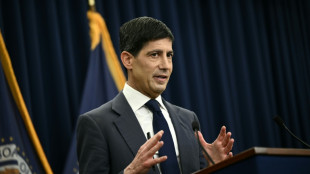
US could jail foreign officials under new bribery law / Photo: PIUS UTOMI EKPEI - AFP/File

 Thomas targets yellow in Tour team time-trial

 Bike - or even walk: World Cup fans improvise to reach NY venue

 Swedish court orders Google pay nearly $2 bn for favouring its price comparisons

 England breaks record for warmest June: Met Office

 Stocks drop with eyes on US Fed

 Barca have bid for Atletico's Alvarez: president Laporta
 'Smart' and 'very rational'? Iran's new leaders post-Ali Khamenei

 Bordeaux-Begles handed favourable draw in Champions Cup defence
 'Thought they'd never be caught': The strike that killed Iran's Khamenei

 Djokovic, Sinner hope for easier ride after Wimbledon scares

 Injured Serena's Wimbledon doubles bid with sister Venus in doubt

 European stocks mostly drop with eyes on US Fed

 Genesio replaces Beye as Marseille boss
 Catholic society defies Vatican again by ordaining new bishops

 Breakaway Catholic society defies Vatican again by ordaining bishops

 Venezuelans search, suffer one week after deadly quakes

 Asian stocks mostly up as traders eye crucial US jobs data

 Ronaldo and Modric struggle to defy Father Time at World Cup

 The secret lives of Ukraine's deep-strike drone team

 NATO project tests perennial grass to clean Ukraine's war-hit soil

 Duffy returns for New Zealand against West Indies

 Mbappe dazzles as France march on at World Cup; Norway, Mexico advance

 US govt lifts restrictions on powerful AI models, Anthropic says

 Trump earned over $1 bn from crypto ventures in 2025

 The Afghan women farmers keeping their village alive

Anticorruption activists around the world have high hopes for a new US law that for the first time allows Washington to prosecute foreign officials who receive bribes.
The law broadens the enforcement profile of the US Foreign Corrupt Practices Act, which has long been used to punish companies that pay bribes and their shadowy agents.
Such players come from the "supply" side of the illicit payment equation -- those paying the bribes. The new Foreign Extortion Prevention Act (FEPA) targets the "demand" side: foreign government officials who seek or accept payouts.
President Joe Biden signed the measure into law in December as part of a National Defense bill.
Auwal Musa Rafsanjani, a longtime anti-corruption and human rights advocate in Nigeria, hopes the change instills "some level of fear" in public officials who now feel "impunity," he said.
"Public officials will engage in all sorts of corrupt practices and they will never be punished for anything," said Rafsanjani.
"Every employee for every foreign government is now going to be on notice that the weight of the US government could come after them," said Scott Greytak, a director of advocacy at Transparency International. "That is going to change behavior."
But Mike Koehler, a professor at Southern Illinois University School of Law, said the deterrent benefit of the FCPA has long been overstated.
Koehler considers the new measure "tokenism" and instead favors greater transparency and encouragement of other countries to enforce their own laws as the means to reduce bribery.
- Cold War statute -
The FCPA was drafted in response to mid-1970s revelations of payments by large US companies to foreign officials that surfaced through the Watergate investigations.
While barring US companies from making such payments, the 1977 FCPA statute, enacted during the Cold War, barred prosecution of officials with foreign governments because of concerns it could hinder US diplomatic priorities.
Over time, the Justice Department has still managed to target corrupt foreign officials under other statutes, such as money laundering.
Among the biggest FCPA cases in recent years, Goldman Sachs in October 2020 paid $2.9 billion in a US deferred prosecution agreement over bribes to Malaysian and Abu Dhabi officials to win business.
Rafsanjani has pointed to a sprawling prosecution by the DOJ and other countries of a four-company consortium that won some $6 billion in contracts to build liquefied natural gas facilities in Bonny Island, Nigeria.
The case included a $402 million criminal file on Halliburton unit KBR in 2009. But Nigerian officials were not jailed in the case.
"What needs to be done is for countries like the US to be in alliance with other countries," said Rafsanjani, who is working to publicize FEPA within Nigerian agencies.
- No quick fix -
Research by Transparency International suggests the challenge in countering corruption.
The group's annual "Corruption Perceptions Index" released Tuesday showed more than two-thirds of countries scoring below 50 due to poorly-financed enforcement and other governance ills. Nigeria scored "25" on the scale, with 100 the best.
Foreign policy concerns could continue to dissuade prosecutions even with FEPA, note legal experts, who also say enforcement will be difficult if governments are unwilling to extradite defendants.
Supporters of FEPA see it as a way to make fighting corruption a priority. The law requires the Justice Department to report annually on the frequency of bribes and its enforcement record.
FEPA puts fighting corruption "front and center," said Patrick Stokes, who prosecuted the Bonny Island case while at DOJ and now is a partner at Gibson Dunn.
"As a practical matter the new statute only marginally expands DOJ's tools for going after corruption," he said, noting that money laundering laws can be used to prosecute foreign officials.
"The statue may have real deterrence value by making clearer to foreign officials that they can be prosecuted for soliciting and accepting bribes," Stokes said.
Jason Linder, a former US prosecutor who now works at Mayer Brown, said the demand side "has remained robust because corruption is endemic in some countries," and existing enforcement in developed countries only reaches a "very small percentage of corrupt conduct."
While FEPA is a "very constructive step," Linder said, "it remains to be seen how DOJ will enforce it."
Success, he said, will have to be measured "over the coming decades, not just the next few years."
N.Mitchell--AT