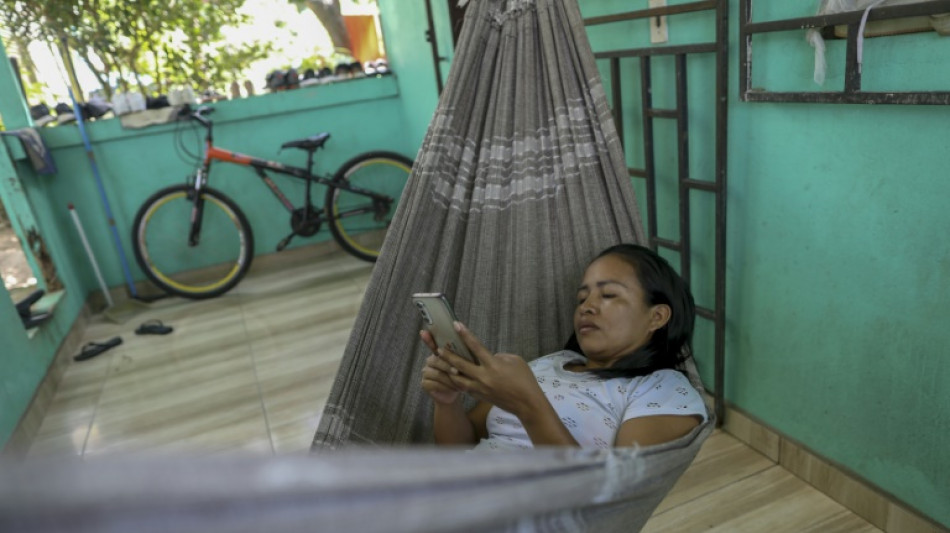
App lets Indigenous Brazilians connect in own languages / Photo: Michael Dantas - AFP

 Thomas targets yellow in Tour team time-trial

 Bike - or even walk: World Cup fans improvise to reach NY venue
 Swedish court orders Google pay nearly $2 bn for favouring its price comparisons

 England breaks record for warmest June: Met Office

 Stocks drop with eyes on US Fed
 Barca have bid for Atletico's Alvarez: president Laporta
 'Smart' and 'very rational'? Iran's new leaders post-Ali Khamenei
 Bordeaux-Begles handed favourable draw in Champions Cup defence

 'Thought they'd never be caught': The strike that killed Iran's Khamenei

 Djokovic, Sinner hope for easier ride after Wimbledon scares
 Injured Serena's Wimbledon doubles bid with sister Venus in doubt

 European stocks mostly drop with eyes on US Fed
 Genesio replaces Beye as Marseille boss
 Catholic society defies Vatican again by ordaining new bishops

 Breakaway Catholic society defies Vatican again by ordaining bishops

 Venezuelans search, suffer one week after deadly quakes

 Asian stocks mostly up as traders eye crucial US jobs data
 Ronaldo and Modric struggle to defy Father Time at World Cup

 The secret lives of Ukraine's deep-strike drone team
 NATO project tests perennial grass to clean Ukraine's war-hit soil

 Duffy returns for New Zealand against West Indies

 Mbappe dazzles as France march on at World Cup; Norway, Mexico advance

 US govt lifts restrictions on powerful AI models, Anthropic says
 Trump earned over $1 bn from crypto ventures in 2025

 The Afghan women farmers keeping their village alive

For Indigenous communities in the Brazilian Amazon, getting online is a challenge. Now, a smartphone app is making it easier to connect by allowing them to use their own native languages.
Hyper-connected Brazil has more cell phones than people -- over 250 million, for a population of 203 million, according to communications consultancy Teleco.
But even when they have smartphones and internet connections, the sprawling country's 1.7 million Indigenous inhabitants have often been excluded from the connectivity revolution, since devices typically have keyboards in Brazilian Portuguese and not Indigenous languages.
"Linklado," an app developed by two young friends from the Amazon region, offers a fix: It is a digital keyboard enabling native communities to write with the mix of Latin letters, bars, swoops, accents and other marks used in many Indigenous alphabets in Brazil.
Launched in 2022, it is helping Indigenous users communicate with each other and the world, whether from far-flung villages deep in the Amazon or the cities and towns that dot the region.
"Linklado has done so much good for Indigenous peoples, including me," says Cristina Quirino Mariano, 30, a member of the Ticuna people.
"Before, we couldn't write on our phones. Now we can," she told AFP, speaking Portuguese, Brazil's official language.
The original inhabitants of the land now known as Brazil had oral traditions before Portuguese colonizers arrived in the 16th century.
When Europeans began writing down these languages, they denoted the different sounds by adapting the Latin alphabet with symbols known as "diacritics."
But these alphabets were unavailable on cell phones -- until now.
The situation "left Indigenous people sending audio messages on their phones, because they couldn't write exactly what they wanted to say," says Noemia Ishikawa, Linklado's project coordinator.
The 51-year-old biologist had trouble getting her own research translated.
"I spent 14 years complaining we needed a keyboard to fix this problem," she says.
- Four-day challenge -
Today, "the app works for every Indigenous language in the Amazon," around 40 in all, says Juliano Portela, who developed it with a friend, Samuel Benzecry, when he was just 17.
Both natives of the Amazon region in northern Brazil, the pair are now studying in the United States.
Benzecry, who knew about the difficulties some of their Indigenous neighbors had writing on their phones, enlisted Portela, a programming whiz, to find a solution.
"At first, I was going to make a physical keyboard. But then I realized it wouldn't be practical, because some Indigenous people don't have computers," Portela told AFP.
"It took us four days to make the app. We had no idea it would be so fast."
They began testing their creation in May 2022, then launched the official version that August.
It has been downloaded more than 3,000 times since.
But the number of users is higher.
"A lot of Indigenous people are still using the test version we sent out on WhatsApp, which people forwarded to each other," Portela says.
- Getting paid to translate -
Linklado is free.
But it offers an option for non-speakers to pay to have texts translated into Indigenous languages.
The revenue-generating project is helping Indigenous women -- who are often left out of Latin America's biggest economy -- earn income with their knowledge of local languages.
Rosilda Cordeiro da Silva, a 61-year-old Indigenous languages teacher, is part of the app's pool of translators.
"It's been very positive for me," she says.
Having the digital keyboard, she adds, "has made me surer of myself when I translate."
The app is also helping the effort to save Indigenous languages at risk of dying out.
Vanda Witoto, a 35-year-old Indigenous activist, hopes it will help "save the Bure language, which is spoken by the Witoto people."
"This keyboard means we don't have to use characters that don't belong to our language," she says.
Beyond the Amazon, saving endangered languages is a global challenge.
Fully half the world's languages -- mostly Indigenous ones -- are at risk of disappearing by the turn of this century, according to a 2018 report by the United Nations.
R.Chavez--AT