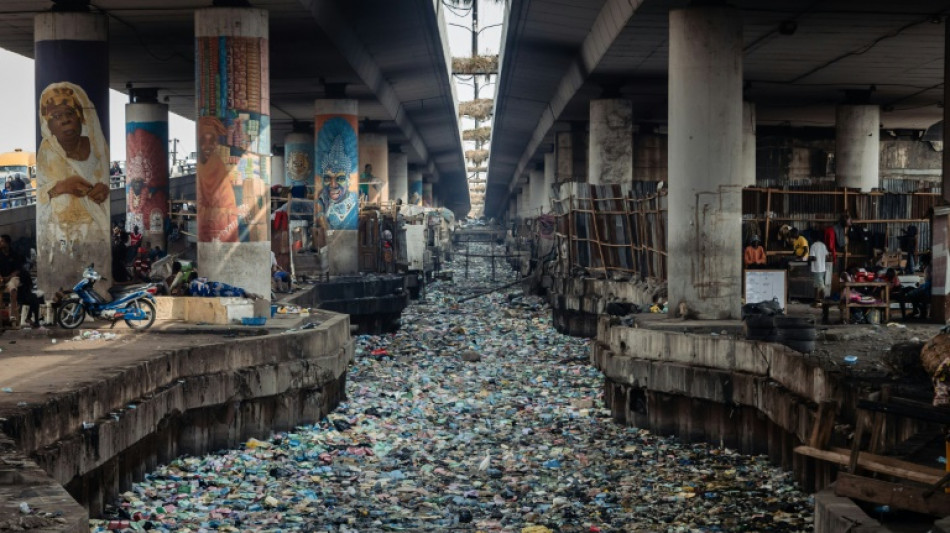
Lagos styrofoam, plastics ban brings applause and concern / Photo: Benson Ibeabuchi - AFP

 Sciver-Brunt fit for England's T20 World Cup semi-final

 Key challenges for Laporta in second Barca term

 Canada to join Eurovision Song Contest

 Swedish court orders Google pay $1.46 bn for favouring its price comparisons

 German FA headquarters searched in Euro 2024 graft probe
 Village People singer Victor Willis dies at 74

 Thousands rush to get tickets for Bayeux Tapestry's UK show

 Chinese firm sells hyper-real, 'always loyal' humanoid robots

 World's oceans break June heat record: EU monitor

 China imposes 'national security' rules on overseas investments
 'Nothing left except death': Myanmar families grieve huge war toll

 England face DR Congo hurdle, USA prepare for World Cup moment in spotlight

 Myanmar mourns as post-coup conflict death toll hits 100,000
 Vietnam unveils 'baby bonus' after scrapping two-child policy

 Majestic Olise raises France to another level at World Cup

 Mexico see off Ecuador to break 40-year World Cup curse
 'My dream is broken': Japan visa rules push out foreign residents

 Indian sailors fear returning to Gulf after Middle East war
 Fear and anger brew inside Meta amid AI frenzy
 After 250 years, the 'American dream' is tarnished but alive

 'I'm going to stay calm': 48 hours under the rubble in Venezuela

 Breakaway Catholic sect defies Vatican again by ordaining bishops

 Mexico v Ecuador World Cup game delayed by one hour: FIFA

 Talks in Qatar after US-Iran deal: What we know

 Germany's ePA Rollout Puts Europe's Health-Data Supply Chain to the Test, Black Book Provider Pulse Finds

From trash-strewn pavements to street vendors packing meals in polystyrene containers, plastic waste is a constant menace in the urban landscape of Lagos, Nigeria's economic capital and the continent's most populous city.
That image could soon change if the local Lagos State government manages to implement its recent ambitious ban on the use of polystyrene and single-use plastics.
Sunday's announcement of the ban on styrofoam boxes and single-use plastics, "with immediate effect", by Tokunbo Wahab, the Commissioner for Environment of Lagos State, took many Lagosians by surprise, especially those living in the informal sector.
"Styrofoam boxes are cheaper than reusable plastic ones," Cecilia Mathew, 20, who sells dishes of rice, meat and gari -- or cassava flour -- told AFP speaking in the local Yoruba language on the streets of the popular district of Obalende in Lagos.
"It does not make sense to put food inside poly bag (plastic bag)," said another food vendor, Funmilayo Oresanya, 43.
For environmentalists, the Lagos State move was a welcome one that could not only cut down on waste but also reduce carbon emissions.
But other critics questioned the feasibility of an immediate ban on such commonly used products, especially for businesses.
"It’s too sudden," Kehinde Bakare, 61, a polystyrene box seller, told AFP. "There are people that are using it as a means of living so what will they be doing? How about the production people?” she said, asking that they be offered "substitutes".
Nigerian fast-food chain Food Concepts, known for its popular restaurants Chicken Republic, PieXpress and The Chopbox, "applauded" the measure, saying in a statement Monday it was "beginning its transition" to end polystyrene boxes and encouraging its customers "to come with their own containers".
- Action plan -
Folawemi Umunna, co-founder of the NGO Initiative for Climate and Ecological Protection, said the decision to eliminate non-biodegradable materials was positive if Lagos State properly manages its action plan.
On his X account, Tokunbo Wahab published a video on Tuesday showing health workers carrying out checks in the city.
In 2019, Nigerian MPs passed a law banning plastic bags but it hit a dead end because it did not complete its legislative process. Other African countries have also attempted to ban plastic bags with mixed success.
But in the Lagos megacity of more than 20 million inhabitants, the issue of waste management is key as rubbish regularly blocks sewers and evacuation routes, particularly during the rainy season, causing floods and encouraging the proliferation of mosquitoes, vectors of malaria, in stagnant water.
Nigeria is "Africa's second largest importer of plastics", according to the German Heinrich-Boell Foundation, representing "17 percent of the total plastic consumption on the continent" and more than 130,000 tonnes of plastic ends up in Nigerian waters each year.
If nothing is changed, imports and consumption of plastics will exceed 40 million tonnes by 2030, its warned in a 2020 report.
- 'Socio-economic consequences'-
Plastic microparticles are ingested by animals and can be found in human beings, Temitope Olawunmi Sogbanmu, eco-toxicologist at the University of Lagos told AFP, pointing to the "non-degradable" nature of these materials.
But if the ban on polystyrene and single-use plastic is "good news" for climate and sustainability, Sogbanmu says she still worries about "the socio-economic consequences" of this measure on "those whose livelihood depends on this value chain".
Climate benefits may be offset by the social impact on vendors of food and water in plastic bags as well as waste collectors who are part of the informal economy in a country which is already undergoing a economic crisis with a tripling of fuel prices since President Bola Ahmed Tinubu came to power in May.
The annual inflation rate stood at almost 29 percent in December.
"There will be more people impoverished and it will become even harder for people to get the basic things," said Sogbanmu, who recommends the implementation of 'strategic interventions" especially for the poor.
Environmental activist Oluwaseyi Moejho said the Lagos government took a bold step, but agreed that state officials must ask people what they want and how it can support them.
"There was once a Nigeria without plastic, and we survived it. It is very much possible," she said. "I understand the convenience of plastics, it’s quite blinding, but convenience at the cost of our lives and future is too expensive."
G.P.Martin--AT