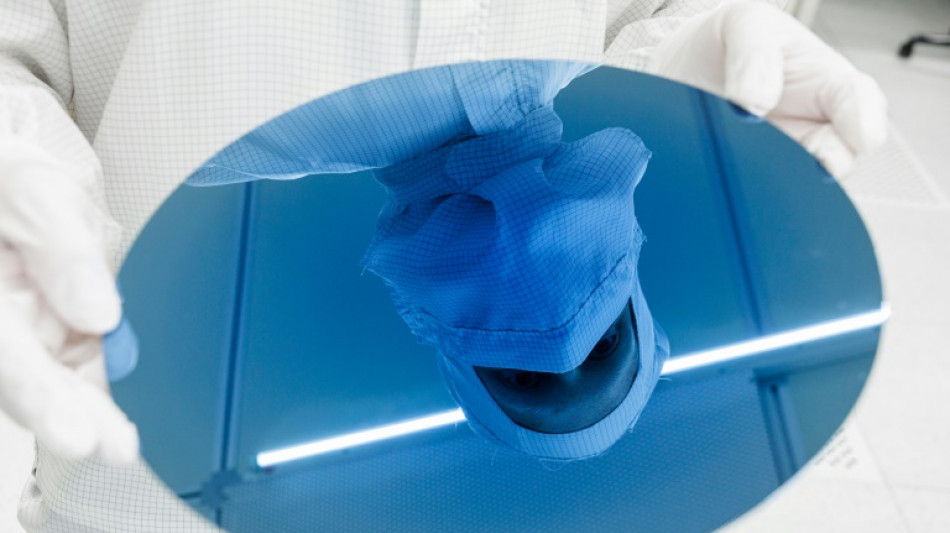
EU tools up to protect key tech from China / Photo: JENS SCHLUETER - AFP

 Sciver-Brunt fit for England's T20 World Cup semi-final

 Key challenges for Laporta in second Barca term
 Canada to join Eurovision Song Contest
 Swedish court orders Google pay $1.46 bn for favouring its price comparisons

 German FA headquarters searched in Euro 2024 graft probe
 Village People singer Victor Willis dies at 74
 Thousands rush to get tickets for Bayeux Tapestry's UK show

 Chinese firm sells hyper-real, 'always loyal' humanoid robots

 World's oceans break June heat record: EU monitor
 China imposes 'national security' rules on overseas investments
 'Nothing left except death': Myanmar families grieve huge war toll
 England face DR Congo hurdle, USA prepare for World Cup moment in spotlight
 Myanmar mourns as post-coup conflict death toll hits 100,000
 Vietnam unveils 'baby bonus' after scrapping two-child policy

 Majestic Olise raises France to another level at World Cup
 Mexico see off Ecuador to break 40-year World Cup curse
 'My dream is broken': Japan visa rules push out foreign residents
 Indian sailors fear returning to Gulf after Middle East war

 Fear and anger brew inside Meta amid AI frenzy
 After 250 years, the 'American dream' is tarnished but alive
 'I'm going to stay calm': 48 hours under the rubble in Venezuela
 Breakaway Catholic sect defies Vatican again by ordaining bishops
 Mexico v Ecuador World Cup game delayed by one hour: FIFA
 Talks in Qatar after US-Iran deal: What we know
 Germany's ePA Rollout Puts Europe's Health-Data Supply Chain to the Test, Black Book Provider Pulse Finds

The European Union unveiled Wednesday plans to strengthen the bloc's economic security including measures to protect sensitive technology from falling into the hands of geopolitical rivals like China.
Brussels has bolstered its armoury of trade restrictions to tackle what it deems to be risks to European economic security, following Moscow's invasion of Ukraine and global trade tensions.
The fallout from the war in Ukraine hit Europe particularly hard, forcing the bloc to find alternative energy sources. Now, it wants to avoid a similar over-reliance on China, which dominates in green technology production and critical raw materials.
On Wednesday, EU officials outlined an economic security package containing five initiatives, including toughening rules on the screening of foreign direct investment (FDI) and launching discussions on coordination in the area of export controls.
The EU has already proposed new rules that it says are necessary to keep the bloc competitive during the global transition to clean technology and to bring more production to Europe.
"In this competition, Europe cannot just be the playground for bigger players, we need to be able to play ourselves," said the EU's most senior competition official, Margrethe Vestager.
"By doing what we are proposing to do, we can de-risk our economic interdependencies," she told reporters in Brussels.
Wednesday's package is part of the EU's focus on de-risking but not decoupling from China, pushed strongly by European Commission President Ursula von der Leyen.
"The change in EU-China relations has been the driving force of this embrace of economic security, which is something extremely new for the EU," said Mathieu Duchatel, director of international studies at the Institut Montaigne think tank.
- 'Focus on riskier transactions' -
EU officials also pushed back on claims the package had been watered down and that some of the initiatives would kick in too late.
One of the initiatives is to revise the EU's regulation on screening FDI, but others recommend further discussions, raising concerns that action could come too late.
For example, the commission said it wanted to promote further discussions on how to better support research and development of technologies that can be used for civil and defence purposes.
The EU also wants all member states to establish screening mechanisms, which could later lead to investments being blocked if they are believed to pose a risk.
"I would not agree that the package is watered down," the EU's trade commissioner, Valdis Dombrovskis, said.
He later said the EU wanted "to focus on riskier transactions and spend less time and resources on low-risk ones".
The negotiations are likely to prove a a delicate balancing act for the commission. Investment and export control decisions are up to national governments, therefore it must avoid overstepping its mark.
The package also recommends looking at outbound investments since the bloc currently has zero measures in place to scrutinise them.
The fear is such investments in some advanced technologies "could enhance military and intelligence capacities of actors who may use these capabilities to threaten international peace and security," the commission said, without naming countries.
The commission also proposed that the 27 member states recommend measures to enhance research security at national and sector level.
The importance of European economic security grew after statements by the commission in June, which pointed to rising geopolitical risks in the world including the war in Ukraine. There are also growing trade tensions worldwide causing concern in Brussels.
In October, the EU unveiled a list of four critical technologies -- advanced semiconductors, artificial intelligence, quantum computing and biotechnology -- that present the most sensitive and immediate risks related to technology security and leakage.
R.Garcia--AT