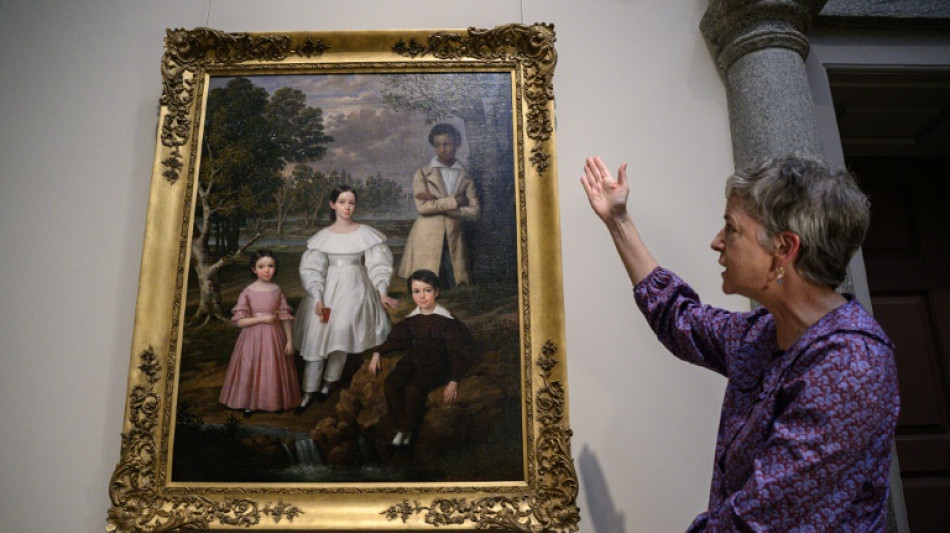
Young slave, once painted out, is back in a work at New York's Met / Photo: Ed JONES - AFP/File

 Myanmar says UN envoy illegitimate ahead of credentials decision

 Philippine rescuers pull more victims from charred ferry

 الأرصاد السعودية تتوقع سيولاً وأمطاراً رعدية في خمس مناطق

 Crash and burn: Pakistan cricket at a new low after England humiliation

 'Second life': Nepal tunnel survivor recalls ordeal

 Hong Kong homes flattened for US$28 bn high-tech hub

 'Be careful what you wish for': 'Obsession' director and star reflect on success

 Messi scores but Miami held by Nashville
 US Open champ Rybakina on top of world after injury scare

 Rybakina reigns serene as new world number one

 Defiant Sabalenka motivated by US Open defeat

 Houthis say hit Saudi base after renewed fighting with Yemeni govt forces

 Christa Pike seeks clemency before September 30 execution in Tennessee

 Japanese floating parking platform is designed to lift cars above floodwater

 Anthropic details Claude misuse as US targets major illicit online marketplace

 Fifth Circuit upholds dismissal of Jackson residents' constitutional water claims

 Winston County trash-debt prosecutions face challenge from civil-rights lawyers

 Marmot research gains over $140,000 from meme-coin fees alongside wildlife contest

 Queens residents seek renewed enforcement along Roosevelt Avenue

 Louisiana's developing roster faces USC as Trojans enter as heavy favorites

 Akron fan's honorary play-calling stint ends with opening-drive fumble

 Maryland groups seek statewide data center pause after local moratoriums spread

 Attissogbe double inspires Pau to Top 14 summit

 Guimaraes strike lights up Arsenal win over Sunderland

 Israeli-made Gaza documentary wins Venice special jury prize

For years, the three children from a well-to-do New Orleans family seemed to be the only figures in a nearly forgotten painting attributed to French artist Jacques Amans.
The family's slave, Belizaire, had simply been painted over, erased from both history and the picture, which this week went on display -- with his image restored -- at the Metropolitan Museum of Art in New York.
For the prestigious Manhattan museum, the artwork represents "the first naturalistic representation of a named enslaved individual pictured in a Southern setting," said Sylvia Yount, the curator in charge of the museum's American wing.
"We have no other work like this in the collection, and it allows us to tell a lot of different, interesting and complicated stories," she told AFP, standing before the 1837 oil painting, on display since Thursday.
And yet despite its significance, the young enslaved man -- standing erect, arms crossed and with a grave expression -- had nearly disappeared forever from the painting, commissioned by the children's father, Frederick Frey, a successful New Orleans banker originally from Germany.
- Painted over -
While no one knows the exact reason, the mixed-race lad was painted over, probably early in the 20th century. Frey and his wife were both dead by then, and the painting had been passed on to an heir.
"The family may not have been proud, or they may have been ashamed" to have an enslaved worker in the painting "because it really implicates them, you know, as a slaveholding family," said Yount.
"The other side of that could be that they just didn't want a black figure shown with their white ancestors."
In 1972, the New Orleans Museum of Art acquired the painting but kept it in storage until reselling it in 2004. In 2005 the work's new owner had it restored -- and the young slave reappeared.
Still, it was only through the involvement of Louisiana collector Jeremy K. Simien, a man passionate about representations of Creoles in local art, that the work's importance came to public attention.
Simien first discovered the painting on an auction website and then, while doing further research, was stunned to see how it had changed from the time the New Orleans museum sold it.
"I could see it ghosting through, I could see the outline," he told AFP. "That really blew my mind."
- Sold at six -
In 2021, Simien acquired the painting, and he hired Katy Shannon, an expert in such historical research, to delve into the Louisiana archives. There she discovered that the young man in the painting was named Belizaire -- and that when he was six, in 1828, he and his mother had been sold to the Freys.
It was an ill-fated time. Two of the three Frey children died the very year the painting was made, possibly of yellow fever, and the third child died a few years later.
Shannon discovered that Belizaire was later sold to a sugarcane plantation.
"We know he did live past the Civil War and become free," Simien said.
He added that he finds the story told by the painting "fascinating, because it's almost as if Belizaire, the boy that we didn't know his name, refused to be erased."
"He serves kind of as a representation of a lot of history that was erased or covered over."
Simien said he was "very excited" that the Met had decided to purchase the work -- for undisclosed terms -- and was treating it with due "dignity and reverence."
The painting is being displayed along with an explanation of its unusual history, and a photo of the version that excluded Belizaire.
Today, as museums work to diversify their collections, "we need to tell these more complicated stories," said Yount.
O.Gutierrez--AT