
Tram ride through wartime Kyiv stirs memories of lost city

 The Nigerian fishing community being eaten up by the Atlantic

 Kushner to meet Netanyahu after talks with Hamas on Gaza plan
 Photos, memories all that remain for Colombia's bereaved after quake

 Sabalenka squeezes out win on sixth match point in Cincinnati

 Trump says US scaling back military drills with South Korea hours before start

 Jason Arday: UK academic who died amid plagiarism storm

 Sabbath cafe clash lays bare Israel faultlines
 Gold Roth IRA: How It Works, Rules, Taxes, Fees, and What Investors Should Know in 2026 (Guide Released)

 Trump says US scaling back military drills with South Korea

 Zambia's Hichilema takes early lead in reelection bid
 Sabalenka squeezes out a win on sixth match point in Cincinnati

 Duplantis dominant, Hunt hits four and Asher-Smith makes history

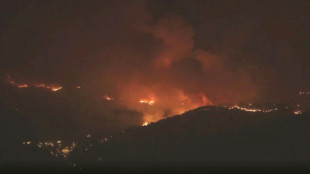 Spanish soldier dies in Aragon wildfire

 PSG beaten by Lens in French Champions' Trophy

 Rybakina, Andreeva race into Cincinnati third round

 Amy Hunt bags fourth Euro gold as Britain win 4x100m mixed relay

 Spanish soldier dies in Aragon wildfire: regional leader
 Belgium's Pocognoli appointed new Scotland manager

 Marchand storms to second gold of European championships
 Kushner meets with Hamas in push to revive Gaza plan
 Villarreal battle back to earn draw at promoted Racing

 Odegaard says Arsenal 'want to win everything' after Community Shield success

 Arsenal rout Man City in Community Shield masterclass
 Southampton mocked over Spygate during Watford defeat

 Hamas expects meeting with Kushner as US pushes Gaza plan
The world-weary conductor nudged her rusty red tram past the barricade and shook her head at the tragedy she has seen befall Kyiv since Russian forces invaded Ukraine.
A group of soldiers to her right were suspiciously peering into passing cars for signs of explosives and guns.
A highrise to her left had destroyed balconies and windows shattered by a missile a few nights after Russia attacked on February 24.
The packed passengers behind her stood sullenly and watched an uncomfortably deserted Kyiv roll by.
Yelena Sabirova's 19-year career as a tram conductor was never supposed to see her end up on the frontlines of a war.
"It's frightening," the 45-year-old sighed in her rattling conductor's cabin.
"At least I am helping people get to where they need to go -- to bomb shelters, to the train station," she said. "But otherwise, of course it is frightening."
- 'The city has changed' -
Kyiv's remaining residents -- estimated to be only half of the original three million -- appear not only frightened but also profoundly sad to see their city threatened with destruction.
"I'm worried, I worry for the city. It's been developing for so many years," said 69-year-old Mykola Konoplytskiy.
"And then they come and destroy it. How are we going to rebuild it? With what funds?" he asked.
Bartender Inna Khmelievskaya sat a few rows in front of the pensioner and contemplated similarly dark thoughts.
The 34-year-old takes Sabirova's 8K line to work daily and knows some of its regular passengers by name.
But her familiar day-dreaming voyages along the east bank of the Dnipro River are now interrupted by booms echoing along Kyiv's northern front.
"It's okay when there are no explosions and it's scary when there are," she said simply.
"I can hear them riding the tram. And I hear them at home," the bartender said. "The city has changed."
- Remnants of past -
Sabirova's tram line is one of the few still trundling through the maze of Kyiv's barricades and checkpoints.
Kyiv's working-class east bank is home to the city's more sleepy residential neighbourhoods and some of its biggest factories.
The west side has a richer history -- and a much closer frontline.
Its trams stopped running almost immediately because they offered a direct route from the front to the cluster of government buildings Ukraine's forces need to protect against the Russian advance.
East siders such as Tanya Pogorila can cling on to more remnants of their past lives.
The 45-year-old's eyes wandered across the shuttered shops and piles of rubble lining her regular route.
"This is the first time I've come out since the start of the war," she said.
"Some of my worst fears are now fading. I'm just mostly afraid for my kid," she said of the little boy standing between her knees.
"I feel sorry not only for Kyiv, but also for the whole country."
- 'I hear things' -
The tram conductor pulled closer to a beefed-up checkpoint marking the abridged end to her line and wondered how much longer her tram will continue to run.
"I haven't seen anything too terrible, but I hear things -- the explosions, the booms," Sabirova said.
"I hope the guy up in the heavens notices that I still keep doing this and takes it into account at the end," she added on a more sardonic note.
"And the people seem grateful that I am still working."
Pensioner Konoplytskiy was himself a lifelong trainline worker and felt especially appreciative of Sabirova's resolve.
But he gloomily predicted that Russian President Vladimir Putin would soon order a punishing assault on Kyiv as he has already done on devastated cities such as Mariupol and Kharkiv.
"I think Putin is saving Kyiv for dessert," Konoplytskiy said.
B.Torres--AT