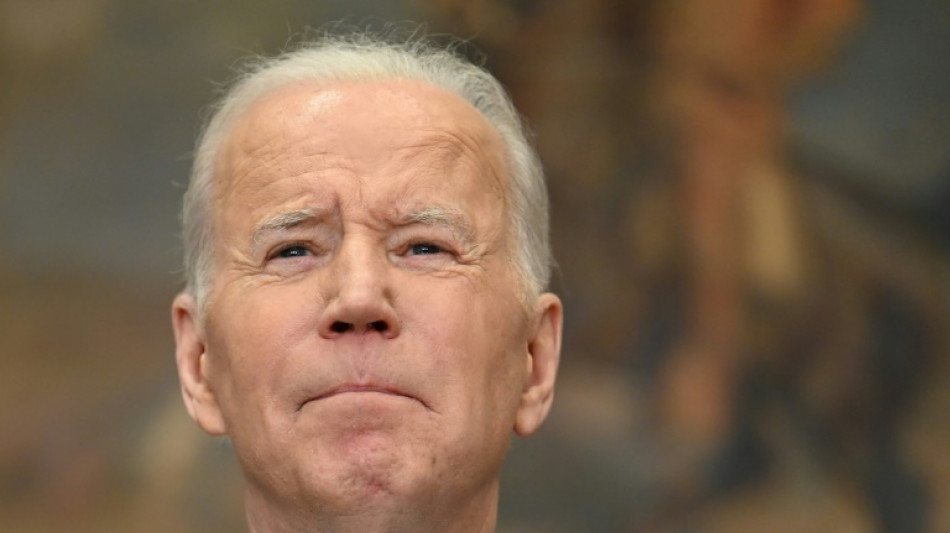
US, UK halt Russian oil imports over Ukraine invasion

 Nearly 13,000 displaced after deadly Indonesian quake

 Axe hangs over Australian batters after Darwin 'disaster'

 Is this cave in Turkey where Homer wrote 'The Odyssey'?

 Winning back walls from gangs, artists fill El Salvador's towns with color

 Opening arguments expected in Tupac murder trial

 As machinery removes rubble, hopes for survivors from Colombian quake dwindle

 Trump says US scaling back military drills with South Korea

 Zambia's Hichilema takes early lead in reelection bid

 Sabalenka squeezes out a win on sixth match point in Cincinnati

 Duplantis dominant, Hunt hits four and Asher-Smith makes history

 Spanish soldier dies in Aragon wildfire

 PSG beaten by Lens in French Champions' Trophy

 Rybakina, Andreeva race into Cincinnati third round

 Amy Hunt bags fourth Euro gold as Britain win 4x100m mixed relay

 Spanish soldier dies in Aragon wildfire: regional leader

 Belgium's Pocognoli appointed new Scotland manager

 Marchand storms to second gold of European championships

 Kushner meets with Hamas in push to revive Gaza plan

 Villarreal battle back to earn draw at promoted Racing

 Odegaard says Arsenal 'want to win everything' after Community Shield success

 Arsenal rout Man City in Community Shield masterclass

 Southampton mocked over Spygate during Watford defeat

 Hamas expects meeting with Kushner as US pushes Gaza plan

 Farmers, helicopters help battle record Belgian wildfire

 Air support kicks in as record Belgian wildfire jumps in size

The United States and Britain announced Tuesday they are cutting off imports of Russian oil, in the most far-reaching action yet by Western allies to punish Moscow for invading Ukraine.
President Joe Biden announced the US embargo, part of a broader prohibition including Russian natural gas and coal, with US Democrats threatening legislation to force his hand, despite the likely impact on already soaring gas prices.
"Russian oil will no longer be acceptable at US ports and the American people will deal another powerful blow to (President Vladimir) Putin's war machine," Biden said, adding that the decision was taken "in close consultation" with allies.
"Ukraine will never be a victory for Putin," Biden vowed from the White House, minutes after Britain announced that Europe's second-largest economy would phase out Russian oil imports by the end of the year.
"Putin may be able to take a city, but he will never be able to hold the country."
The US ban has support from both parties in Washington, although economists have been divided on the effect of turning off the spigot, with oil prices already soaring above $120 a barrel.
Brent crude, the international benchmark, rose by more than five percent on Tuesday on news of Biden's imminent announcement.
US Speaker Nancy Pelosi told members on Sunday the House was exploring the ban, as well as ending trade relations with Russia and Belarus and pushing to curtail Moscow's access to the World Trade Organization.
But Biden -- initially reluctant but wary of appearing less tough than Congress on Putin -- intervened personally, according to several US media outlets, phoning Pelosi to ask her to drop the initiative.
Pelosi said in a letter to colleagues released after Biden's address that House Democrats would press ahead with a vote on the ban and other measures targeting the Russian economy before the end of the day.
- 'Dramatic increases' -
Secretary of State Antony Blinken revealed on Sunday that the administration and its allies were already in talks about whether to implement a ban.
"We are now in very active discussions with our European partners about banning the import of Russian oil to our countries while of course, at the same time, maintaining a steady global supply of oil," he told NBC.
But European Union nations, who are far more reliant on Russian energy than the United States, have declined to take similar action.
Russia accounts for eight percent of US imports of oil and petroleum products, which means the impact on the world's largest economy would be easier to bear.
The White House will nevertheless have to reassure voters already alarmed over spiraling gasoline prices, which are threatening Democrats' chances of holding on to Congress in November's midterm elections.
Americans are now paying an average of $4.17 per gallon, a 72 cent increase in just one month and the highest price at the pump since the global economic downturn of 2008.
"Bottom line is that the USA would feel some impact to the loss of supplies from Russia, but we are in a far better position than Europe," energy analyst Andy Lipow said.
US officials, seeking to offset the loss of Russian oil, reportedly traveled to Venezuela over the weekend to meet with the government of Nicolas Maduro.
The South American country was once a top source of US oil, but Washington halted imports in 2019 following sanctions on the country.
Congressional Democrats have pushed back on the idea, however, voicing reluctance to switch from one unsavory regime to another.
"We shouldn't be advancing other countries who don't share our values," Montana Senator Jon Tester told reporters.
In a Quinnipiac poll released before the White House announcement, 71 percent of respondents said they would support a ban on Russian oil even if it meant higher gas prices.
"The next step needs to be to work to get Europe to do the same thing, to wean themselves from Russian oil and gas," Republican Senator Ted Cruz, who recently introduced a bill to "restore American energy independence," told CNBC.
"And the way to do that is to have alternative sources, and the obvious alternative sources is the United States."
The British oil sanction does not apply to Russian natural gas, which accounts for some four percent of UK supply. But Business Secretary KwasiKwarteng said he was "exploring options to end this altogether".
A.Clark--AT