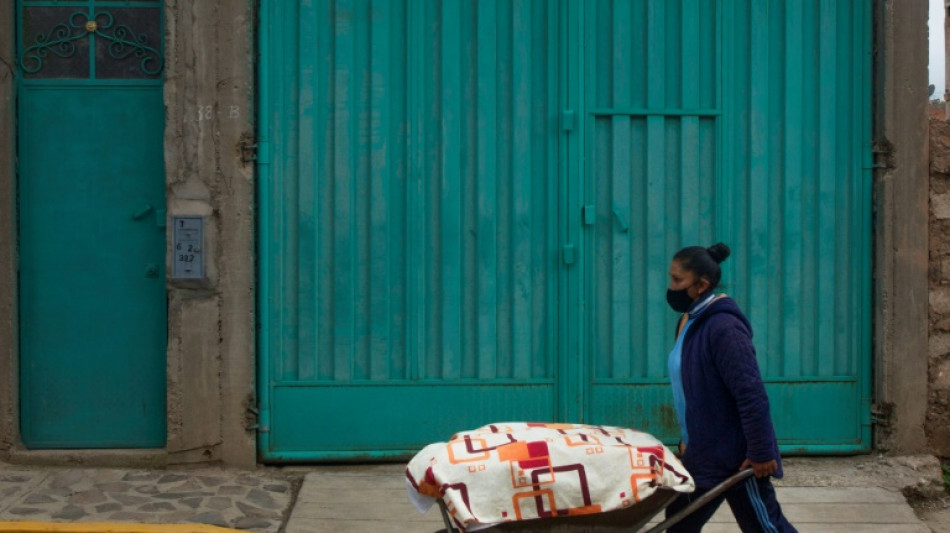
Unemployment, pay gap, instability the pandemic legacy for Peru's women

 Nearly 13,000 displaced after deadly Indonesian quake
 Axe hangs over Australian batters after Darwin 'disaster'

 Is this cave in Turkey where Homer wrote 'The Odyssey'?

 Winning back walls from gangs, artists fill El Salvador's towns with color
 Opening arguments expected in Tupac murder trial

 As machinery removes rubble, hopes for survivors from Colombian quake dwindle

 Trump says US scaling back military drills with South Korea

 Zambia's Hichilema takes early lead in reelection bid
 Sabalenka squeezes out a win on sixth match point in Cincinnati

 Duplantis dominant, Hunt hits four and Asher-Smith makes history

 Spanish soldier dies in Aragon wildfire

 PSG beaten by Lens in French Champions' Trophy

 Rybakina, Andreeva race into Cincinnati third round

 Amy Hunt bags fourth Euro gold as Britain win 4x100m mixed relay

 Spanish soldier dies in Aragon wildfire: regional leader

 Belgium's Pocognoli appointed new Scotland manager
 Marchand storms to second gold of European championships
 Kushner meets with Hamas in push to revive Gaza plan
 Villarreal battle back to earn draw at promoted Racing

 Odegaard says Arsenal 'want to win everything' after Community Shield success
 Arsenal rout Man City in Community Shield masterclass
 Southampton mocked over Spygate during Watford defeat

 Hamas expects meeting with Kushner as US pushes Gaza plan

 Farmers, helicopters help battle record Belgian wildfire

 Air support kicks in as record Belgian wildfire jumps in size

When the pandemic struck Peru and forced the economy to shut down in an attempt to stop the spread of the coronavirus, women were some of the hardest hit.
Silvia Munoz lost her job as a domestic worker, while Yolanda Chambi was forced to close her shop selling traditional Peruvian clothes.
Both were among millions of Peruvian women to lose their income during the pandemic, which exacerbated gender inequality.
Theirs is a story seen throughout Latin America on the eve of International Women's Day, where four million women remain unemployed even after regional economies have reopened.
When Covid struck, many women were forced to give up work to look after sick family members and children as schools and creches were closed as part of government restrictions.
And while most have since returned to work, many have had to accept lower salaries or even make do with working in the informal sector.
Once the virus reached Peru in March 2020, "there was no work, there was nothing," said Munoz, 65, speaking from her home in the working class Lima neighborhood of Villa Maria del Triunfo.
One thousand kilometers (620 miles) away in Puno on the shores of Lake Titicaca, Chambi tells a similar story.
"We lost all our earnings," she said.
She used to sell clothes to locals for the Virgen de la Candelaria festival that takes place on February 2 and involves traditional Andean music and dancing.
It has been canceled for the last two years due to Covid.
Unable to sell her wares, Chambi could no longer afford the rent on her home-cum-workshop.
She was forced to move with her four children to the family home in the countryside, where they grow potatoes, broad beans and other vegetables.
While many countries in the region paid out benefits to those that lost their jobs due to the pandemic, few people in Peru received such aid because 70 percent of the 33-million population works in the informal sector, and very few -- especially the poor -- have bank accounts.
- Gone back 10 years -
The International Labor Organization says women have been disproportionately affected by the pandemic.
The ILO says 24 million women in Latin America lost their jobs during the pandemic and as many men.
But while only half a million men remain out of work, eight times as many women do, "which contributes to amplifying the impact of the crisis on gender inequality at work."
Women's unemployment in the region is 12.4 percent, compared to just 8.3 percent for men.
After years of steady progress, "the pandemic has taken us back more or less to the figures from 10 years ago," Italo Cardnoa, the ILO chief for Peru, told AFP.
Sectors that traditionally employ a lot of women have been particularly hard-hit by the pandemic, such as hotels, restaurants, services and the informal sector.
"The return of women to the labor market is much slower than for men," said Cardona.
Daysi Falcon, 34, lost her job as an administrative assistant at a manufacturing company in March 2021.
She now sells prepared meals to acquaintances.
She says her family members were "dying one after another from Covid," and she spent months caring for them.
- 'I feel powerless' -
Many of those back in work have been forced to accept lower pay.
A few months ago, Munoz, who supports her ill husband, started working again four days a week -- but for 30 percent less pay than before.
Having previously earned $25 a day, she now receives $17.50.
"You have to accept it because behind me is someone who takes less," said Munoz.
"I feel powerless because you get older, you're not as strong as you used to be and when you're older still, there's no pension."
Chambi, who sells breakfasts by the roadside, is likewise pessimistic about the future.
"If the festival remains suspended, if our economy remains suspended, we will have no earnings," she said.
A.O.Scott--AT