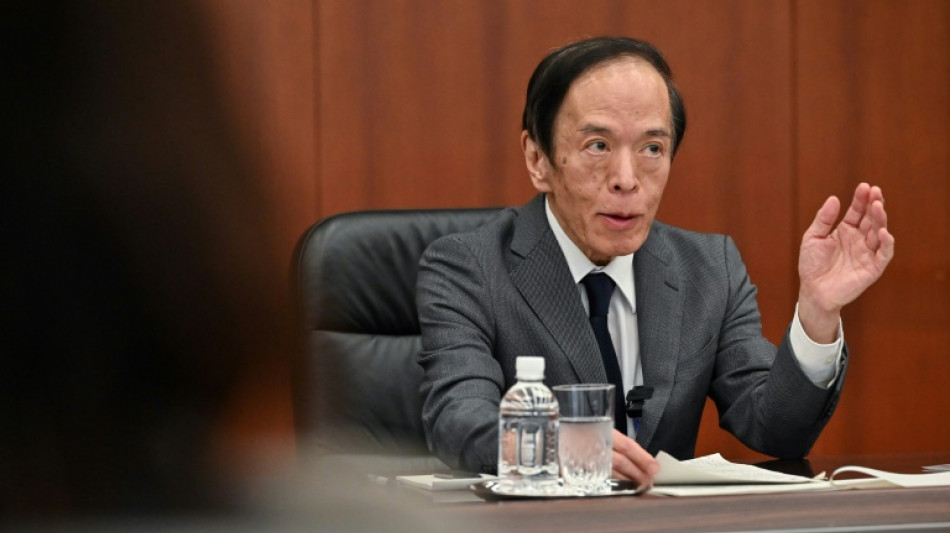
Japan central bank chief admits 'big gap' on women officials / Photo: Richard A. Brooks - AFP

 England No 8 Pollock could move abroad or switch sports amid contract stand-off

 Canada makes pitch as safe place to invest in 'uncertain world'

 In-form Malen fires Roma to Serie A summit

 IOC visits Lyon amid leadership turmoil for 2030 Winter Olympics

 New York seizes 12 celeb deep-fake porn sites

 Jesse Eisenberg channels emotional intensity into 'The Debut'

 Alarm over AI grows as divided US Congress struggles to act

 PopDEX Surpasses $61M TVL and $2B Trading Volume in Closed Beta

 Oasis announce new 2027 world tour

 Women athletes condemn 'sexualised' Sydney Sweeney commercial
 UN calls for 'urgent action' to rein in AI in face of 'unprecedented risks'

 Russia intensifies attacks seeking to intimidate Ukraine, Europe

 Richarlison not in Spurs League Cup squad: De Zerbi

 French defence group Thales calls on governments to regulate AI

 Three talking points from the Spanish Grand Prix

 Saudi football body vows action against Jota chants, Ronaldo urges life ban

 North Korea win 10-0 in Asian Games football mismatch

 Nigerian oil refinery Dangote launches IPO

 Houthis target Saudi base as Iran denies involvement in Yemen war

 Sweden faces political uncertainty after election thriller

 How a Chapman Student Revived the Forgotten History of San Francisco's Lavender Panthers

 Philippine Muslim enclave heads to polls after deadly shooting

 New coach won't use AI in bid to make South Korea fans happy

 J-VISIONS Vol. 4 Now Online: Read English Articles on Japanese Corporate IR

 In DR Congo streets, ex-hoods get tough on litter -- and locals
A "big gap" exists between female representation at Japan's central bank and its overseas counterparts, the bank's new governor Kazuo Ueda acknowledged Thursday.
Ueda took office last month, with some analysts arguing it was time for Japan to join Europe and the United States by naming a woman governor to succeed long-time chief Haruhiko Kuroda.
The 71-year-old economics professor secured the top job instead, along with two male deputy governors.
Ueda, speaking to AFP in an interview with several other media outlets, conceded the bank was behind some counterparts on gender representation.
At international meetings such as the G7, G20 and IMF "there has been a high percentage of women at the table with me", he said.
"There are women like (BoJ) executive director (Tokiko) Shimizu, but the number is still very low compared with foreign countries. There is a big gap."
The problem, however, extended far beyond the central bank.
"This is a reflection of Japanese society as a whole, not just the Bank of Japan. It cannot be changed by the Bank of Japan by itself overnight," Ueda said.
The bank was working to address the issue, including through recruiting, he said.
Its fiscal 2022 annual review said women were being targeted as recruits and made up more than 30 percent of new hires who will be candidates for senior jobs in the future.
Japan has a highly educated female labour force but women occupy few top jobs in business and politics.
The US Federal Reserve and the European Central Bank have both had female chiefs, although they remain relative outliers globally.
- Room for caution -
Ueda took office after a decade of ultra-loose monetary policy championed by Kuroda and is being closely watched for any sign he might move to finally raise rates in line with other central banks.
Kuroda argued Japan has yet to achieve its long-sought goal of sustained two percent inflation, seen as key to turbocharging the world's third-largest economy.
Inflation has hit double that figure this year but the bank argues that is the result of temporary factors such as the war in Ukraine, and the figure is likely to drop back below two percent in coming months.
Ueda has squelched any talk of sudden policy shifts, although he said there are signs of a shift in longstanding wage stagnation and past reluctance by companies to pass higher costs on to customers.
"Until recently, the feeling was that if others were not raising their prices and wages, you would not raise them either," he said.
"Now it has changed to I can raise mine and others are also doing the same. In the case of wages, we now see people having to increase because other companies are raising their wages."
He said there was still room for caution and the bank was waiting to see if the shifts will "continue in the future, and will they will spread and be sustained".
The bank announced last month a "broad-perspective" review of its easing, with a timeframe of 12-18 months.
There has been criticism of the market distortions created by the BoJ's policy, and also a perception that it has worked hand-in-glove with a government that has an interest in keeping rates low given its astronomical debt-to-GDP ratio.
But Ueda insisted the bank's policies were not driven by the government's spending plans or its finances.
N.Mitchell--AT