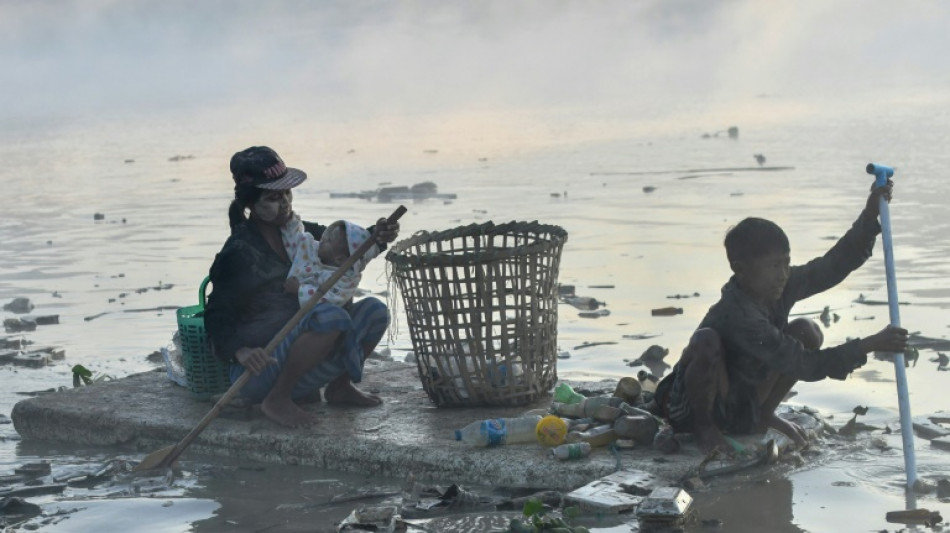
High-stakes talks to end plastic pollution resume / Photo: Sai Aung MAIN - AFP/File

 England No 8 Pollock could move abroad or switch sports amid contract stand-off
 Canada makes pitch as safe place to invest in 'uncertain world'
 In-form Malen fires Roma to Serie A summit
 IOC visits Lyon amid leadership turmoil for 2030 Winter Olympics

 New York seizes 12 celeb deep-fake porn sites

 Jesse Eisenberg channels emotional intensity into 'The Debut'
 Alarm over AI grows as divided US Congress struggles to act
 PopDEX Surpasses $61M TVL and $2B Trading Volume in Closed Beta
 Oasis announce new 2027 world tour
 Women athletes condemn 'sexualised' Sydney Sweeney commercial

 UN calls for 'urgent action' to rein in AI in face of 'unprecedented risks'

 Russia intensifies attacks seeking to intimidate Ukraine, Europe
 Richarlison not in Spurs League Cup squad: De Zerbi
 French defence group Thales calls on governments to regulate AI

 Three talking points from the Spanish Grand Prix

 Saudi football body vows action against Jota chants, Ronaldo urges life ban

 North Korea win 10-0 in Asian Games football mismatch

 Nigerian oil refinery Dangote launches IPO
 Houthis target Saudi base as Iran denies involvement in Yemen war

 Sweden faces political uncertainty after election thriller

 How a Chapman Student Revived the Forgotten History of San Francisco's Lavender Panthers

 Philippine Muslim enclave heads to polls after deadly shooting
 New coach won't use AI in bid to make South Korea fans happy

 J-VISIONS Vol. 4 Now Online: Read English Articles on Japanese Corporate IR

 In DR Congo streets, ex-hoods get tough on litter -- and locals
Negotiations on a global treaty to combat plastic pollution will resume Monday, with nations under pressure to stem the tide of trash amid calls from campaigners to limit industry influence on the talks.
Some 175 nations pledged last year to agree by 2024 a binding deal to end the pollution from largely fossil fuel-based plastics that is choking the environment and infiltrating the bodies of humans and animals.
The May 29-June 2 talks in Paris are tasked with agreeing the first outline for actions that could form the basis of a draft negotiating text.
A global ban on single-use plastic items and "polluter pays" schemes are among the measures under discussion.
Last month wealthy G7 nations -- United States, Japan, Germany, France, United Kingdom, Italy and Canada -- committed to zero plastic pollution by 2040.
They said it was an attainable goal thanks to the rise of the circular economy and the possibility of reducing or banning single-use plastics and non-recyclables.
Campaigners are pushing for the talks to go further and focus on cutting the amount of plastic that gets made in the first place.
Plastic production has doubled in 20 years. It wraps food, is woven into clothes and the fabric of buildings, and is an important material for disposable medical products.
In 2019, a total of 460 million tonnes (Mt) of the stuff was made, according to the Organisation for Economic Co-operation and Development (OECD), which predicted production could triple again by 2060 without action.
- 'Once-in-a-generation' -
Around two-thirds of plastic waste is discarded after being used only once or a few times, and less than 10 percent is recycled.
Millions of tonnes of plastic waste are dumped in the environment or improperly burned, polluting the air. Over time, it breaks down into tiny fragments that have been found everywhere from mountain tops and the deepest sea trenches, to inside human blood streams and placentas.
In a report published in mid-May, the United Nations Environment Programme (UNEP) called for systemic change to wean societies off throwaway consumerism by significantly scaling up reuse and recycling, while promoting alternative materials.
It said this would help slash annual plastic pollution 80 percent by 2040 overall and cut single-use plastic production by half.
But campaigners want a greater focus on slashing production.
The treaty is a "once-in-a-generation opportunity to solve the plastics crisis", said Louise Edge, Global Plastics Campaigner for Greenpeace UK, in an open letter this week raising concerns about industry influence in the negotiations.
"Whether it succeeds or fails depends on whether governments are bold enough to ensure that the treaty delivers what the science says is needed - a cap and phase down of plastic production."
- Ambitions -
Reduction of plastic use and production is at the top of a plan devised by a "High Ambition" coalition of 53 countries, led by Rwanda and Norway and including the European Union, Canada and Mexico.
Other nations are pushing instead for a reliance on recycling, innovation and better waste management.
As in the UN negotiations on climate and biodiversity, financing is a key point of tension.
Rich economies have historically polluted more -- and for years exported trash for recycling to poorer nations, where it often winds up in the environment.
Some developing nations are concerned about rules that might place too great a burden on their economies.
The binding nature of the treaty is also still in question.
The United States, for example, wants to limit the legal scope of the agreement, leaving signatories free to develop solutions in national plans, said a spokesperson from the French foreign office.
Celebrities such as Jane Fonda and Joaquin Phoenix joined Greenpeace USA in mid-May to call on US President Joe Biden to raise his ambitions.
- Fossil fuels -
The Paris talks follow an opening round of technical discussions in November in Uruguay and mark the second of five stages of negotiations expected to lead to a historic agreement covering the entire life cycle of plastics.
Host country France plans a political summit on Saturday, with some 40 environment ministers and diplomats, to present recommendations by the EU -- one of the world's main consumers of plastic.
Meanwhile, activists have raised fears over the involvement in the process of the plastics industry, even as many professional and scientific observers are unable to attend due to a lack of space.
Around 175 campaign groups signed a Greenpeace letter to UNEP this week to express concern over "the role that the fossil fuel and petrochemical industries and their lobbyists are having on the negotiations".
A spokesperson from the treaty secretariat told AFP that the original UN resolution on the negotiations decided that they "are open for participation of all relevant stakeholders".
They added that a full list of attendees would be provided only after Monday's meeting.
A.Clark--AT