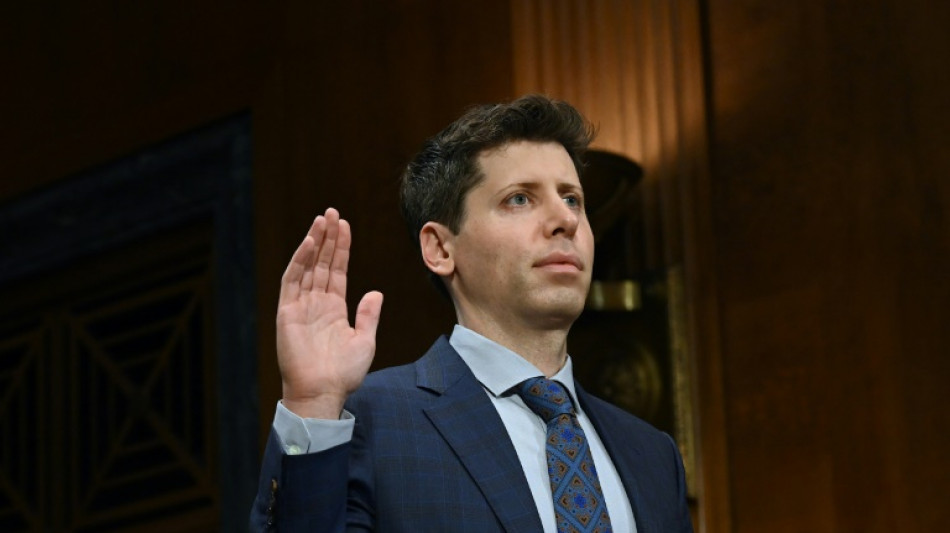
ChatGPT's Altman pleads US Senate for AI rules / Photo: ANDREW CABALLERO-REYNOLDS - AFP

 Qatar Chamber and Maltese envoy consider business forum
 Spanish PM denies being blackmailed by Morocco

 Doha Islamic finance forum names AlRayan firms as co-lead partners

 Leeds thrash Newcastle to go third in the Premier League

 Zelensky says Ukraine ready for 'de-escalatory steps'

 In-form Malen fires Roma to Serie A summit, Inter on their heels
 Lebanese agency reports Israeli shelling and gunfire in south
 Expert proposes phased digital reform for Arab business schools

 Trump rejects 'hoax' warnings that AI could destroy humanity

 Houthis say Saudi Arabia hits Yemen with 54 strikes after attack on bases

 Why the far right is losing ground in Sweden

 Ex-Ireland fly-half O'Gara extends deal as La Rochelle coach

 Russian attacks on Ukraine railways escalating every week: rail CEO to AFP

 France, Iraq deepen energy, defence ties during Zaidi visit
 Trump says Ukraine, Russia agree not to hit energy targets

 Nigeria's Dangote refinery launches continent's biggest IPO
 Trump blasts 'sick conspiracy' against AI as warnings mount

 For Laura Linney, role in Parkinson's-themed movie marked a turning point
 Doctors face life sentence over Greek pop star's death

 Trump moves to axe power plant climate rules

 Slow the AI race? Investors weigh the potential cost
 Philippine Muslim enclave votes for parliament after deadly shooting

 Germany seeks guarantees from Italy's UniCredit over Commerzbank takeover

 Liverpool will have to accept 'ups and downs', says Iraola

 Inaugural Ultimate a hit with the athletes, says Coe

Sam Altman, the chief executive of ChatGPT's OpenAI, told US lawmakers on Tuesday that regulating artificial intelligence was essential, after his poem-writing chatbot stunned the world.
The lawmakers stressed their deepest fears of AI's developments, with a leading senator opening the hearing on Capitol Hill with a computer-generated voice -- which sounded remarkably similar to his own -- reading a text written by the bot.
"If you were listening from home, you might have thought that voice was mine and the words from me, but in fact, that voice was not mine," said Senator Richard Blumenthal.
Artificial intelligence technologies "are more than just research experiments. They are no longer fantasies of science fiction, they are real and present," said Blumenthal, a Democrat.
The latest figure to erupt from Silicon Valley, Altman's testimony in front of a US Senate judiciary subcommittee was far from the testy grilling given to the bosses of Facebook or TikTok when they visited Washington.
"If this technology goes wrong, it can go quite wrong,” Altman said.
Tipped as an opportunity to educate lawmakers, Altman used the session to urge Congress to impose new rules on big tech, despite deep political divisions that for years have blocked legislation aimed at regulating the internet.
But governments worldwide are under pressure to move quickly after the release of ChatGPT, a bot that can churn out human-like content in an instant, went viral and both wowed and spooked users.
Altman has since become the global face of AI as he both pushes out his company's technology, including to Microsoft and scores of other companies, and warns that the work could have nefarious effects on society.
"OpenAI was founded on the belief that artificial intelligence has the potential to improve nearly every aspect of our lives, but also that it creates serious risks," Altman told the hearing.
He insisted that in time, generative AI developed by OpenAI will "address some of humanity's biggest challenges, like climate change and curing cancer."
However, given concerns about disinformation, job security and other hazards, "we think that regulatory intervention by governments will be critical to mitigate the risks of increasingly powerful models," he said.
- Go 'global' -
Altman suggested the US government might consider a combination of licensing and testing requirements before the release of powerful AI models, with a power to revoke permits if rules were broken.
He also recommended labeling and increased global coordination in setting up rules over the technology as well as the creation of a dedicated US agency to handle artificial intelligence.
"I think the US should lead here and do things first, but to be effective we do need something global," he added.
Blumenthal underlined that Europe had already advanced considerably with its AI Act that is set to go to a vote next month at the European Parliament.
A sprawling legislative text, the EU measure could see bans on biometric surveillance, emotion recognition and certain policing AI systems.
Crucially for OpenAI, US lawmakers underlined that it also seeks to put generative AI systems such as ChatGPT and DALL-E in a category requiring special transparency measures, such as notifications to users that the output was made by a machine.
OpenAI's DALL-E last year sparked an online rush to create lookalike Van Goghs and has made it possible to generate illustrations and graphics with a simple request.
Lawmakers also heard warnings that the technology was still in its early stages.
"There are more genies yet to come for more bottles," said New York University professor emeritus Gary Marcus, another panelist.
"We don't have machines that can really... improve themselves. We don't have machines that have self-awareness, and we might not ever want to go there," he said.
Christina Montgomery, chief privacy and trust officer at IBM, urged lawmakers against being too broad stroked in setting up rules on AI.
"A chatbot that can share restaurant recommendations or draft an email has different impacts on society than a system that supports decisions on credit, housing, or employment," she said.
A.Clark--AT