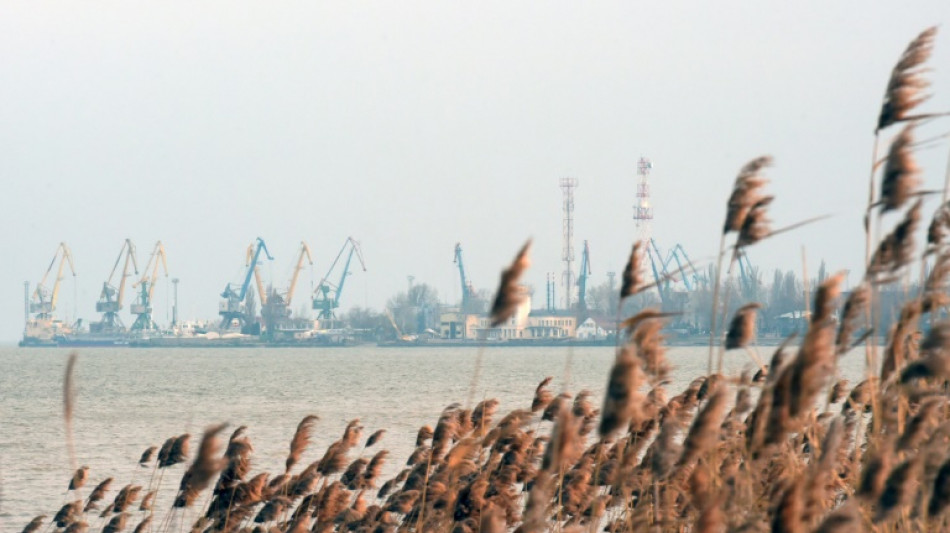
The Azov Sea, symbolic prize of Russia-Ukraine war

 As machinery removes rubble, hopes for survivors from Colombian quake dwindle

 Trump says US scaling back military drills with South Korea

 Zambia's Hichilema takes early lead in reelection bid
 Sabalenka squeezes out a win on sixth match point in Cincinnati

 Duplantis dominant, Hunt hits four and Asher-Smith makes history

 Spanish soldier dies in Aragon wildfire

 PSG beaten by Lens in French Champions' Trophy

 Rybakina, Andreeva race into Cincinnati third round

 Amy Hunt bags fourth Euro gold as Britain win 4x100m mixed relay

 Spanish soldier dies in Aragon wildfire: regional leader
 Belgium's Pocognoli appointed new Scotland manager

 Marchand storms to second gold of European championships
 Kushner meets with Hamas in push to revive Gaza plan
 Villarreal battle back to earn draw at promoted Racing

 Odegaard says Arsenal 'want to win everything' after Community Shield success

 Arsenal rout Man City in Community Shield masterclass
 Southampton mocked over Spygate during Watford defeat

 Hamas expects meeting with Kushner as US pushes Gaza plan
 Farmers, helicopters help battle record Belgian wildfire

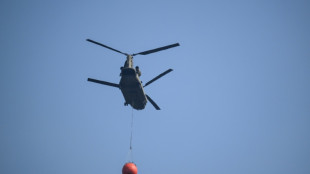 Air support kicks in as record Belgian wildfire jumps in size
 Firefighters battle second day of blaze on Greek island
 Strikes kill 12 in Russia and Ukraine

 India's Sindhu backs monkey measures as badminton worlds set to open
 Mass drone attack on Moscow as Russian strikes kill three in Ukraine

 Djokovic feels the heat in Cincinnati defeat, Zverev wins all-nighter
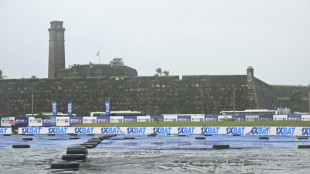
In the mist and pouring rain, the usually bustling port of Taganrog in south-west Russia has come to a standstill. The Azov Sea, usually calm, has become a symbolic prize in Russia's war in Ukraine.
A single crane moves slowly over a huge pile of coal, most likely from the nearby Donbas mining region. The port has been shuttered by the authorities, as have most airports in this area close to the border with Ukraine.
Military helicopters and planes fly low over the region, heading towards the frontier, which is now blocked.
From the border can be heard the faraway explosions from Mariupol, the main port in south-east Ukraine, whose half-million inhabitants are now under siege by Russian forces.
Since the start of the Russia invasion last Thursday, Mariupol has been a target. What happens on the edge of this shallow sea, which can freeze in winter, is vital to the war.
From Russia, Mariupol stands on the route between the Russian-annexed peninsula of Crimea to the west, and the forces of the self-proclaimed pro-Russian separatist republic of Donetsk to the east.
Russian troops have now blockaded Mariupol and it has lost electricity.
If Moscow manages to take Mariupol and the surrounding territory, it will win control over the Azov Sea, which opens into the Black Sea, as it becomes entirely encircled by Russia.
- Territorial continuity -
"In reality, Russia already controls this (Azov) sea as it controls the only entry point -- the Kerch Strait," said Igor Delanoe, deputy director of the Franco-Russian Observatory in Moscow.
But since 2014, when Russia annexed Crimea, it has been pursuing the theory of "territorial continuity", seeking to link up the Black Sea peninsula with the separatist territories in the east of Ukraine, which Moscow recently recognised as independent, he added.
Russia built a bridge spanning the Kerch Strait in May 2018, physically linking the Crimean peninsula to Russia and thus encircling the Azov Sea.
Since then, tensions have only increased.
At the end of 2018, the Russian navy opened fire on and then captured three Ukraine military vessels trying to reach Mariupol via the Kerch Strait.
NATO has demanded in vain that Russia guarantee freedom of passage to Ukrainian ports through the Azov Sea.
Such requests over a sea Moscow considers its own -- as well as the presence of NATO ships in the Black Sea -- have only angered Russia.
Yet if Russia already in practice controls the Azov Sea, why does it need to control the Ukrainian territory bordering it?
"These are symbols," said political analyst Alexei Malashenko of the Dialogue of Civilizations Research Institute.
"Everything that happens now has a symbolic meaning. There is less and less of a rationale.
"The objective is to show that Russia is a great power. Ukraine is the last place where it is possible to demonstrate that."
If Russia manages to take control of the Azov Sea, "it will not be accountable to anyone, it can place anything there -- nuclear submarines, for example", he added.
For now, both the local and global economies are suffering from the situation in the Azov Sea.
Up until 2017, when the last available data was available -- three years after the annexation of Crimea -- the port of Taganrog said more than a quarter of its exports went to Ukraine, the source of more than half of its imports.
According to a statement Monday from the Russian naval authorities, more than 40 ships are waiting to enter the Azov Sea.
Across all Russia's ports in the sea, almost 170 ships are stranded, some with cargoes of grain -- causing a knock-on effect on global wheat prices as Ukraine and the south-west of Russia are both major producers.
"Navigation is temporarily suspended pending further notice," said the Russia naval authorities, citing "the implementation of anti-terrorist measures in the waters of the Azov Sea".
T.Wright--AT