How Russia will benefit from fresh oil production cuts / Photo: Patricio ARANA - AFP

 British PM says to make 'difficult decisions' as inflation rises

 TotalEnergies pumps up controversy in France with cut-price gas

 Global fuel price demos: a round-up

 Leverate Launches MCP for Traders to Connect AI Assistants With Trading Platforms

 MEXC Launches $1M "Discover Your Wall Street DNA" Campaign to Help Traders Find Their Market Fit

 Emporio Armani names Dario Vitale new creative director
 Maresca defends VAR officials after Man City benefit from error

 Courts jails LGBTQ activists as Turkey crackdown widens

 French court to hear Depardieu's appeal against rape trial order: sources

 The German state premier hoping to halt far-right surge
 Lebanon wants Israel security deal as prelude to peace: president to AFP

 England's Brook keen to learn from 'hero' Pietersen after stunning ton
 Saudi says Houthis target Mecca, warns of 'red line'

 Phillippines ex-leader Duterte makes first appearance at ICC
 Lebanon wants Israel security deal, Hezbollah disarmament without confrontation: president to AFP
 BASIS.pro Expands On-Chain Infrastructure with XDC Network Partnership and Zypher DAO as Auto Earn Goes Live

 Samson relishing battle with teen star Sooryavanshi for India spot
 Pickle-flavoured tart? AI inspires Japan's convenience stores
 Macau holds first closed-door national security trial
 Bank of Japan set to raise rates under pressure from inflation, US

 Zverev, Shelton back on court for Davis Cup qualifiers
 Peace is a 'dangerous' word in Russian city heading to polls
 Meta chief pushes back on AI slowdown calls

 'Resident Evil' film brings video game's ethos to the big screen
 Court orders N. Korea pay Seoul $32.5 mn for blowing up office
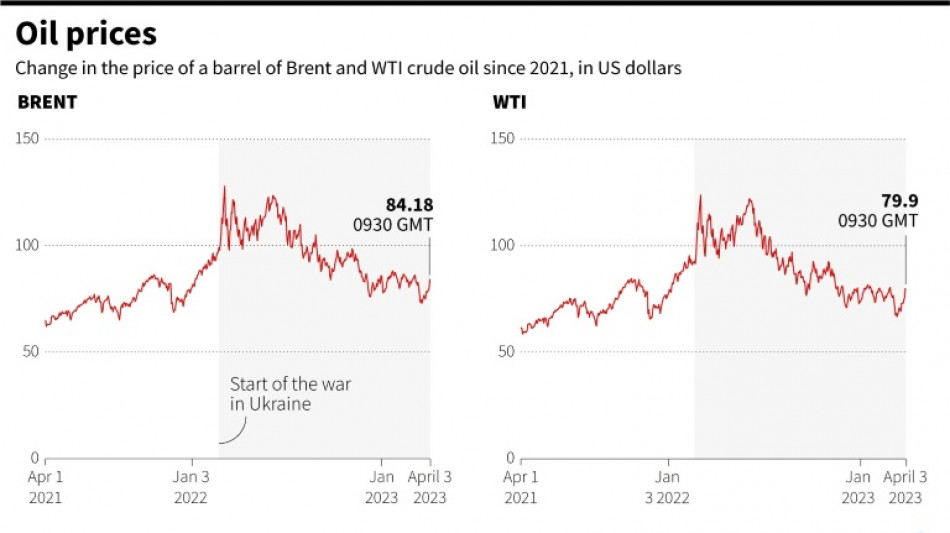
The shock announcement by several OPEC+ members to voluntarily cut their oil production by more than a million barrels per day from May has sent world oil prices soaring, in a move widely seen as the tightening of the bond between Russia and Saudi Arabia.
This is what you need to know about Sunday's decision by some members of the Organization of the Petroleum Exporting Countries (OPEC) and their allies:
- Why cut oil production further? -
Independent of the broader OPEC+ output policy, eight members of the bloc led by heavyweight Saudi Arabia announced they would cut a further 1.16 million barrels per day of production until the end of the year.
It came on top of a decision from Russia -- also an OPEC+ member -- to extend a cut of 500,000 barrels per day.
Unlike two previous cuts, several members preferred to act independently on Sunday, without going through the formal framework of the alliance that requires the agreement of the 13 countries of the OPEC cartel and its 11 partners (OPEC+).
"What we are witnessing is an adaptive and agile OPEC+ group which is able and willing to act ahead of the curve," SEB analyst Bjarne Schieldrop said, of the surprise move.
Established in 1960, Vienna-based OPEC aims to "coordinate and unify petroleum policies" of its members to ensure "fair and stable prices for producers".
To form the OPEC+ alliance, the organisation in 2016 included non-OPEC oil-producing countries led by Russia.
Oil prices have suffered greatly from the recent banking crisis in the United States and Europe, with fears of a global recession resurfacing and investors shifting away from riskier assets such as commodities.
"To the dismay of global leaders, OPEC has decided to draw a hard line at Brent $80 per barrel for self-serving economic interests," said SPI AM analyst Stephen Innes.
- How will Moscow profit from the decision? -
The rise in crude oil prices particularly benefits Russia, which "needs oil-money for its expensive war in Ukraine", said Schieldrop.
The cuts "will tighten up the oil market and thus help Russia to secure better prices for the crude oil it sells", he added.
Targeted by numerous Western sanctions over its invasion of Ukraine, Russia has seen its revenues from crude exports capped and the markets where it can sell limited.
According to Schieldrop, the new cuts also confirm "that Russia is still an integral and important part of the group".
The consequences of Sunday's decision are all the greater because, unlike the cuts previously made by the group at the height of the pandemic or last October, "the momentum for global oil demand is up, not down" with a strong recovery of China expected, said Innes.
Prices were immediately impacted by the decision, with the two global crude references jumping by about eight percent in early Monday trading.
The surprise reduction further consolidates the Saudi-Russian marriage of convenience, by aligning their production levels, thus placing them on equal footing.
- A slap in the face for Washington? -
Despite calls from the United States to raise production as consumption rises, the announced cuts represent "a provocation for the oil consuming nations, which are struggling with increasing interest rates and high inflation numbers," DNB analysts said.
For Finalto analyst Neil Wilson, they also signal a new era, in which "the Saudis are not afraid of the US" as OPEC "leverage" is on Riyadh's side.
"The Saudis are doing what they need to do and the White House has no say," he noted, adding that "a recasting of regional and global dynamics" has been set in motion.
"OPEC+ has sent a firm signal that... it does not see shale oil production growth as a threat to its market share," DNB analysts said.
With US shale oil production growth muted, production cuts by the alliance will not lead to any market share losses.
While "more political wrangling between US and OPEC is likely", the Biden administration won't use "the SPR (strategic petroleum reserve) inventories to counter the OPEC cuts", DNB analysts added.
T.Wright--AT