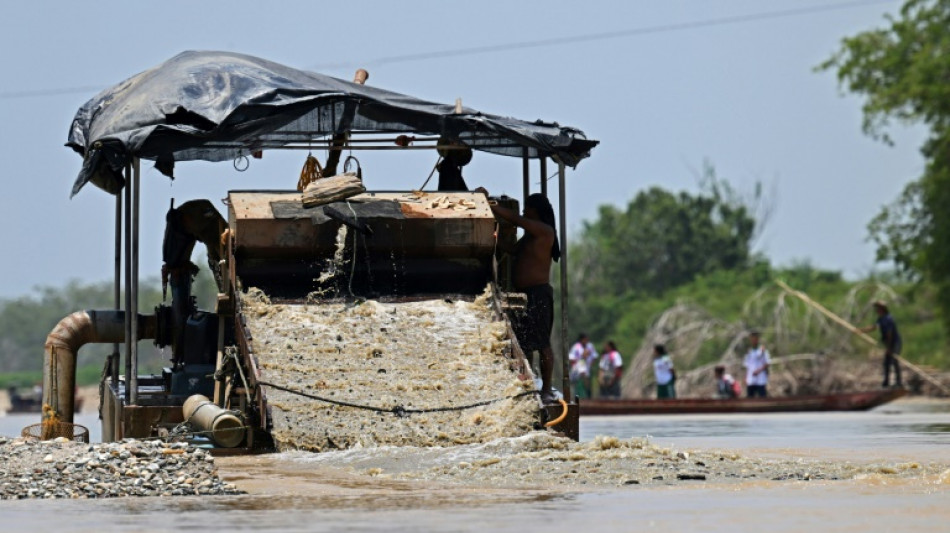
Battle in Colombia over river-wrecking gold 'dragons' / Photo: Raul ARBOLEDA - AFP

 US House targets data centers as midterm backlash grows

 French ex-minister Dati goes on trial in Renault-Nissan corruption case

 'Being Heumann' captures joy in fight for disability rights

 Retired great Nadal to play in exhibition matches

 IR-MED and Dice Technologies Announce collaboration to Evaluate and Advance Pressure-Injury Prevention Platform in Japan

 Watts, Pitt, Cruz to light up Spain's top film festival

 Sweden expels Iran embassy employee over anti-Jewish threats
 Toogood Gold's Table Mountain Sits in the Shadow of a Nevada Gold Rush

 MEXC July–August Security Report: 38.66M USDT in Risk Funds Intercepted, Futures Insurance Fund Hits 792M USDT

 'Breathing toxin every day': Indonesians choked by haze feel helpless

 Stocks edge higher ahead of US Fed rate call

 Philippines ex-leader Duterte makes first in-person ICC appearance

 2027 Formula One calendar includes Monaco sprint race

 Palestinians are the real victims, Thunberg tells Ed Sheeran

 Hashim Thaci: From 'George Washington of Kosovo' to Hague convict

 Amnesty says Iran committed 'crimes against humanity' in crackdown on 2022 protests

 EU to ban social media for under 13s, curb access until 15

 Philippines ex-leader Duterte makes first appearance at ICC

 EU chief pitches 'associate member' status for Canada

 English village votes to 'secede' from UK over asylum centre plan

 Wildfires push endangered Sumatran elephants to brink: Indonesian NGO

 Stocks head higher as traders prepare for Fed decision

 English village votes to 'secede' from UK over asylum centre

 Hong Kong unveils plan to align economy with China's goals

 Brazilian voters the latest to eye Bukele security model with envy

The giant skeletons of burnt and dismantled gold dredgers litter the rivers of northwest Colombia, where the government is waging a full-out war on illegal mining.
Nicknamed "dragons" by locals, the massive machines used to suck gold from riverbeds are blamed for destroying the environment and financing organized crime.
But their dismantling in a massive army operation has been met with hostility by communities who depend on mining for their daily survival.
Around El Bagre in the gold-rich Bajo Cauca region, a protest by miners that started early this month has been marked by acts of vandalism the government blamed on the Gulf Clan drug cartel for instigating.
But Luis Manuel Campo, 32, one of the miners, insisted to AFP that "we have nothing to do with criminal groups."
Campo co-owns a dredger with three other people.
"We are not hiding. We just want the persecution to stop," he said.
"We want to be formally recognized as miners so that we can work in peace, without stigma."
- New gold rush -
The names of the villages in this region such as Zaragoza and Caceres serve as a reminder of the Spanish colonizers who were already extracting gold in Bajo Cauca in the 17th century.
It became a bastion of rightwing paramilitary fighters in the 1990s, and is now a stronghold of the Gulf Clan, Colombia's most powerful cartel.
President Gustavo Petro this month called off a ceasefire with the Clan, accusing it of being behind attacks on civilians committed by protesting miners.
Criminal groups in Colombia make almost as much money from illegal mining as they do from trafficking cocaine, authorities say.
With a recent rise in gold prices, Bajo Cauca has been gripped by a new type of gold rush, with poor communities scouring the gravelly river beds with shovels, bulldozers and dredging machines.
"Apart from gold, there is nothing here," said Campo.
Locals say about 350 dredging machines are active in the region -- big and small -- on top of those operated legally by the Mineros Aluvial multinational.
- 'Profitable' -
The illegal dredgers range from simple machines with makeshift conveyer belts to larger mechanical contraptions that require several divers to guide a massive vacuum pipe under the dark water.
Then there are the "dragons" -- three-storey, 20-meter (66-foot) long boats with massive engines.
There are about two dozen of these in the Bajo Cauca region.
One "dragon" costs about half a million dollars, their owners tell AFP.
"At the current (gold) price, it is profitable," said Alex Cossio, 41, who runs one of these monsters.
One "dragon" can extract up to two kilograms (4.4 pounds) of gold per day -- worth more than $50,000, according to a police official who did not want to be named.
AFP visited a number of these beasts, including one named "Native" that has been operational for only two months in a branch of the Nechi river.
"The (army) helicopters fly over us every day, we are afraid," said Cossio, who insisted there was no link to organized crime.
"Diesel, food, logistics... We buy everything in the neighborhood, a large number of families live from our activity," he added.
AFP observed at least six "dragons" lying mutilated and burnt by the riverside, some already being repaired by their owners.
There is no official data on how many dredgers have been destroyed.
"We tried to stop them, it was terrible," said Julia Tatis, who owns a small eatery, of a raid this month on three of the machines in Nueva Esperanza, a poor hamlet on the water's edge.
"The military just arrived saying we are the Gulf Clan. And they burned everything," added dredge owner Juan Manuel Carcamo.
- Damage 'already done' -
Campo insists the dredges are working river beds "that were already exploited by Mineros 40 years ago... The damage has already been done."
Lawyer Francisco Arrieta Franco is an advocate for the miners who he describes as victims.
"It is false to say the dredges belong to the Clan," he told AFP.
"It's complicated and expensive to operate a dredger. Criminals are more interested in extortion, which is everywhere in this region."
Locals say the miners are subject to Gulf extortion rather than perpetrators of it.
In a gold shop in El Bagre, an employee warned of trouble if the government continues to "harass" the miners.
"We need these dredgers to work and to eat," shouted the employee, who did not want to be named. "They serve the whole community!"
Added a miner, also on condition of anonymity: "It is when you have an empty stomach that you are forced to do illegal things."
W.Moreno--AT