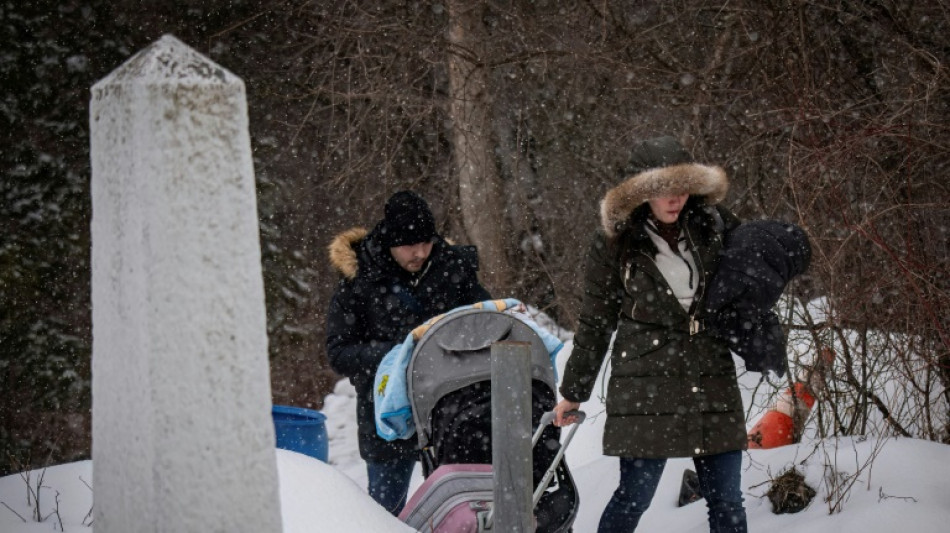
From Colombia or Haiti, migrants' long road ends in Canada / Photo: Sebastien ST-JEAN - AFP

 Trump threatens EU over 'hostile' Canada association plan

 Argentine judge orders suspension of Falklands oil project

 Carrick takes the blame as troubled Man Utd suffer League Cup misery

 Barcelona hit seven in Racing Santander rout

 Amorim's Milan beaten by Benfica, Sunderland make dream European return

 US stocks fall, dollar gains after Fed lifts interest rates
 Seahawks rule out Darnold for Sunday game at Arizona

 Mbappe explains Ceuta shirt stance after criticism

 Improving Atletico cruise to comfortable win over Osasuna

 Candidate for UN chief calls for AI regulation akin to nuclear weapons

 O'Neill expects Celtic recovery after Old Firm misery

 Man City midfield trio backed to emulate Rodri and Silva

 'We're losing control,' AI pioneer Yoshua Bengio tells AFP
 WHO eyes 'encouraging' signs in DRCongo fight against Ebola
 Liga boss criticises Real Madrid trio for Ceuta shirt incident

 WTA Finals moved to Charlotte from 2027

 Almost 8,000 excess deaths in France's scorched summer: statistics

 Ex-president's lengthy war crimes sentence shocks Kosovo

 US House faces test on sweeping Russia sanctions bill

 British PM says to make 'difficult decisions' as inflation rises

 TotalEnergies pumps up controversy in France with cut-price gas

 Global fuel price demos: a round-up

 Leverate Launches MCP for Traders to Connect AI Assistants With Trading Platforms

 MEXC Launches $1M "Discover Your Wall Street DNA" Campaign to Help Traders Find Their Market Fit
 Emporio Armani names Dario Vitale new creative director

For exhausted migrants, a small stretch of snow-covered road is the last step in a long journey to a new life in Canada. Some drag heavy suitcases, others carry all their worldly belongings in small plastic bags.
In a hurry to get into their new country, Haitians, Venezuelans, Colombians and Turks hasten their pace as they step out of a car with their heads down to finally cross the last border of their journey: one separating Canada and the United States, between New York state and Montreal.
"Stop! Passing here is illegal, if you do you will be arrested," a Canadian police officer repeats to migrants who arrive in clusters throughout the day and night at what is known as the Roxham Road crossing point.
Among the latest ones to arrive under a heavy snowfall, some don't have winter coats or boots, only light clothes and sneakers. Mothers carrying children or stuffed animals struggle to push strollers through the deep snow.
Only the children are smiling, looking fascinated to see snow for the first time.
A small backpack flung over his shoulder, Makenzy Dorgeville says he is very happy to have finally arrived in Canada after fleeing violence in Haiti and spending years on the road. He describes his trip as an obstacle course, listing 10 countries he crossed in South and Central America to eventually get here.
The 40-year-old with a slight build knows that even if his asylum bid is rejected, Canada does not deport Haitians.
As they cross the border, NGO volunteers give migrants coats, gloves and hats as well as words of encouragement. "We just want them to know that there's people who support the journey that they're going through in their search to find a place to live in safety," says Bridges Not Borders volunteer Frances Ravensbergen.
After being checked and registered by police, the migrants are taken to the nearest official border post to file an asylum claim -- between 50 and 60 percent of applications are approved.
- Growing insecurity -
After a few months, generally they obtain a work permit and children go to school. Migrants become eligible for health care and other social benefits and are put up in refugee centers or hotels paid for by the government while their application is being processed.
Since pandemic restrictions were lifted and the borders reopened, migratory flows have intensified all over the world.
Roxham Road is now a known crossing point and social media are full of videos explaining how to get there, how much it costs to get from the nearest bus station in Plattsburgh, New York to the border.
In 2022, nearly 40,000 people arrived in Canada by this route, twice as many as in 2017, which was the previous record year, according to Canadian immigration data. And they've been undeterred even by the bone-chilling cold of Canadian winters, with more than 5,000 arriving in January alone.
This irregular migration is somewhat new for Canada, which is difficult to reach due to its relative geographic isolation and very strict visa policy.
"It is, among other things, the speed of the system in Canada that attracts people here, compared to the United States. On the American side, it can take five to six years or more compared to about two years in Canada," explains Stephanie Valois, president of the Quebec Association of Immigration Lawyers, referring to how long it takes to process an asylum request.
Calls are growing to close Roxham Road, but she notes that to "seek safety people are ready for anything" and that Canada has a responsibility. "Asylum seekers cross the Darien, so it's not the border that will stop them," she says.
That notorious patch of jungle between Colombia and Panama "is very difficult physically with mountains, lots of mud, and then criminal groups who arrest migrants and rob them," she says.
"The people who have been through there are left shaken. My clients tell me horror stories, the women have been raped, the men beaten, they have lost everything and many die," says the lawyer, who has dedicated her life to defending asylum seekers.
- 'If you fall, you're going to die' -
That part of the trip remains traumatizing for Eli, a Haitian migrant who recently arrived and spoke with AFP in Montreal (at her request AFP is not using her real name).
"The jungle is the worst," confides the young woman with long braids and large hoop earrings, who rarely loses her smile. "I saw a lot of bodies, dead people on the road. One night, we had to sleep next to corpses," continued the 29-year-old woman who came to Canada with her two-year-old daughter.
The narrow road, the cliffs, the wild animals, "you know that if you fall, you're going to die," she adds.
The influx of asylum seekers, particularly via Roxham Road, is expected to be a topic of discussion between President Joe Biden and Canadian Prime Minister Justin Trudeau during the American leader's March 23-34 visit to Ottawa.
In Canada, which is unaccustomed to this type of talk, anti-migrant rhetoric is growing.
More and more voices are calling for the renegotiation of a Canada-US treaty which stipulates that migrants who wish to apply for asylum must do so in the first country in which they land after leaving home.
M.White--AT