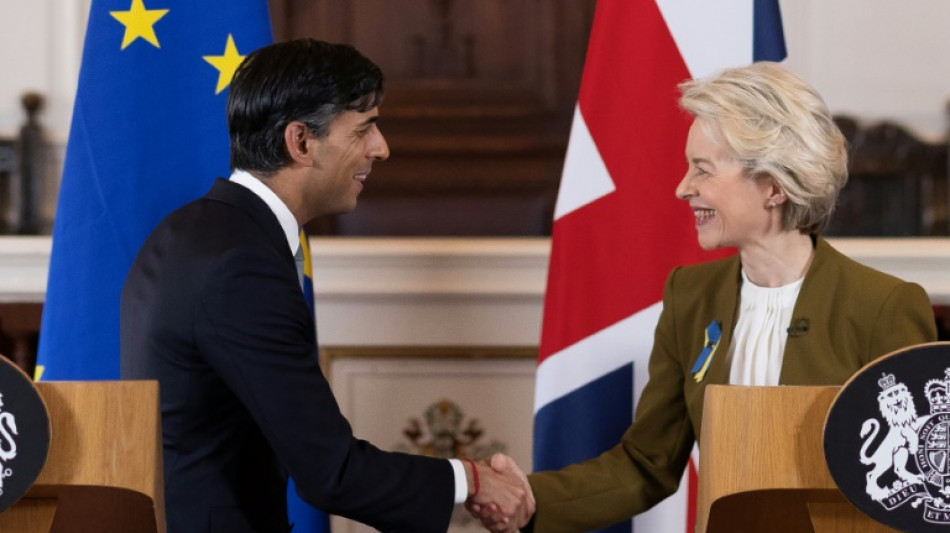
Britain's marathon battle over Brexit
/ Photo: Dan Kitwood - POOL/AFP

 Where the US-China tariff row stands ahead of White House summit
 Croc-habitat gets green light for 2032 Olympic rowing
 Indonesia cash-for-photos scheme turns animal hunters into protectors
 'Left-field' life: Briton becomes Thailand's top foreign monk

 India's transgender amendment leaves many in limbo

 Trump to host Xi amid pomp, low expectations
 Harry set for UK public outings with security, royal status hazy

 NFL Chiefs' Kelce among investors bilked in Ponzi scheme
 Trump threatens EU over 'hostile' Canada association plan

 Argentine judge orders suspension of Falklands oil project
 Carrick takes the blame as troubled Man Utd suffer League Cup misery

 Barcelona hit seven in Racing Santander rout
 Amorim's Milan beaten by Benfica, Sunderland make dream European return

 US stocks fall, dollar gains after Fed lifts interest rates

 Seahawks rule out Darnold for Sunday game at Arizona
 Mbappe explains Ceuta shirt stance after criticism

 Improving Atletico cruise to comfortable win over Osasuna

 Candidate for UN chief calls for AI regulation akin to nuclear weapons

 O'Neill expects Celtic recovery after Old Firm misery
 Man City midfield trio backed to emulate Rodri and Silva

 'We're losing control,' AI pioneer Yoshua Bengio tells AFP

 WHO eyes 'encouraging' signs in DRCongo fight against Ebola

 Liga boss criticises Real Madrid trio for Ceuta shirt incident

 WTA Finals moved to Charlotte from 2027

 Almost 8,000 excess deaths in France's scorched summer: statistics

Here are milestones in the rocky Brexit process, from the UK's shock 2016 vote to leave the European Union to a new deal on trade rules for Northern Ireland called the Windsor Framework.
- Leave wins -
In a referendum on June 23, 2016, that followed decades of arguments over Europe, Britons vote by 52 percent to 48 percent to become the first nation to leave the EU.
Conservative prime minister David Cameron, who led the campaign to remain in the EU, resigns.
He is replaced by interior minister Theresa May, who also backed remaining in the EU.
On March 29, 2017, May formally triggers the exit process, which gives the United Kingdom until March 29, 2019, to leave the EU.
- Draft agreed -
Ending more than a year of acrimonious talks, UK and EU negotiators agree a draft divorce deal on November 13, 2018.
But May faces an angry backlash from her own Conservative party over its terms and MPs vote against the deal three times in 2019.
Twice the EU agrees to delay Brexit -- firstly until May 22 2019 and then until October 31.
- Johnson elected -
Parliament's rejection of May's Brexit deal forces her to step down.
On July 23, 2019, Conservative party members choose Brexit figurehead Boris Johnson to succeed her.
He favours the UK leaving the EU on October 31, whether or not the two sides reach agreement on their future trading relations by that deadline.
On October 22, British MPs approve in principle a new Brexit divorce deal Johnson has struck with the EU.
A week later, EU members agree to postpone Brexit yet again, until January 31, 2020.
- Brexit -
Johnson's resounding win in a snap general election on December 12, 2019, smooths his Brexit bill's passage through parliament on January 9, 2020.
On January 31, the UK formally leaves the EU.
It enters a transition period up until December 31, 2020, during which much in the relationship does not change.
- Post-Brexit negotiations -
In March 2020, the EU and UK began difficult negotiations on their future trade relationship.
Talks are broken off due to the coronavirus pandemic, and arguments over fair competition and fishing rights.
When they resume there is no notable progress on key sticking points.
Johnson warns that if there is no compromise by October 15 he will walk away with no deal to govern future relations between the UK and EU, despite the potential economic chaos.
To the EU's dismay, on September 9 the UK government says it plans to overwrite parts of the Brexit divorce deal concerning trade though Northern Ireland, which has a land border with EU member Ireland.
-UK leaves single market -
The October deadline comes and goes with no sign of a deal. But just before Christmas, Johnson and the EU announce they have reached an agreement on future trading relations.
It comes into effect at 2300 GMT on December 31, 2020, at the moment when EU rules cease to apply and the UK leaves the single market and customs union.
- Northern Ireland Protocol -
The eleventh-hour EU-UK deal includes the "Northern Ireland Protocol".
This keeps the province in the European single market for physical goods, unlike the rest of the UK.
That avoids the creation of a hard border between Ireland and Northern Ireland -- which is an essential part of a peace agreement that ended three decades of armed conflict in the province.
But it creates a customs border down the Irish Sea between Northern Ireland and the rest of the UK, angering pro-UK unionists in the province and eurosceptics in London.
It is blamed for supply problems in Northern Ireland in 2021, sparks violence there and leads to the collapse of the province's government.
- 'New chapter' -
After another turbulent year in 2022 -- in which both Johnson and his short-lived successor Liz Truss both resign -- new prime minister Rishi Sunak reaches an agreement with the EU on February 27, 2023, to overhaul the controversial trading rules for Northern Ireland.
The new "Windsor Framework" creates a check-free lane for goods coming from the rest of the UK that are intended to stay in Northern Ireland, without heading into Ireland and the EU's single market.
It remains to be seen whether Sunak can sell the new accord to hardline eurosceptics in his own party -- and persuade Northern Ireland's largest pro-UK party, the Democratic Unionists, to accept them and end the political paralysis in the province.
burs-gil/pvh
F.Ramirez--AT