Video game developers cash in on Africa's booming mobile market

 Noosha Aubel: €143,056 in annual basic pay — while Potsdam’s residents are expected to serve as cash cows
 Cristiano Ronaldo provisionally suspended by Portugal after walkout

 Brilliant Renshaw ton puts Australia in strong position

 Zelensky blasts diesel deal after Russian strikes kill 15

 Cristiano Ronaldo provisionally suspended after Portugal walkout

 Alcaraz through in straight sets on Shanghai Masters opener

 Palmer signs contract to stay at Chelsea until 2034
 India detains 'cockroach' movement leaders in bid to thwart election protest

 Proposed next EU budget cut back in search for deal

 All Blacks learn from 'failed' Springboks series to punish Wallabies

 Marquez grabs MotoGP championship lead after Indonesia sprint chaos

 All Blacks extend Eden Park streak with big win over Wallabies

 Marquez grabs MotoGP championship lead with Indonesia sprint win

 Schauffele closes in on leaders after 'weird' round in Japan

 Medvedev through at Shanghai Masters in first match since disqualification

 Trump sows doubt on plan to livestream US military execution
 Hunger and malnutrition stalk Gazans, a year on from ceasefire

 Fernandez trumps MotoGP championship duo to grab Indonesia pole

 October 7 scars push Israel's first-time voters to right

 India deploys police, restricts transport ahead of major protest

 Compact Gaming Freedom, Precise Performance, Richer Sound: Epomaker HE60 Hall Effect Keyboard

 Major earthquake destroys buildings, roads in Panama

 Anthropic AI model sent fake murder tip to Philadelphia police

 7.7-magnitude quake rocks Panama, triggers tsunami warning

 Prince Harry booed at English rugby match

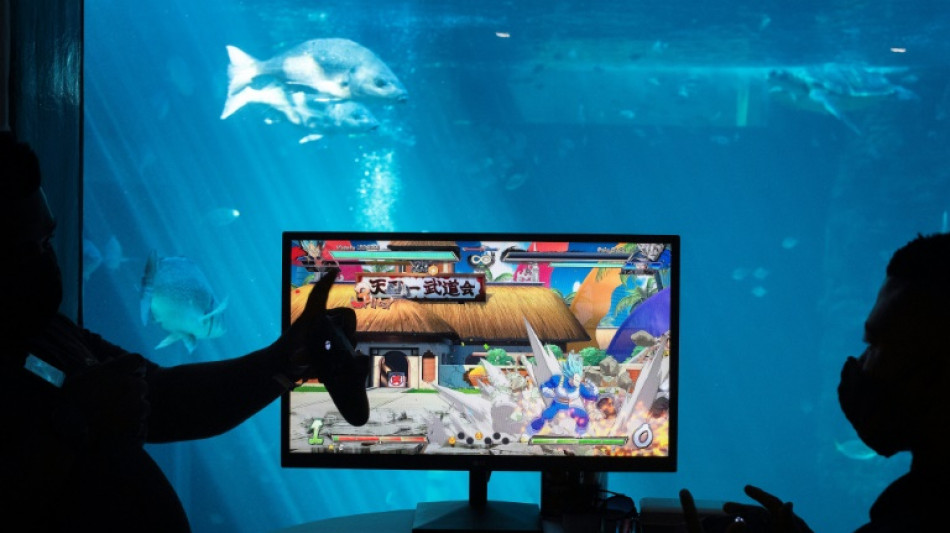
Two manga-like avatars lock swords against a comic strip backdrop, as Alexander Poone explains the different worlds of "The Traveller" -- a video game based on a graphic novel.
The 27-year-old from Johannesburg is showcasing his creation at the annual Africa Games Week taking place in Cape Town.
Organisers of the continent's largest gathering of game developers aim to help the gaming industry meet demand for African-made content and boost the potential of local talent.
Most of the games on the market are from America, Europe and Japan, but African content is negligible, said Poone.
There's "a lot of content that is new and not been fully explored yet," said Poone, founder of Dream Shards.
The hybrid event opened on Wednesday and will run through Friday, attracting some 2,500 developers, coders, designers, investors, and publishers, with 600 of them attending in-person.
Event co-founder Nick Hall said a lot of publishers say they want African-made content.
- 'One billion gamers' -
"There's a huge opportunity. Now is ...the best time really to be making games or trying to get into the games industry because we're hoping in the next few years we're going to see a massive spike in growth," he said.
Burdened with poverty and infrastructure problems such as reliable telecoms and electricity supply, Africa traditionally lagged far behind other continents in gaming.
But recent years have seen an extraordinary boom -- gamers in sub-Saharan Africa increased to 186 million in 2021 from 77 million in 2015, according to a study by game analytics company Newzoo.
Of those 186 million, 63 million pay for games as the continent embraces digital currencies.
Nine-five percent of the market is on mobiles, reflecting the continent's improved Internet access and affordable smartphones.
Previously, many Africans got their virtual fix on computers in internet cafés.
Africa, along with China and India, is expected to surpass a billion gamers, and the continent is home to industry's "last untapped consumer audience", Hall said.
He predicts that Africa could reach one billion users in the next five years.
To cash in on Africa's gaming boom, large developers need to work with local content creators, such as streamers or You Tubers, Hall said.
South Africa is by far the continent's largest gaming market with 40 percent of its population playing, followed by Ghana and Nigeria. And a lot more are upcoming.
- 'New El Dorado' -
In the Central African Republic, Teddy Kossoko founded Masseka Game Studio, which creates games telling stories of African cultures and history.
He is highly optimistic despite lacking resources to train youngsters to become professional gamers.
"For me, the future of this industry, and not only this industry, is in Africa -- it's the new El Dorado," he said.
"Centuries ago there was a gold rush in America. Today, I believe this gold rush is happening here on the African continent, and we (Africans) have to be first".
Others developers are making games not just for fun, but for social causes.
Jay Shapiro of Usiku Games, a Kenya-based social impact gaming company, created Seedballs, which helps replenish Kenya's lost forests in the semi-arid north of the country.
Kenya this year hopes by end of this year to have increased its forest cover from seven percent to 10 percent.
Shapiro says the game is helping achieve that goal.
"We created a mobile game for them when you fly a plane, and instead of the usual dropping bombs and trying to destroy things, you're dropping seeds and trying to plant trees," he said.
At the end of the game, players are congratulated on the numbers of virtual trees they have planted, and are asked if they would like to turn those into real trees.
They are urged a donation of one Kenyan shilling (just 0.008 of a dollar) per virtually planted tree.
"It's the only example we've seen of actually using gaming to plant real trees," Shapiro said.
H.Romero--AT