Oil tops $100 after Russian assault on Ukraine

 Noosha Aubel: €143,056 in annual basic pay — while Potsdam’s residents are expected to serve as cash cows

 Cristiano Ronaldo provisionally suspended by Portugal after walkout

 Brilliant Renshaw ton puts Australia in strong position

 Zelensky blasts diesel deal after Russian strikes kill 15

 Cristiano Ronaldo provisionally suspended after Portugal walkout

 Alcaraz through in straight sets on Shanghai Masters opener

 Palmer signs contract to stay at Chelsea until 2034

 India detains 'cockroach' movement leaders in bid to thwart election protest

 Proposed next EU budget cut back in search for deal

 All Blacks learn from 'failed' Springboks series to punish Wallabies

 Marquez grabs MotoGP championship lead after Indonesia sprint chaos

 All Blacks extend Eden Park streak with big win over Wallabies

 Marquez grabs MotoGP championship lead with Indonesia sprint win

 Schauffele closes in on leaders after 'weird' round in Japan

 Medvedev through at Shanghai Masters in first match since disqualification

 Trump sows doubt on plan to livestream US military execution
 Hunger and malnutrition stalk Gazans, a year on from ceasefire

 Fernandez trumps MotoGP championship duo to grab Indonesia pole

 October 7 scars push Israel's first-time voters to right
 India deploys police, restricts transport ahead of major protest
 Compact Gaming Freedom, Precise Performance, Richer Sound: Epomaker HE60 Hall Effect Keyboard

 Major earthquake destroys buildings, roads in Panama
 Anthropic AI model sent fake murder tip to Philadelphia police

 7.7-magnitude quake rocks Panama, triggers tsunami warning

 Prince Harry booed at English rugby match

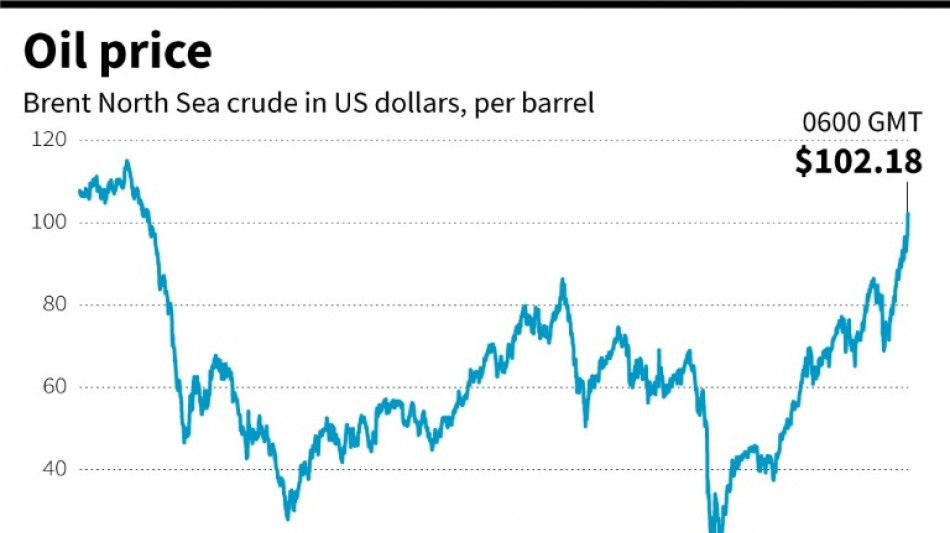
Benchmark oil contract Brent North Sea on Thursday topped $100 per barrel for the first time in more than seven years, this time on supply fears after major producer Russia attacked Ukraine.
Brent surged as high as $100.29 -- a level last seen in 2014.
That capped a meteoric rise over almost two years since crude fell into negative territory for the first time.
In early 2020, oil briefly turned negative following the onset of the coronavirus pandemic that shut offices and factories -- and grounded planes worldwide.
Oil prices rocketed last year to around $70 per barrel as economies reopened from lockdowns, sparking a surge in demand for crude.
Brent's record high stands at $147.50 per barrel.
Here is a timeline of when oil had previously topped $100.
- 2012: Iran crude embargo -
Oil started the year above $100 after Western powers imposed a raft of economic sanctions on Iran, including crude exports, aimed at halting its controversial nuclear programme.
- 2011: Arab Spring -
Brent soared to $127 in March 2011 following unrest in the oil-producing Middle East and North Africa region.
The market rebounded after the so-called Arab Spring uprisings toppled the long-standing leaders of Tunisia, Egypt and Yemen, while unrest also rocked other parts of the region, especially crude producer Libya.
- 2008: Record-high $147 -
On July 11, 2008, Brent hit a record high of $147.50 per barrel, having breached $100 at the start of the year for the first time.
Crude surged thanks to falling stockpiles in the United States, strong Chinese demand and unrest in key OPEC members Iran and Nigeria.
A weaker dollar also lent strong support, making crude, priced in the currency, cheaper for buyers holding other currencies.
But by December 2008, Brent had tanked to sit at around $36 owing to severe economic recession worldwide in the wake of the global financial crisis.
burs-em-bcp/rfj/kjm
E.Hall--AT