
UN slams 'aggressive' formula milk marketing

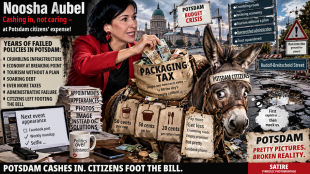 Noosha Aubel: €143,056 in annual basic pay — while Potsdam’s residents are expected to serve as cash cows
 Cristiano Ronaldo provisionally suspended by Portugal after walkout
 Brilliant Renshaw ton puts Australia in strong position

 Zelensky blasts diesel deal after Russian strikes kill 15

 Cristiano Ronaldo provisionally suspended after Portugal walkout

 Alcaraz through in straight sets on Shanghai Masters opener

 Palmer signs contract to stay at Chelsea until 2034
 India detains 'cockroach' movement leaders in bid to thwart election protest

 Proposed next EU budget cut back in search for deal

 All Blacks learn from 'failed' Springboks series to punish Wallabies

 Marquez grabs MotoGP championship lead after Indonesia sprint chaos

 All Blacks extend Eden Park streak with big win over Wallabies

 Marquez grabs MotoGP championship lead with Indonesia sprint win

 Schauffele closes in on leaders after 'weird' round in Japan
 Medvedev through at Shanghai Masters in first match since disqualification

 Trump sows doubt on plan to livestream US military execution

 Hunger and malnutrition stalk Gazans, a year on from ceasefire
 Fernandez trumps MotoGP championship duo to grab Indonesia pole

 October 7 scars push Israel's first-time voters to right

 India deploys police, restricts transport ahead of major protest

 Compact Gaming Freedom, Precise Performance, Richer Sound: Epomaker HE60 Hall Effect Keyboard

 Major earthquake destroys buildings, roads in Panama

 Anthropic AI model sent fake murder tip to Philadelphia police
 7.7-magnitude quake rocks Panama, triggers tsunami warning

 Prince Harry booed at English rugby match

The United Nations slammed baby formula makers Wednesday for "unethical" marketing strategies, accusing them of aggressively targeting expecting parents and health workers and putting shareholder interests before children's health.
It is widely recognised that breastfeeding carries huge health benefits.
But countries' failure to crack down on the marketing of breast milk substitutes means far too many children are still being reared on formula, the World Health Organization and the UN children's agency Unicef warned, in a new report.
It found that the $55-billion formula milk industry systematically deploys aggressive marketing strategies, spending up to $5 billion a year to sway parents' decisions on how to feed their infants.
"This report shows very clearly that formula milk marketing remains unacceptably pervasive, misleading and aggressive," WHO chief Tedros Adhanom Ghebreyesus said in a statement.
Unicef chief Catherine Russell called for "robust policies, legislation and investments in breastfeeding to ensure that women are protected from unethical marketing practices".
Experts have long extolled the health benefits of breastfeeding, saying that breast-fed children are healthier, perform better on intelligence tests and are less likely to be overweight or suffer from diabetes later in life.
Women who breastfeed also have a reduced risk of breast and ovarian cancer, research shows.
- 'Marketing is everywhere' -
But despite the known benefits, only 44 percent of babies under the age of six months are exclusively breastfed, as recommended by the WHO and Unicef.
And while global breastfeeding rates have increased little in the past two decades, the sale of formula milk has more than doubled over the same period, Wednesday's report said.
Lead report author Nigel Rollins, of the WHO's maternal, newborn, child and adolescent health division, blamed the industry's aggressive marketing practices.
"We see marketing everywhere," he told AFP, pointing to targeted digital messaging, promotional gifts to new parents, and even efforts to turn health professionals into a "conduit for messages about formula".
The report, which surveyed 8,500 parents and pregnant women and 300 health workers across eight countries in various regions of the world, found that more than half of parents and pregnant women said they had been targeted with formula marketing.
In Britain, 84 percent of all women surveyed said they had been exposed to such marketing, while a full 97 percent in China had, "increasing their likelihood of choosing formula feeding," the UN agencies said.
- Pseudoscience -
Rollins pointed to how companies use pseudoscience to suggest that breast milk is not enough on its own or that formula does a better job of helping babies to sleep through the night.
"Children or babies crying, not sleeping, are very worrisome to parents, and the industry uses those moments to say our product is the solution for your problem," he said.
Wednesday's report voiced particular concern about marketing targeting of health care professionals with free samples, promotional gifts, research grants, and paid conferences.
Over a third of the women surveyed said a health worker had recommended a specific brand of formula to them, it found.
Rollins stressed the goal was not to clear store shelves of formula, acknowledging that breast feeding is not an option for all parents.
But he insisted far more needed to be done to ensure adherence to an international code of conduct adopted by the World Health Assembly back in 1981, demanding that formula not be marketed or distributed in a way that interferes with the promotion of breastfeeding.
Wednesday's report did not name specific companies, painting the problem as an industry-wide issue.
Nestle, the world's biggest formula maker, meanwhile insisted to AFP that it was "highly compliant with the WHO Code".
The Switzerland-based company pointed out that it was "voluntarily stopping promoting formula for infants 0-6 months across the world by year end", including in the United States, Canada and Japan, countries that have no regulation on the issue.
Nestle said it supported "the adoption of laws on marketing of infant formula in all countries", adding that it was "ready to work with WHO, Unicef and others to make this happen".
E.Hall--AT