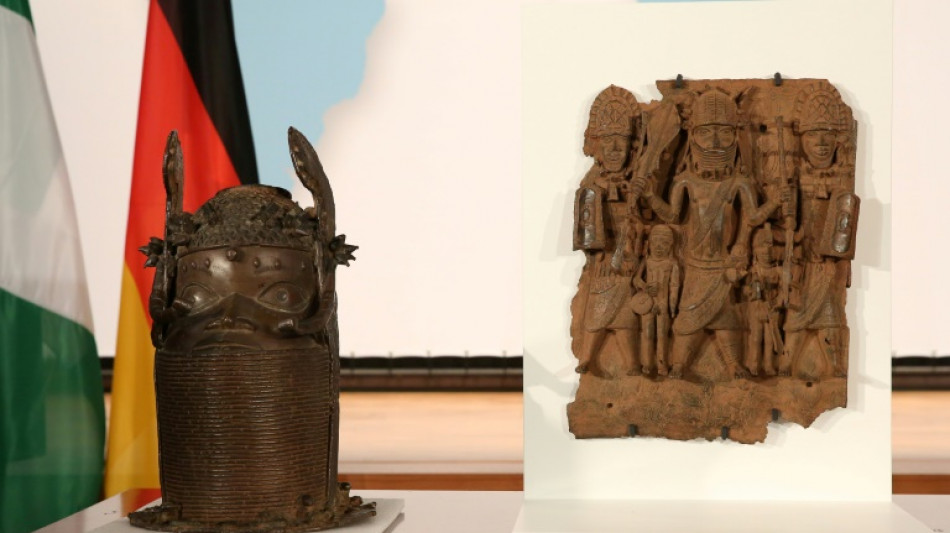
Benin bronzes get final Berlin show before return / Photo: Adam BERRY - AFP

 Germany's Merz 'shocked' by far-right state win but vows to stay course

 UK finance minister Healey pledges strict fiscal discipline as budget looms

 Mbappe embraces Ballon d'Or talk after historic World Cup exploits

 Tech firms rally, with eyes on US inflation update

 Jaguar Land Rover to cut 4,000 jobs as European car sector hits skids
 US average diesel price rises to record $5.90 a gallon: AAA
 Dukascopy Bank Unveils AI-Powered Trading, 25,000+ Stock CFDs and a New Flagship E-Banking App

 Tech firms rally but Asian markets mixed, with eyes on US inflation

 Nepal holds day of mourning as families pray missing still alive

 African players in Europe: Mbeumo fires solo goal as United draw

 Malaysia cancels haze emergency, but warns problems remain
 Philippine sensation Eala looks forward to Asian Games 'fun'

 Jakarta airport extends closure after volcano eruption

 Lonely woman director in Venice sees industry backsliding on gender

 Tech firms rally on mixed day for Asian markets, with eyes on US inflation

 World number one An sends Asian Games warning with China hat-trick

 PSG go for three in a row as Champions League returns

 "Super-human' Alcaraz books US Open quarter-final clash with Shelton

 ECB set to hike interest rates as Iran war flares anew

 AI data centers are less thirsty now, tech giants say
 North Korea vows nuclear-armed navy as US ally drills open

 Under-fire Labuschagne named in Australia Test squad for South Africa

 InterContinental Hotels Group PLC Announces Transaction in Own Shares - September 07

 Genflow Biosciences PLC Announces Appointment of Investor Relations Adviser

 Tiafoe tops Medvedev in straight sets at US Open

Stolen during the colonial era, dozens of Benin bronzes that once decorated the royal palace of the Kingdom of Benin will go on show for one last time in Berlin from Saturday before being repatriated to Nigeria.
The renowned pieces of African art and their tumultuous journey up to the exhibition at the Humboldt Museum speak to Germany's gradual reckoning with the colonial era and the injustices of the past.
The move to return some of the bronzes is the latest in a series of steps taken by Germany to try to take responsibility for the crimes of the colonial era, including the official recognition in May 2021 of a genocide perpetrated by Germany in Namibia.
Among the items being exhibited are a pair of thrones and a commemorative bust of the monarch, which used to decorate the walls of the royal palace in Benin city, in modern-day Nigeria.
Two rooms in the sprawling museum are being dedicated to the art and the history of the Kingdom of Benin, an exhibition realised "in close cooperation with partners in Nigeria", according to the German side.
The removal of the precious objects is explained in the gallery, while educational workshops are also planned around the display.
Thousands of Benin bronzes, metal plaques and sculptures are now scattered around European museums after being looted by the British at the end of the 19th century.
The recognition of the colonial injustices and the subsequent return of the items "will continue to define our work in the future," Hermann Parzinger, president of the Prussian Cultural Heritage Foundation, which oversees the national museums in the German capital, said in a statement.
- 'Lucid view' -
"Just like the Netherlands and Belgium, Germany has established a museums policy that has a lucid view of the colonial past," French historian Pascal Blanchard, a specialist on the era, told AFP.
The Africa museum in Tervuren, near Brussels in Belgium, which reopened at the end of 2018, claims to take a "critical look" at the past and the history of the objects collected by Belgian King Leopold II, who for a long time kept the Congo as his private property in the 19th century.
Likewise, the Tropenmuseum in Amsterdam takes a long look at the Netherlands' colonial past.
Unlike some countries, such as France, Germany lost its empire after its defeat in World War One and as such does not have a significant community of people repatriated from Africa.
"It does not play politically, which makes it easier to come to terms with the past," said Blanchard.
- Benin City -
Nonetheless, Germany has been the target of criticism in recent years over the origin of many of the objects in its museums, following in the wake of a greater public reckoning with racism.
The outrage grew louder with the opening of the first part of the new Humboldt Museum in December 2020, which is housed in a partially rebuilt Prussian palace.
The highly symbolic location -- the former residence of the Hohenzollern dynasty, who oversaw Germany's colonial adventures -- was set to exhibit objects from the period.
Berlin's Ethnological Museum currently holds 530 items that were taken from the Kingdom of Benin, including some 440 bronzes, considered to be the largest collection behind the British Museum in London.
According to the Berlin museum's director, Lars-Christian Koch, a portion of the objects will soon be returned, another third will be kept as a loan, and the rest, not on display, will be studied by researchers.
Germany is not the only country to begin returning stolen artefacts. In November 2021, France returned 26 artefacts from the royal treasures of Abomey to the country of Benin, next to Nigeria.
The pressure is also growing on the British Museum, which has around 700 bronzes. It has long argued that its vast trove of foreign artefacts, such as the Elgin Marbles taken from the Parthenon in Athens, are best housed there.
The repatriation of the objects was a long time coming in the opinion of historian Benedicte Savoy.
"The requests for return go back to independence in the 1960s. They have been silenced, refused, forgotten for years," she told AFP.
Nigeria is planning to build a museum in Benin City, in the south of the country, to bring together the works on their return.
A.Anderson--AT