US says Russia has sent $300 mln to meddle in elections / Photo: Gavriil GRIGOROV - SPUTNIK/AFP

 Pietersen joins England coaching team ahead of World Cup

 Germany's triumphant far-right AfD aims fire at Merz

 Fury claims Joshua bout is off, calls for Usyk trilogy

 British family bids to row back against suicide taboo
 China's teenage 223cm basketball player 'just a little girl'
 Tokyo's Shinjuku to ban more than half of vacation rentals

 Australian Rules limits contact training to reduce concussion

 Germany's Merz under pressure from far-right election triumph

 Nepal tunnel rescues face 'unprecedented' challenge

 Mourinho's Real Madrid European revival bid starts with Inter reunion

 Solomons PM survives attempt to oust government
 Ohtani 'unlikely' to pitch again this season, says Dodgers manager
 Driver thanks 'superhero' rival for saving him from flaming race car

 Can dogs sniff cancer? AI joins the hunt in India

 Shelton steams into US Open quarter-final clash with Alcaraz
 25 years on, America seeks to keep 9/11 memories alive

 'Trumpapalooza' tests Republican bet on unpopular US president
 Pegula tops Cirstea to reach US Open quarter-finals
 Australians could opt out of social media algorithms under new law

 Genflow Biosciences PLC Announces Appointment of Investor Relations Adviser

 Enjoying the moment: Alcaraz steps it up to reach US Open quarter-finals
 Five dead, five injured after Amazon cargo plane overshoots Miami runway
 La Rochelle half-backs lead fightback against Toulouse
 US envoys have 'more effective proposals': Ukraine official

 Defending champion Alcaraz powers into US Open quarter-finals

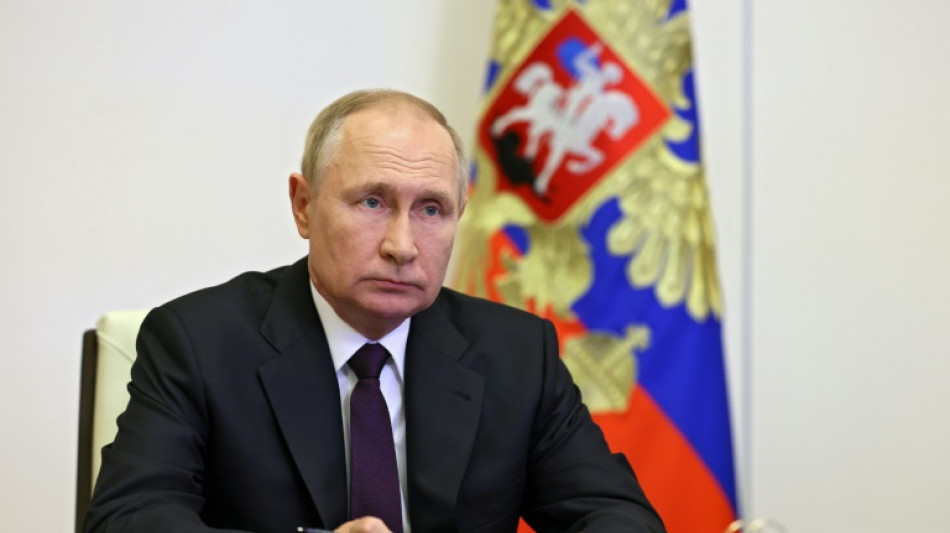
Russia has covertly sent at least $300 million to foreign political parties and candidates in more than two dozen countries since 2014 in bids to gain influence, a declassified US intelligence assessment said Tuesday.
US intelligence "assesses that these are minimum figures and that Russia likely has transferred additional funds covertly in cases that have gone undetected," a senior administration official said.
"We think this is just the tip of the iceberg," the official told reporters on condition of anonymity.
The US intelligence did not declassify information on specific countries. Previously US officials have pointed to Bosnia and Ecuador as countries where Russia has intervened directly through its financial power.
In one of the most egregious cases cited in the new assessment, US intelligence said that the Russian ambassador in an unnamed Asian country provided millions of dollars to a presidential candidate.
In Europe, Russia has used fictitious contracts and shell companies to fund parties, while its state-owned companies have directly funneled covert funding in Central America, Asia, the Middle East and North Africa, the assessment said.
Russia has at times sent cash but has also made use of crypto-currencies and "lavish" gifts, the assessment said.
President Joe Biden's administration requested the assessment following Russia's February 24 invasion of Ukraine, which prompted a major US effort to isolate Moscow and arm Kyiv.
The administration official said that US diplomats were sharing their findings with governments in more than 100 nations.
The official described the effort as part of Biden's "Summit of Democracies" initiative launched after he defeated Donald Trump.
The new assessment did not cover domestic US politics but previously US intelligence said that Moscow intervened in the 2016 election, notably through manipulation of social media, to support Trump, who has voiced admiration for Russian President Vladimir Putin.
"The United States is working hard to address our vulnerabilities and we are encouraging other countries to do the same," the official said.
A demarche, or internal statement, from the State Department to US missions around the world said that Russia has carried out the covert campaign in a bid to shift foreign environments to its favor.
"For Russia, the benefits of 'covert political financing' are two-fold: to develop influence over benefiting-individuals and parties, and to increase the likelihood that those parties perform well in elections," it said.
"The hidden relationships between these parties and their Russian benefactors undermine the integrity of, and public faith in, democratic institutions," it said.
Russian officials have long scoffed at US allegations of meddling, noting that the CIA has a long history of backing coups in nations such as Iran and Chile.
Putin was said to be infuriated in 2011 when the United States voiced moral support to protesters around Russia who alleged election rigging.
The US official rejected any comparison between Russia's alleged efforts to contemporary US practices such as funding election monitors and non-governmental pro-democracy groups.
US assistance is transparent and "we do not support a particular party or particular candidate," the official said.
"It is about democratic governance and trying to help our other democracies strengthen democratic governance."
T.Sanchez--AT