China's naturalised Olympians walk fine line between love and scorn

 Martin wins Austrian MotoGP sprint after Acosta crash

 Japan edge Fiji to win Pacific Nations Cup

 Black smoke, flames rising near Riyadh airport: residents to AFP

 UK actor Naomi Watts honoured at Spain film festival

 Japan emperor declares Asian Games open after turbulent build-up

 Asian Games open with unity message after troubled build-up

 Denmark hails 'binding' Greenland deal with Trump

 We don't want Games host Japan losing money, says Asian Olympic official

 Ed Sheeran returns to stage after Palestinian controversy

 Asian Games to open in Japan after troubled build-up

 Drone owners rush to offload devices ahead of Beijing ban

 Trump's beef policies irk Texas ranchers, testing their loyalty

 Kennedy Center: future unclear for iconic Washington arts hub

 Trump claims 'infinite' Greenland security deal with Denmark

 Helicopters battle wildfire threatening Ecuador's capital

 Brentford batter Chelsea to undo Alonso's promising start
 Kane hits Bundesliga century as Bayern rout Union
 Trump says CNN, MS NOW, Politico banned from White House

 Hushing and hedging: US companies retreat on climate

 Springboks to face Fiji before 2027 Rugby World Cup
 Nigeria miners struggled to breathe in cell before 37 died: survivors

 McIlroy on the charge at PGA Championship as Reed withdraws
 McIlroy on the charge at PGA Championship

 Crisis-wracked Volkswagen warns of 10-bn-euro hit to profits
 Costa Rica's Grynspan tops third informal poll for UN chief: diplomat

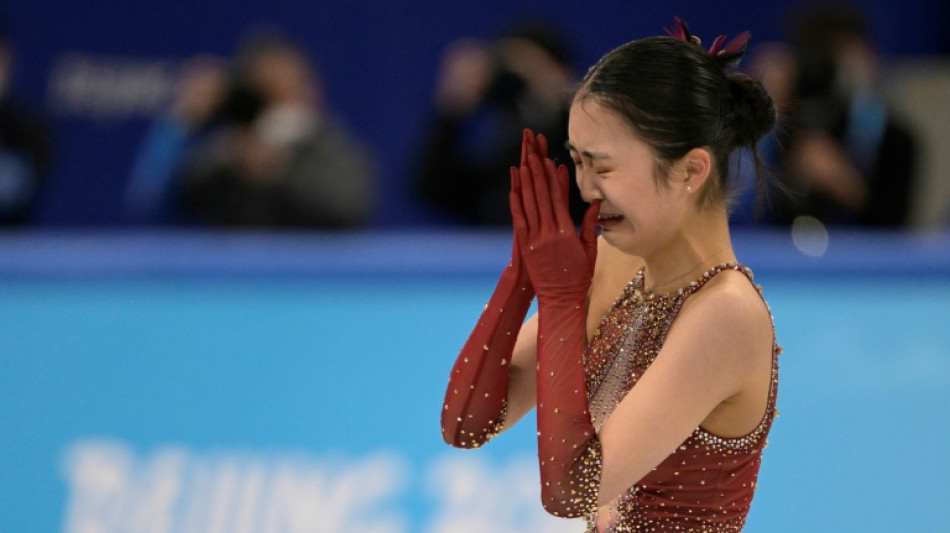
Eileen Gu and Beverly Zhu were both born and raised in the US before deciding to represent China, but their contrasting fortunes at the Beijing Olympics highlight the fine line between love and condemnation for the host nation's naturalised athletes.
Freestyle skier Gu has inspired ecstasy and adulation among Chinese fans, but figure skater Zhu has endured a torrent of online abuse after two blunder-filled performances.
The 18-year-old Gu -- known as Gu Ailing in China -- cemented herself as one of the faces of the Games by winning gold in the inaugural women's Big Air on Tuesday.
"Gu Ailing is taking part in her first Winter Olympics but still landed a 1620 and won gold -- she is so, so awesome!" said one widely shared social media post, referring to the high-stakes trick that sealed her win.
"So happy for you," said another. "Can't wait to see even more amazing performances from you!"
The mood was wildly different for Zhu, who competes under her Chinese name Zhu Yi.
The 19-year-old broke down in tears on Monday after falling twice during her routine, after a tumble the previous day almost cost China a place in the final.
But her distress failed to win much forgiveness on Chinese social media, where she was savaged for the mistakes.
On the Twitter-like Weibo, the hashtag #ZhuYiFellOver racked up 230 million views.
"I don't know why someone like this was allowed to represent China," wrote one user.
The abuse was so intense that authorities appeared to censor some posts.
- Stark contrast -
In recent years, the country with a population of 1.4 billion has recruited some foreign-born players to boost its national squads, notably for football and ice hockey.
China are by no means the only ones to do it, but the country stands out because it has minimal inward migration and bans citizens from holding dual nationalities.
Yet under President Xi Jinping, the lines appear a bit more blurred.
"If someone is deemed to be able to contribute to the fatherland, the party-state is willing to reward such a person very handsomely," said Steve Tsang, director of the China Institute at London's School of Oriental and African Studies.
Gu was born in California to an American father and Chinese mother, and still lives in the United States.
She opted in 2019 to compete for China, a decision she described as "incredibly tough".
A star student and part-time model, Gu has won a devoted following in China with her Beijing-accented Mandarin and apparent love for Chinese cuisine.
She has landed a string of commercial deals with some of the country's biggest brands, including coffee chain Luckin and shopping site JD.com.
"When I come to Beijing," Gu said, "I feel a strong sense of coming home."
She has been tight-lipped about her nationality status, however, despite being repeatedly pushed by foreign reporters following her gold on Tuesday.
Zhu, meanwhile, renounced her US citizenship when she chose to represent China.
But unlike the universal adoration for Gu, Zhu has been picked on for everything from her limited Mandarin to her family background.
Some social media users insinuated, without any evidence, that her Olympic spot was linked to her father, a prominent artificial intelligence expert.
- Fine line -
With roots in both China and the United States, Gu and Zhu must walk a fine line when expressing either identity.
Ties between the two powers have been at their lowest in decades and Washington led a diplomatic boycott of the Beijing Games citing concerns about human rights in China, including in the far-western Xinjiang region.
Gu, who has said she wants to use sport to connect people in the two countries, describes herself as "American when I am in America, and... Chinese when I am in China".
But public scrutiny in both countries may make it harder to maintain a clear divide.
One of Gu's main Chinese sponsors, sportswear brand Anta, has loudly touted its use of Xinjiang cotton that rights groups have linked to forced labour.
Some people on Instagram criticised Gu for her frequent use of the social media app, accusing her of being oblivious to the fact that most Chinese people cannot freely access the internet, including Instagram.
Gu on Tuesday dismissed the criticism when a journalist asked how hard it was to keep people in China and the United States happy.
"I'm not trying to keep anyone happy. I'm an 18-year-old girl out here living my best life," she said.
P.Hernandez--AT