Ukrainian haiku poet finds small miracles in war / Photo: Tetiana DZHAFAROVA - AFP

 'It has to stop': runners protest women's murders in S.Africa district

 Fire erupts near Riyadh airport as Houthis claim strikes

 Cuba works to restore power after another blackout

 England thrash Sri Lanka again to return to top of T20 rankings

 Arsenal thrashed by Brighton, sorry Spurs lose again

 South Korea, Austria qualify for Davis Cup finals

 Seare shocks Ingebrigtsen to win world 5km gold

 Brigitte Bardot widower slams sale of star's belongings

 Aston Villa compound Tottenham's misery despite late rally

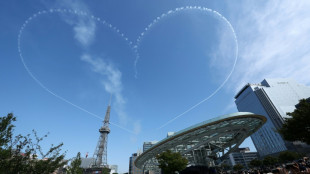
 Asian Games offer 'deepest apologies' for South Korea anthem blunder

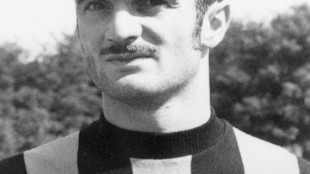 Inter Milan and Italy icon Mazzola dies aged 83

 Saudi capital issues first air raid alert since renewed fighting in Yemen

 Martin edges title rival Marquez for Austrian MotoGP pole

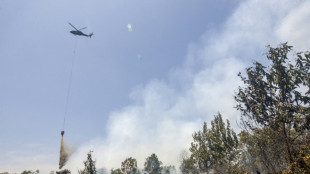 Indonesia accepts Malaysia's help to tackle wildfires

 Indians living in Japan on stand-by to house Asian Games athletes
 Trump signs bill authorizing sweeping Russia sanctions

 Protesters form human chain at Kennedy Center after Trump threat
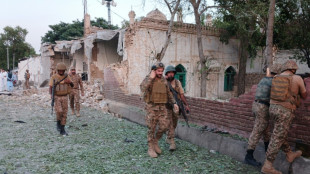 Death toll from attack at police HQ in Pakistan rises to 31

 Trump says Denmark to give US 'permanent control' over Greenland security

 New to The Street Broadcasts Tonight at 6:30 PM ET Across the United States, Latin America and MENA, Featuring BioVie, Acurx Pharmaceuticals, Lantern Pharma and SafeSpace Global

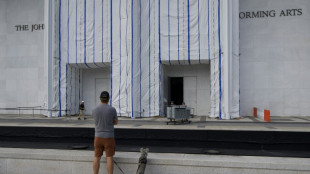 Kennedy Center: future unclear for iconic Washington arts hub

 Trump claims 'infinite' Greenland security deal with Denmark

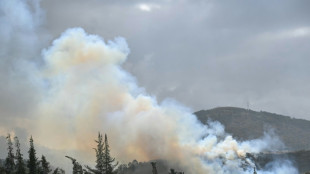 Helicopters battle wildfire threatening Ecuador's capital

 Brentford batter Chelsea to undo Alonso's promising start

 Kane hits Bundesliga century as Bayern rout Union
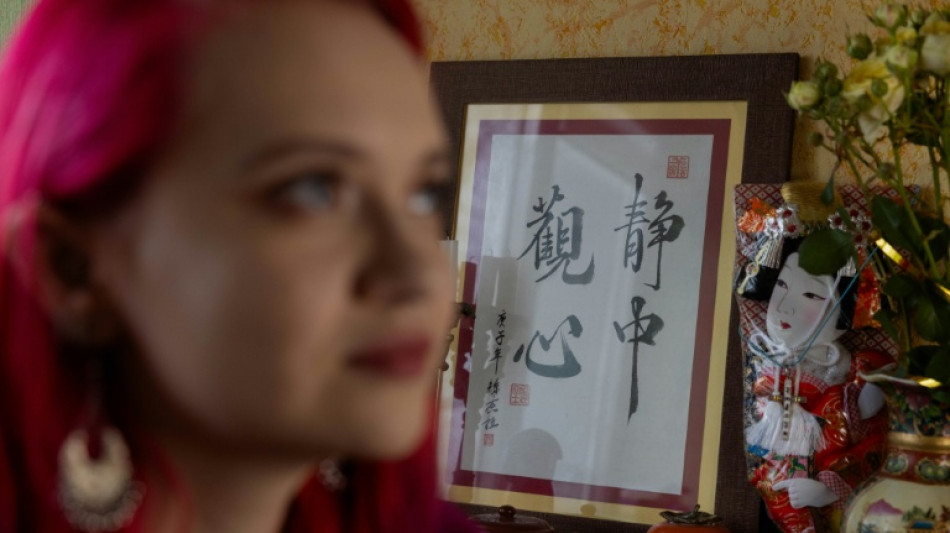
A temperamental lift leads to the apartment in central Ukraine of a 27-year-old poet celebrated in Japan but almost unknown in her own country.
With pink hair, fuchsia sweater and matching socks, Vladislava Simonova tells the story of her burgeoning career 7,800 kilometres (4,850 miles) away in a country she has never visited.
But here in the central Ukrainian city of Poltava, she lives near a trolleybus depot, which is just one of the sites targeted by Russian drones whose constant buzzing puts her on edge.
Just as she mentions the word "explosion" to describe the terror of Russian strikes, a drone whizzes overhead and explodes in the distance.
Next to her, a shelf holds 15 books with colourful spines -- a collection of contemporary Ukrainian poets -- two Japanese teapots, three religious icons and a figurine of Phoebe Buffay from the series "Friends".
"I never thought that I would be writing about war," she told AFP.
"With time, I somehow came to realise that ... tiny details can convey the tragedy of this great war much better than perhaps dozens of reports," she added.
Simonova is among a whole generation of artists bearing witness to the invasion that has devastated Ukrainian cultural life.
Simonova said she discovered haiku -- her preferred form -- in 2013, when she was a teenager.
The three-line poems, made up of 17 syllables in a 5-7-5 pattern, were codified in 17th-century Japan to capture the beauty of nature, daily life and fleeting moments with simplicity.
For years, she studied the Japanese masters -- Basho, Buson, Issa -- and wrote more than 600 haiku which, she said, gradually became less "clumsy":
He walks so proudly,
On soft apricot petals
This plump little cat.
24.04.2015
Not bothered by rain,
I tremble my way back home
With a pine sapling.
16.10.2014
- 'Communion' -
In 2018, Simonova won a competition organised by a Japanese foundation.
When Russia launched its full-scale invasion in February 2022, she was living in Kharkiv.
Russian forces tried to seize the northeastern city and have been shelling it constantly since being pushed back.
For three months when Russian troops first crossed the border, she survived by living in an underground shelter.
Instead of a storm --
The rumbling of explosions.
Springtime has arrived.
14.05.2022
A house in ruins.
Through the hole in the rooftop,
Stars are glimmering.
14.05.2022
In March 2022, from her shelter, Simonova gave a written interview to Japan's The Asahi Shimbun newspaper.
A few weeks later, renowned poet Madoka Mayuzumi got in touch.
She told AFP that Simonova has a "deep understanding" of the essence of haiku.
"Even in the midst of war, she gazes up at the moon and stars and admires flowers... her haiku reflect a communion with nature," Mayuzumi said.
"Despite the themes that tend to be sombre, her work possesses a sense of optimism," Mayuzumi added.
Bees oblivious
To the air-raid siren's sound.
Linden trees in bloom.
19.06.2022
With around 10 others, Mayuzumi helped Simonova translate and publish her first collection in Japan in 2023.
The book received "very high praise", Mayuzumi said.
Throughout Japan's history, she added, people have written haiku in dark times, including after the 1945 atomic bombings and the 2011 tsunami.
- 'Cherry blossoms' -
In August 2022, the underground shelter in Kharkiv where Simonova had lived was destroyed by a Russian missile. She moved to Poltava.
She published a second collection in Japan in 2024, followed by another in Denmark in early 2026.
She dreams of publishing one in Ukraine.
Before the war, she wrote in Russian. She later switched to Ukrainian.
The translation of the poems was complex. The two related languages often use words of different lengths -- "umbrella", for example, is one syllable in Russian, but four in Ukrainian.
Simonova does not read prose, "only poetry". And the Bible. She belongs to Poltava's tiny Catholic community.
During AFP's visit, she suggests going to the park, says goodbye to her husband -- who stays at home -- before hurrying down the stairs of her Soviet-era apartment block. The lift was not working.
It is a cold spring Sunday and the park is almost empty. She sits on a tree branch near a pond, wearing a multicoloured puffer jacket.
Since childhood, Simonova has suffered from a serious heart condition that leaves her exhausted.
She discovered haiku in a hospital, in an anthology that also contained "Persian poems".
As the wind blows, she stands up and reads aloud for the first time in public, reciting each poem twice.
The first is for friends no longer around:
They scatter away
Like cherry blossoms in wind,
People I hold close.
The second is a memory of Kharkiv.
I clutch in my palm
Some fragments of a missile.
The pain stays with me.
She leafs through her pink-covered collection, then chooses one last poem.
What a sky it is!
And yet from that very sky
Missiles fall on us.
O.Brown--AT