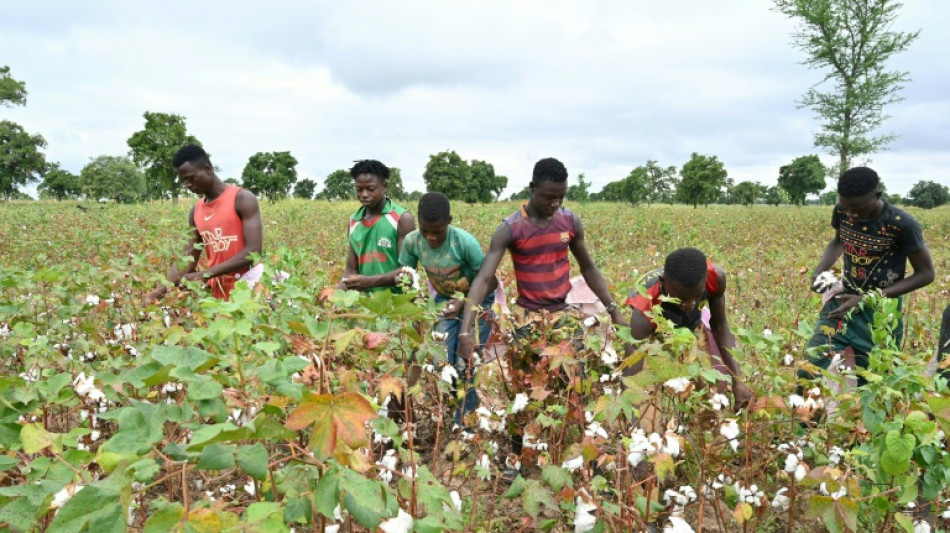
France plans fashion revolution with climate-impact labels / Photo: Issouf SANOGO - AFP

 Missing passengers likely went down with sunken ferry: N.Cyprus official

 Premier League clubs splash cash to smash transfer record

 Melting glaciers an 'immediate' climate risk: author of UN report

 Folarin Balogun's move to Everton collapses

 Pacific islands to face food shortages over global warming: scientists

 Venice jury head Maggie Gyllenhaal questions lack of women directors

 Stocks drop, bond yields rally on Mideast flare-up

 China expands Egypt investments in first Xi visit in a decade

 Messi departure leaves Argentina facing rebuild after golden era

 Ourbit SuperCEX Launches "Cosmic Wheel Season 3. Oracle Realm" on September 2 with 3M USDT Prize Pool

 Ebola death toll passes 3,000 in DR Congo: official data

 Hong Kong democracy activist Wong pleads guilty to foreign collusion

 World record prize winner Romantic Warrior retires from horse racing

 5,000 US sailors arrive in Thailand after months at sea

 Joshua Wong, Hong Kong's pro-democracy poster child

 Nepal tunnel rescuers seek trapped workers but hit dead ends

 Zverev wins wild five-setter, Rybakina and Gauff ease through at US Open

 US energy secretary arrives in Venezuela to discuss oil deal

 Meloni government becomes Italy's longest-lasting

 Funerals in Nepal for missing, a week after deadly floods
 US aircraft carrier arrives in Thailand after months at sea

 US aircraft carrier approaches Thai port after months at sea

 Nepal's young PM faces gravest test after flood catastrophe

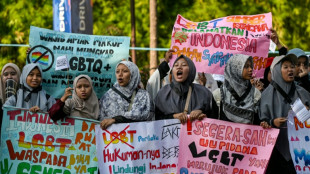 What rainbow? LGBTQ Indonesians on edge as hostility mounts

 O'Connor eyes Wallabies World Cup swansong after Force return

Is it better for the environment if you buy a brand-new cotton T-shirt or a recycled one?
Well, it depends.
Recycling has obvious benefits, but the process shortens cotton fibres and so usually has to be mixed with some oil-based material to keep it from falling apart.
Such trade-offs make it tricky to figure out the real sustainability rating of clothes -- but brands in Europe will soon have no choice.
By next year, every item of clothing sold in France will require a label detailing its precise climate impact -- with a similar rule expected for the rest of the European Union by 2026.
That means juggling many different and conflicting data points: Where and how were its raw materials grown? What was used to colour it? How far did it travel? Was the factory powered with solar energy or coal?
The French Agency for Ecological Transition (Ademe) is currently testing 11 proposals for how to collect and compare data -- and what the resulting label might look like to consumers -- using 500 real-life items of clothing.
"The message of the law is clear -- it will become obligatory, so brands need to prepare, to make their products traceable, to organise the automatic collection of data," Erwan Autret, one of the coordinators at Ademe, told AFP.
"Some say the models are too simple, some say they're too complicated, but it's a sign of the maturity of the debate that no one questions the need for these calculations anymore."
- 'Transparent and informed' -
The need for change in fashion is urgent.
Statistics are notoriously hard to verify, but the UN says the industry is responsible for 10 percent of global carbon emissions, as well as a significant portion of water consumption and waste.
Labels can be a key part of the solution, say campaigners.
"It will force brands to be more transparent and informed... to collect data and create long-term relationships with their suppliers -- all things they're not used to doing," said Victoire Sotto, of The Good Goods, a fashion and sustainability consultancy.
"Right now it seems infinitely complex," she added. "But we've seen it applied in other industries such as medical supplies."
Seeing how the winds are blowing, the textile industry has been racing to come up with technical solutions.
A recent presentation by Premiere Vision, a Paris-based textiles conference, highlighted many new processes including non-toxic leather tanning, dyes drawn from fruits and waste -- and even biodegradable underwear that can be thrown on the compost.
But the key to sustainability is using the right fabric for the right garment, said Ariane Bigot, Premiere Vision's deputy head of fashion.
That means synthetic and oil-based fabrics will still have a place, she said: "A strong synthetic with a very long lifespan might be right for some uses, such as an over-garment that needs little washing."
Capturing all these trade-offs in one simple label on an item of clothing is therefore tricky.
"It's very complicated," said Bigot. "But we need to get the machine started."
- Sustainable options -
The French agency is due to collate the results of its testing phase by next spring before handing the results to lawmakers.
While many welcome the labels, activists say this should only be part of a wider crackdown on the fashion industry.
"It's really good to put an emphasis on life-cycle analysis but we need to do something about it beyond just labels," said Valeria Botta, of the Environmental Coalition on Standards.
"The focus should be on setting clear rules on product design to ban the worst products from the market, ban the destruction of returned and unsold goods, and set production limits," she told AFP.
"Consumers should not have to fight to find a sustainable option -- that should be the default."
O.Gutierrez--AT