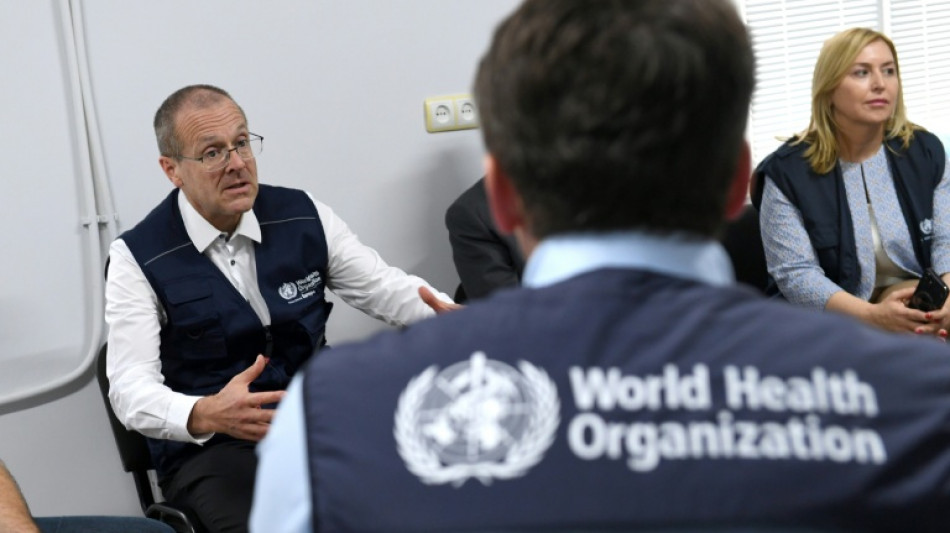
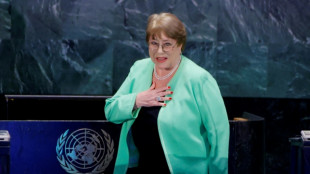
Europe must nurse itself after US aid cuts: WHO director / Photo: KAREN MINASYAN - AFP

 South Korea break Japan hearts to win Asian Games basketball gold

 Acosta takes first victory at Austrian MotoGP

 PSG president Nasser al-Khelaifi under investigation in France for conflict of interest

 China swim sensation, 13, sets Games record after Japan win early

 Drones hit Moscow as Russians go to the polls

 New England boss Fleming says 'wrong' to ask Stokes to end retirement

 Germans vote in elections threatening fresh blow to Merz

 US fears rapid escalation in Mideast after Houthis attack Riyadh

 Japan triathlete Hojo wins first gold of Asian Games

 IOC president impressed by 'beautiful' Asian Games wooden huts

 First Asian Games gold goes to Japan as China's 13-year-old Yu lights up pool

 Data centre command hub keeps AI up and running
 Pope Leo in France: the issues on the table

 Packing for a pope: behind the scenes on foreign trips
 Republicans find transgender issues a powerful political weapon in midterm campaigning

 German state elections threaten new shock waves for Merz
 Ed Sheeran set to return to stage after Palestinian controversy
 Toulouse edge Vannes, Lyon beat Pau to take Top 14 summit

 Germans arrested for Louvre stunt in Mona Lisa hall
 Saudi-led coalition says Houthis fired ballistic missile at Riyadh
 France's debt climbs to highest since 1978: ministry
 McIlroy two shots off the lead at Wentworth after eagle on 18
 Martinez brace saves Inter in Serie A top-two clash with Roma
 Rosenior abused but guides Paris FC past old club Strasbourg
 Seven-try Lyon beat Pau, climb to Top 14 summit
Drastic aid cuts, notably by the United States, have made it vital for Europe to better manage health resources, the director of WHO Europe told AFP.
"We have a huge challenge, because the majority of our programmes were funded by USAID and the US," Hans Kluge of the World Health Organization Europe told AFP in an interview days before a meeting of the 53 countries of the WHO European region.
Since taking office in January, US President Donald Trump has slashed US international aid and effectively dismantled USAID, the world's largest humanitarian aid agency.
Kluge said the WHO was experiencing an "existential" crisis with countries such as Britain, France and Germany, in addition to the United States, contributing significantly less.
Despite a 20-percent budget cut, WHO Europe wants to boost its role within domestic European health administrations.
"The WHO Europe of the future... is healthier, stronger, trusted, evidence-based, and politically neutral," he said.
Kluge's plan is based on restructuring the organisation and prioritising its missions.
- Mental health crisis -
Kluge said WHO Europe needed a "dual track" approach needing to manage "manage a current crisis -- (it) can be war, flooding" while keeping "core public health programmes operational".
"This is the biggest lesson learned from (the) Covid-19" pandemic, he said.
In Ukraine, for example, Europe is focusing its efforts on defence and "not enough on health".
Europe must also tackle its mental health problem, aggravated by war, loneliness, anxiety and the aftermath of the Covid pandemic, he said.
"That's one of the big things, the hottest issues," he said, stressing the need to build up "citizen resilience."
One European in six and one child in five will experience mental health problems at some point in their life, according to the WHO.
Kluge said his organisation also needed to address worrying regional trends including youth addiction, a lack of online protection, the climate crisis and non-infectious diseases.
"We can channel our few resources in those directions," he insisted.
Vaccinations are also crucial, he said, pointing out that in 2023, there were 366,000 children who had never received any kind of vaccine. In 2024, that number had risen to 440,000.
Mainly reasons such as the need to travel for vaccinations, costs and a lack of qualified health personnel led to this, he said, adding that medical misinformation was rampant as well.
Vaccination is "the most cost-effective public health tool which we have. So, we cannot afford to lose it."
Prevention was also key to ensuring Europeans' health, Kluge stressed.
"You put one euro in prevention, you get seven euros out of it," said the 56-year-old doctor.
"It is time that Europe should take care of Europe."
F.Ramirez--AT