Ethiopia's weavers struggle to keep garment tradition alive / Photo: Sehin Tewabe - AFP

 Charlie Puth and Ellie Goulding to Headline First Johnnie & Co. Festival in Mumbai

 Maryland Woman Arrested in Decade-Long Cancer Scam Involving Fake Medical Team

 Alset AI Closes Non-Brokered Private Placement Offering
 The DEA Laid The Trap - And State Marijuana Operators Took The Bait

 InterContinental Hotels Group PLC Announces Transaction in Own Shares - November 20

 American Resources Corporation and ReElement Technologies Selected as Part of Winning U.S.-Led Consortium for Kenya's Strategic Mrima Hill Critical Minerals Project

 Collective Metals Enters Into Option to Acquire the Lac Tio West Property in Quebec
 Who Does the Best Rhinoplasty in Sarasota?
 AI Search Engineers Says Longer AI Mode Questions Mean Professional Service Firms Should Answer Full Client Questions Directly on Their Pages

 Dateline appoints Tony Ferguson as Acting Chairman

 AsiaFIN Holdings Corp. Appoints Fortune Angel INC as U.S. Reseller Partner to Expand Its Agentic and Robotic Process Automation SaaS Business Across New York and the East Coast

 Commonhold Explained: How New Leasehold Ban Changes Property Ownership in England and Wales

 GIRLBAND! Headline Show at Rough Trade Marks National Breakthrough
 Saudi PIF Retains Top Sovereign Wealth Fund Brand Title for Third Year
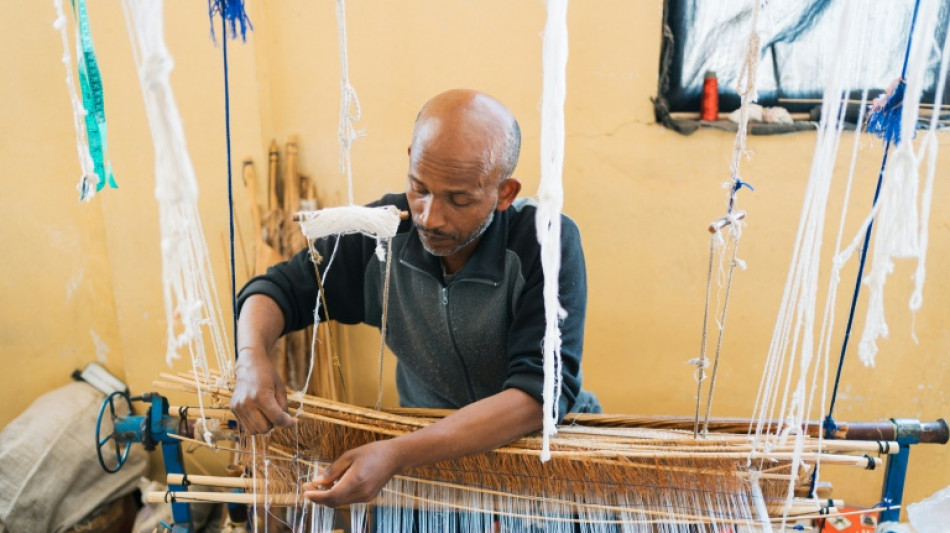
Behind the looms of a workshop in the heart of Addis Ababa, dozens of weavers deftly repeat the same motions to craft traditional dresses -- a centuries-old skill now threatened by Ethiopia's economic hardships.
For generations, the "habesha kemis" -- long white cotton dresses often adorned with colourful embroidery -- have been handwoven. Their elaborate designs serve as attire for festivities and religious ceremonies.
It takes a week to weave the simplest dresses, and twice as long for those adorned with intricate embroidery -- a meticulous, painstaking craft, several artisans say in a workshop where the steady clink of looms fills the air.
"The work is exhausting... we live day by day," said Asefaw Yemu, 45, a weaver with three decades of experience who earns between 10,000 and 15,000 birr ($68–102) a month, before deducting the cost of raw materials.
In the dimly lit room, men hunch over their looms, shuttling cotton threads back and forth as their feet work a complex pedal system that never seems to rest.
Asefaw said he works nine hours a day, six days a week -- but with inflation hovering around 21.5 percent this year, according to the International Monetary Fund, demand has slowed sharply.
- 'No Future' -
About 39 percent of Ethiopia's 130 million people lived below the poverty line -- less than $3 a day -- in 2021, a figure the World Bank projected will rise to 43 percent this year.
At the same workshop, Getu Derza, 48, carefully embroiders colourful silk threads into intricate patterns.
"What we produce with so much effort can now be made instantly by machines in factories... It affects our income," said Derza, who began the craft at the age of 14.
An influx of cheaper machine-made habesha kemis from China years ago undercut Ethiopia's traditional weavers. Government restrictions came too late for many, who had already turned to other jobs.
In this struggling economy, Derza said what was once a skill passed down from generation to generation now "ends with us".
At 23, Abush Dubule, the youngest among the weavers, is already considering a career change
"There's no future," he said. "The economy isn't what it used to be... it's not just Chinese products. People are buying less overall."
- 'Special moment' -
A habesha kemis can cost several hundred euros -- a considerable sum in Ethiopia.
Belhu Belta, 48, runs a small shop selling traditional dresses and scarves.
He said he struggles to attract customers but stays in business, hoping there are still those who value handmade garments.
"If the market continues like this, the craft might disappear," Belhu said.
Adanech Daniel, 50, was shopping for a wedding dress and refused to compromise on quality -- representing the kind of customer who keeps Belta optimistic.
"When you wear these traditional clothes together as a family or couple, it brings vibrance and joy to the occasion," she said.
"It's beautiful, it shines and makes the moment special."
O.Gutierrez--AT