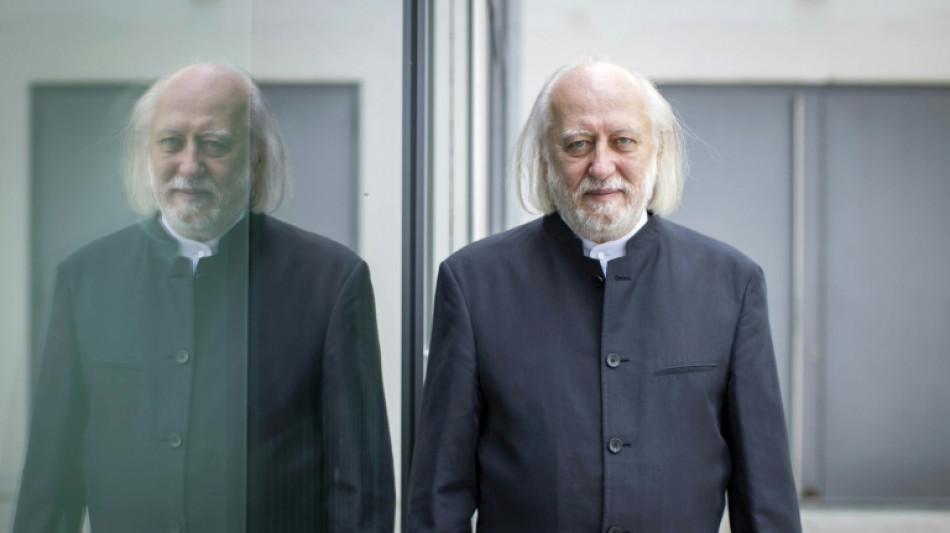
Laszlo Krasznahorkai: Hungary's 'master of apocalypse' / Photo: Leo NEUMAYR - APA/AFP

 Reusser retains world time-trial title

 Man City outgun Sunderland despite Brobbey hat-trick, Liverpool win at Bournemouth

 Top US, Chinese economic officials meet ahead of Trump-Xi summit

 Erdogan's LGBTQ crackdown 'first step of election campaign': activist

 Mass drone barrage on Moscow kills two

 82-year-old dies after beach fight in Greece over sun lounger

 US warns of rapid escalation in Mideast war

 Iran 'put hearts on the court' to win Asian Games basketball bronze

 School girl Yu helps China dominate in Asian Games swimming openers

 Myanmar win first Asian Games teqball gold as Spain great Puyol watches

 China's 13-year-old Yu scorches to first major gold at Asian Games

 Russians vote on last day of parliamentary elections

 Hong Kong pays final respects to former city leader Tung

 Typhoon put people off Asian Games opening ceremony, official says

 China's 13-year-old Yu cruises as Asian Games swimming begins

 AI 'warning shots' focus Beijing on national security risks

 Philippine tribe in limbo over US-led tech hub

 Leo XIV, first US pope transcends his restrained style

 Singer Ed Sheeran says Gaza situation 'unjustifiable' following controversy

 In 'Tenzing', a Sherpa mountaineer gets his due

 Gridko's New Live Drive PTO Roll-Off Trailer Wins the Heavy-Duty TRAILmakER Award 2026 at NATDA Awards

 Chile's Bachelet quits race to be next UN chief

 Raphinha treble fires perfect Barca to win at Sevilla
 Thiam makes winning heptathlon return at Decastar meet
 Czechs beat USA to qualify for Davis Cup finals

Hungarian writer Laszlo Krasznahorkai, who won the Nobel literature prize on Thursday, has been described as the postmodern "master of the apocalypse".
"He is a hypnotic writer," Krasznahorkai's English-language translator, the poet George Szirtes, told AFP.
"He draws you in until the world he conjures echoes and echoes inside you, until it's your own vision of order and chaos".
Until now, the late Holocaust survivor Imre Kertesz was the only Hungarian to win the Nobel literature prize. He was honoured in 2002.
Krasznahorkai, now 71, was born in Gyula, a small town in southeast Hungary in 1954, and grew up in a middle-class Jewish family.
He has drawn inspiration from his experiences under communism, and the extensive travels he undertook after first moving abroad in 1987 to West Berlin for a fellowship.
- 'No hope left' -
Since the fall of communism, Krasznahorkai has lived in several countries including China, France, Germany, Japan and the United States, from where he has taken a critical look at at Hungary's political developments.
He is not an admirer of Prime Minister Viktor Orban, who has been in power since 2010.
"There is no hope left in Hungary today, and it is not only because of the Orban regime," he told Swedish newspaper Sveska Dagbladet earlier this year.
"The problem is not only political, but also social," he added.
His novels, short stories and essays are best known in Germany -- where he lived for long periods -- and Hungary, where many consider him the country's most important living author.
His work is considered difficult and demanding -- and Krasznahorkai himself once described his style as "reality examined to the point of madness".
His penchant for long sentences and few paragraph breaks have also seen the writer labelled as "obsessive".
- 'Painfully beautiful' -
Exploring themes of postmodern dystopia and melancholy, his first novel "Satantango" (1985) brought him to prominence in Hungary and remains his best-known work.
Recounting life in a decaying village in communist-era Hungary, its uncompromising style (12 chapters each consisting of a single paragraph) was called by its translator Szirtes as "a slow lava-flow of narrative".
The book was for people who "want something other than entertainment... who have a preference for the painfully beautiful," Krasznahorkai said in a interview.
"Satantango" was made into a feature film -- lasting more than seven hours -- of the same name in 1994 by the acclaimed Hungarian director Bela Tarr.
Tarr also brought to the screen an adaptation of the writer's 1989 novel "The Melancholy of Resistance", also set in a desolate communist-era location, in his 2000 film "Werckmeister Harmonies".
Variously compared to Irish writer Samuel Beckett and Russia's Fyodor Dostoyevsky, late American critic Susan Sontag called Krasznahorkai "the contemporary Hungarian master of apocalypse who inspires comparison with Gogol and Melville".
His "War and War" novel (1999) was described by the New Yorker magazine critic James Wood as "one of the most profoundly unsettling experiences I have ever had as a reader".
"I felt that I had got as close as literature could possibly take me to the inhabiting of another person," Wood wrote.
In 2015, Krasznahorkai won the international version of the Booker Prize for his body of work. The first Hungarian author to receive that award, he credited writer Franz Kafka, guitarist Jimi Hendrix and the city of Kyoto in Japan for inspiration.
"I hope that with the help of this prize I will find new readers in the English-speaking world," he told AFP at the time.
Asked about the apocalyptic images in his work, he said: "Maybe I'm a writer who writes novels for readers who need the beauty in hell".
burs-ros/jza/jj
A.Clark--AT