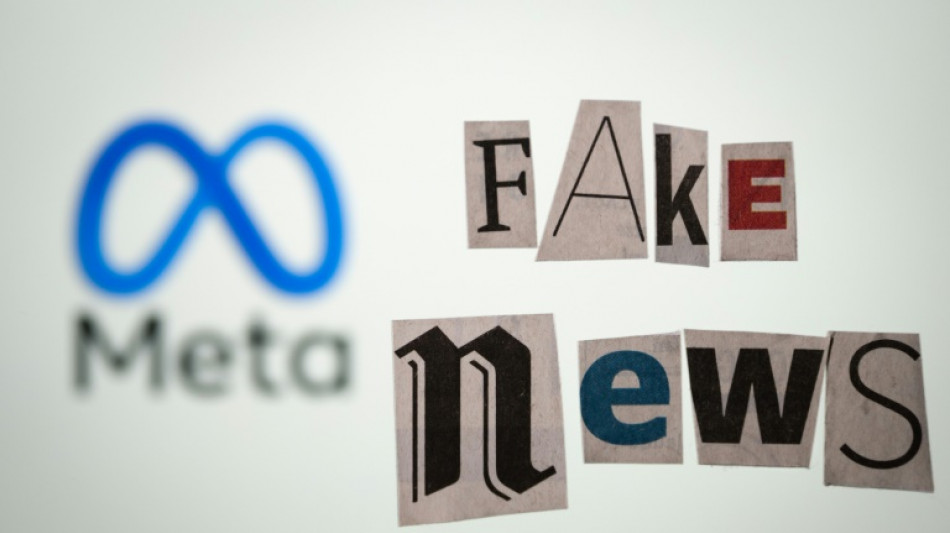
Deepfake political scam ads surge on Meta platforms, watchdog says / Photo: SEBASTIEN BOZON - AFP

 Reusser retains world time-trial title

 Man City outgun Sunderland despite Brobbey hat-trick, Liverpool win at Bournemouth

 Top US, Chinese economic officials meet ahead of Trump-Xi summit

 Erdogan's LGBTQ crackdown 'first step of election campaign': activist

 Mass drone barrage on Moscow kills two

 82-year-old dies after beach fight in Greece over sun lounger

 US warns of rapid escalation in Mideast war

 Iran 'put hearts on the court' to win Asian Games basketball bronze

 School girl Yu helps China dominate in Asian Games swimming openers

 Myanmar win first Asian Games teqball gold as Spain great Puyol watches

 China's 13-year-old Yu scorches to first major gold at Asian Games

 Russians vote on last day of parliamentary elections

 Hong Kong pays final respects to former city leader Tung

 Typhoon put people off Asian Games opening ceremony, official says

 China's 13-year-old Yu cruises as Asian Games swimming begins

 AI 'warning shots' focus Beijing on national security risks

 Philippine tribe in limbo over US-led tech hub

 Leo XIV, first US pope transcends his restrained style

 Singer Ed Sheeran says Gaza situation 'unjustifiable' following controversy

 In 'Tenzing', a Sherpa mountaineer gets his due
 Gridko's New Live Drive PTO Roll-Off Trailer Wins the Heavy-Duty TRAILmakER Award 2026 at NATDA Awards

 Chile's Bachelet quits race to be next UN chief

 Raphinha treble fires perfect Barca to win at Sevilla

 Thiam makes winning heptathlon return at Decastar meet

 Czechs beat USA to qualify for Davis Cup finals

Scammers are among the top political ad spenders on Meta's platforms, using deepfake videos of American politicians -- including President Donald Trump -- to promote fake government benefits, a watchdog group said Wednesday.
The nonprofit Tech Transparency Project said it identified 63 scam advertisers that collectively spent $49 million on Facebook and Instagram, often targeting seniors with ads promoting fake stimulus checks, government spending cards and healthcare payments.
The ads have reached tens of thousands of the platforms' users.
"The findings show how scammers are taking advantage of advances in artificial intelligence technology, public confusion around the status of social safety net programs, and lax Meta content moderation to target new victims," TTP said in a report.
"Meta is allowing this activity even though it prohibits scams and says it invests in scam prevention to keep users safe," it added.
Meta did not immediately respond to AFP's request for comment.
TTP's report quoted a Meta statement saying that the company would "invest in building new technical defenses" as scammers "constantly evolve their tactics to try to evade detection."
According to Meta's rules, advertisers who seek to run political ads in the United States have to undergo a special authorization process, which involves submitting an official ID such as a driver's license along with a US mailing address.
TTP said all of the 63 scam advertisers -- who accounted for over 150,600 political ads -- had their advertisements removed by Meta within the past 12 months for violating the tech giant's policies. Still, nearly half of them continued to advertise as of Tuesday.
Meta appeared to disable 35 ad accounts, but only after they ran dozens -- and in some cases hundreds -- of ads. Six of the accounts spent over $1 million before they were disabled or deleted, the report said.
One advertiser identified by TTP -- called the Relief Eligibility Center —- ran an ad on Meta platforms in April and May featuring a deepfake video of Trump falsely promising stimulus checks to Americans.
The video matched a speech by Trump in the White House's Rose Garden in early April, but TTP found that the words in the ad did not match the official transcript from the event.
The ad, which directed users to a website to get a "FREE $5,000 Check from Trump," appeared to target men and women over the age of 65 in more than 20 US states, TTP said.
For years, professional fact-checkers have warned about bogus stimulus check offers circulating on social media platforms.
The latest findings underscore the explosion of online fraud, with surveys showing a growing number of American adults experiencing internet scams or impersonation attacks.
In August, the Federal Trade Commission reported a more than four-fold increase since 2020 in complaints from older adults who lost $10,000 or more -- sometimes their entire life savings -- to scammers impersonating trusted government agencies or businesses.
Th.Gonzalez--AT