Libya traditional jewellery hangs on by silver thread / Photo: Mahmud Turkia - AFP

 Pope warns against losing humanity in 'paradise of machines'

 From FBI warning to literary acclaim: the Russian journalist who took on Putin

 China swimmer in Asian Games first as North Korea lifters reign

 French literary prize removes novel from longlist after AI claims

 China's Zhang wins record seventh Asian Games swimming gold

 Verstappen edges Russell in final practice in Azerbaijan

 English, Spanish, Italian, German football leagues call for FIFA reform

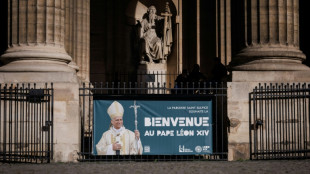
 Pope arrives in France on first official visit in 18 years

 Pope arrives in France on first state visit in 18 years

 Heavy fighting, internet disruption as Ethiopia conflict rages

 From transit to consumption: drug use surges in Mozambique

 Chicago teams, Guardians and Padres all book MLB playoff berths
 Bijan Robinson destroys Packers in 35-14 win for Falcons

 Harimoto hails new era as Japan dethrone table tennis kings China
 India rape cases turn focus back onto women's safety
 Rebellious Afghan taxi drivers defy ban on music

 Brazil candidates mount digital armies for fierce online campaign

 Nepal PM says floods 'a warning to the world' about climate change
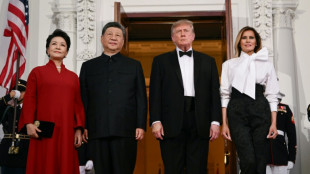 Trump hosts Xi for state dinner as pomp masks tensions

 Core Silver Announces Grant of Stock Options

 Tocvan Reports Positive Closed-Circuit Column Leach Results at Gran Pilar

 InterContinental Hotels Group PLC Announces Transaction in Own Shares - September 25

 Helio Concludes Successful Southwest Roadshow, Expands Investor Outreach to the Northeast in Support of Its Uplisting Strategy

 American Hotel Income Properties REIT LP Announces Corporate Update

 Karbon-X (OTCQB:KARX) to Present Global Growth Strategy and Showcase SkyXero at 26th MK-Equity Investment Conference in Munich

In Tripoli's Old City, young Libyans weave delicate patterns with threads of silver and gold to create traditional filigree jewellery -- reviving an art almost lost through decades of dictatorship and war.
Abdelmajid Zeglam is just 12 years old, but his minutely detailed creations are already selling fast in the streets around a Roman-era archway dedicated to emperor Marcus Aurelius.
"I hesitated at first for fear of failing because I'm young, but my mum encouraged me," Zeglam said.
He is the youngest of 20 or so students, around half of them female, studying at the Libyan Academy for Traditional Gold and Silver Crafts, in a building that once served as a French consulate to the Ottoman Empire.
Trainees learn about precious metal alloys before studying the art of filigree, in which beads and threads of the precious materials are woven into intricate designs then soldered together to create jewellery.
"I love it," Zeglam said. "I want to become a petroleum engineer in the mornings and a jeweller in the afternoons."
Mohamed al-Miloudi, a 22-year-old civil engineering student in a baseball cap, said he had not missed a class since signing up in September.
"It's a hobby, but I'd like to make it into my trade," he said.
The institute's founder, Abdelnasser Aboughress, said filigree jewellery was an ancient tradition in the North African country.
"Craftsmen in the medina of Tripoli were trained by Jewish masters and later by Arabs, at the prestigious School of Arts and Trades" founded in the late 19th century, he said.
- Secret jewellers -
But generations of tradition were abruptly halted after Moamer Kadhafi took power in a 1969 coup.
The capricious ruler scrapped the constitution and established his "jamahiriya" -- a medley of socialism, Arab nationalism and tribal patronage.
He also scrapped the private sector, seizing companies and confiscating their assets.
Overnight, self-employed artisans lost everything: their workshops, their livelihoods and their students.
"The state reduced Libyan crafts to nothing and forced a generation of young apprentices, who should have taken up the baton, to instead leave the traditional crafts and join the army" or become civil servants, said Aboughress.
The 55-year-old was born just a few streets away in the medina, and despite Kadhafi's ban, he took up the craft at the age of 15.
Along with his father, for decades he worked in secret on jewellery for trusted clients.
Now, he hopes to pass the craft on to younger generations, as well as fighting back against a tide of "lower-quality jewellery imported from Egypt and China (which) has flooded the market".
Aboughress is working on a project to document and preserve as much of this cultural heritage as possible.
- 'People with passion' -
Student Fatima Boussoua hit out at the practice of selling old Libyan silver jewellery at cheap prices to be exported then melted down.
"It's part of Libya's artisanal heritage that's disappearing!" she said.
A dentist in her 40s who also teaches at the University of Tripoli, Boussoua has been training at the centre for the past year, hoping to master the craft.
"We should be training artists to preserve our heritage," she said. "All it needs is people with passion."
While becoming a true expert takes years of training, Aboughress's students are already producing works for sale online or at the centre itself.
That said, he admits the project needs financial help to buy the expensive raw materials -- as well as "moral support".
He hopes that with enough resources, he will one day be able to set up a string of other workshops across Libya.
"It's time to bring this craft back to life," he said.
E.Rodriguez--AT