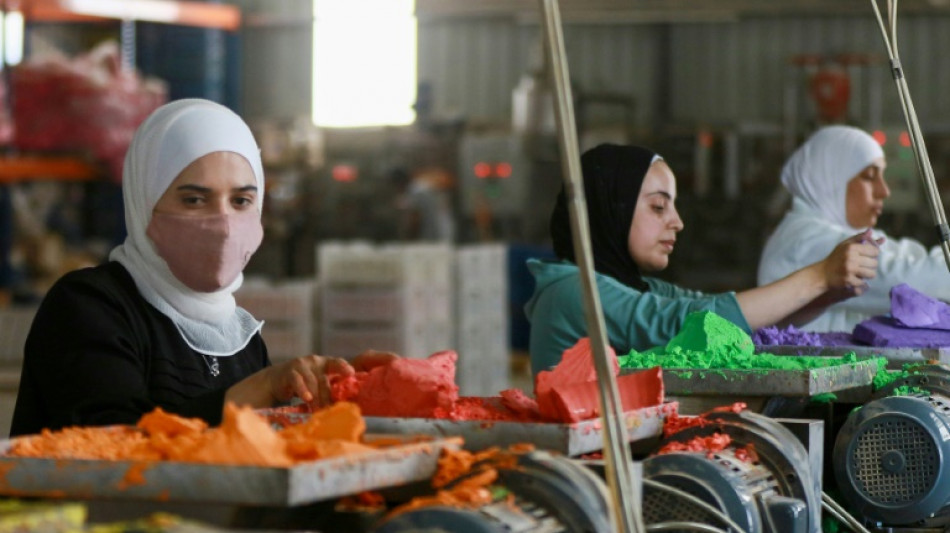
Jordan chalks up business success from limestone riches / Photo: Khalil MAZRAAWI - AFP

 Pope warns against losing humanity in 'paradise of machines'

 From FBI warning to literary acclaim: the Russian journalist who took on Putin

 China swimmer in Asian Games first as North Korea lifters reign
 French literary prize removes novel from longlist after AI claims
 China's Zhang wins record seventh Asian Games swimming gold

 Verstappen edges Russell in final practice in Azerbaijan

 English, Spanish, Italian, German football leagues call for FIFA reform

 Pope arrives in France on first official visit in 18 years

 Pope arrives in France on first state visit in 18 years
 Heavy fighting, internet disruption as Ethiopia conflict rages

 From transit to consumption: drug use surges in Mozambique

 Chicago teams, Guardians and Padres all book MLB playoff berths
 Bijan Robinson destroys Packers in 35-14 win for Falcons
 Harimoto hails new era as Japan dethrone table tennis kings China

 India rape cases turn focus back onto women's safety
 Rebellious Afghan taxi drivers defy ban on music

 Brazil candidates mount digital armies for fierce online campaign
 Nepal PM says floods 'a warning to the world' about climate change

 Trump hosts Xi for state dinner as pomp masks tensions
 Core Silver Announces Grant of Stock Options

 Tocvan Reports Positive Closed-Circuit Column Leach Results at Gran Pilar
 InterContinental Hotels Group PLC Announces Transaction in Own Shares - September 25

 Helio Concludes Successful Southwest Roadshow, Expands Investor Outreach to the Northeast in Support of Its Uplisting Strategy

 American Hotel Income Properties REIT LP Announces Corporate Update

 Karbon-X (OTCQB:KARX) to Present Global Growth Strategy and Showcase SkyXero at 26th MK-Equity Investment Conference in Munich

Long before whiteboards, beamers and laptops entered modern school classrooms, teachers relied on the humble, dusty, sometimes screechy blackboard chalk -- a material that has created a Jordanian business success story.
Chemical engineer Salah Aloqbi remembers sitting on a bus in Amman in 1995 when he hit on the idea that would lead him to create his company. More than two decades later it boasts 150 staff, with exports to more than 100 countries.
Chalk, a white, soft limestone, was formed aeons ago when the shells of tiny marine creatures were compressed on the sea floor -- and the landlocked Middle Eastern desert country of Jordan is blessed with vast deposits.
"It was a game-changing idea," recalled Aloqbi, now 49, who founded the Jordan Chalk Manufacturing Company.
"I was returning from work at the Jordan Carbonate Company when I heard a radio interview saying that the calcium carbonate produced by the company is used in various industries in Jordan -- except the chalk industry."
Aloqbi pondered how to make blackboard chalk, which was until then wholly imported, to gain extra value from the calcium carbonate that is also used to produce white cement, make soils less acidic, and toothpaste more abrasive.
Seven years later, he launched a small factory in Karak governorate south of Amman, with two rooms and just five workers, and started experimenting -- initially by pulverising the porous material with a meat mincer.
"But the chalk that we produced at that time was no longer used around the world, so we moved to produce dustless medical chalk," he said, referring to a carbonate-based type with larger particles.
- The right stuff -
Some 2,149 attempts later, the businessman said proudly, he hit the right formula for dustless chalk, creating a "very strong export opportunity" that now sees his company produce 10 billion pieces a year.
Jordan has a near endless supply of the raw material, with the ministry of energy and mineral resources estimating the country's "assets of limestone exceed 1.3 billion metric tons".
Limestone is the common form of calcium carbonate CaCO3, the main ingredient for chalk.
"It comes to mind that this is an outdated product, but the truth is that we are struggling to meet the great demand," Aloqbi said as he inspected hundreds of cartons heading to Britain and Germany, Mali and Morocco.
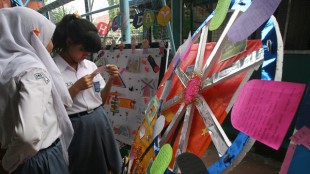
The chalk pieces come in a wide palette of colours and are used for art and play around the world.
The firm has also branched out into coloured crayons and modelling clay, and is the country's only producer of chalk sticks.
Today, the company sits on a 7,500 square metre plot and offers sought-after jobs in a country where the unemployment rate soared to 25 percent last year, about the same as the poverty rate.
"Most of us are from villages in Karak governorate," said one employee, 28-year-old Sundus Majali. "More than half of the workers are women."
At first, she said, "it was difficult for parents to allow females to work ... But today they have no problem with that, especially because the factory is safe, not like other workplaces."
Another colleague, Alaa Aloqbi, 33, said "the factory has provided job opportunities at a time when life became difficult".
N.Walker--AT