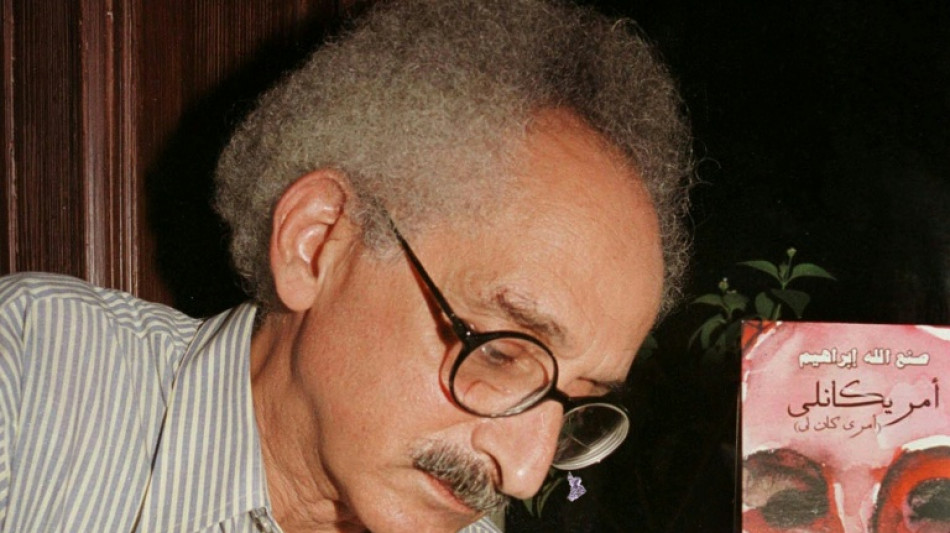
Renowned Egyptian novelist Sonallah Ibrahim dies at 88 / Photo: Amro MARAGHI - AFP

 Braves clinch division title as Red Sox reach MLB playoffs

 Bordeaux-Begles hammer Stade Francais despite Jalibert injury

 Milan and Juventus end blips with home wins

 Bridgeman wins PGA Biltmore title with sizzling 61

 Williams injured as Bears shut down by Vikings

 US warns of rapid escalation in Middle East war

 Germany's far-right AfD celebrates another state election win

 Russia vows revenge for election-day attacks as poll shows ruling party win

 Spaun late shows snatches PGA Championship win

 Conceicao strikes as Juventus beat Atalanta

 Britain, Zverev-inspired Germany, Spain complete Davis Cup finals

 Man Utd salvage Fulham draw as pressure mounts on Carrick

 Spanish civil war drama 'The Black Ball' wins at Toronto festival

 Germany's Merz shaken by far-right and far-left gains in state votes

 Macron welcomes Canada's Carney to French Atlantic territory

 Fiorentina frustrate Napoli with Serie A draw, Como upset

 Five-star Man City top Premier League after Sunderland thriller

 Ukrainian drones hit Moscow on last day of Russian elections
 Multi-Asset Trading Venue Monochrome Exchange Announces IEO of Its Native Token, $MCR

 South Korea break Japan hearts to win Asian Games basketball gold
 Acosta takes first victory at Austrian MotoGP

 PSG president Nasser al-Khelaifi under investigation in France for conflict of interest

 China swim sensation, 13, sets Games record after Japan win early

 Drones hit Moscow as Russians go to the polls

 New England boss Fleming says 'wrong' to ask Stokes to end retirement

Egyptian novelist Sonallah Ibrahim, famed for his critiques of political repression, neoliberalism and Western hegemony, has died at the age of 88, the culture ministry announced on Wednesday.
Ibrahim "passed away today, leaving behind an immortal literary and humanitarian legacy," Culture Minister Ahmed Fouad Hanno said in a tribute, calling the writer a "pillar of modern Arabic literature".
Born in Cairo in 1937, Ibrahim was famed around the Arab world as a chronicler of social injustice, known for his sparse, documentary-style prose and his fierce independence.
His writings -- which blurred the line between the personal and the political -- captured the struggles of the Arab world in the postcolonial era, particularly those of his native Egypt.
Arguably his most famous novel, "Zaat" (1992), tells the story of Egypt's modern history -- from the overthrow of the monarchy in 1952 to the neoliberalism of the 1990s under president Hosni Mubarak -- through the eyes of an ordinary, middle-class woman.
It was adapted into a prime-time television series in 2013, bringing Ibrahim's scathing portrayal of power to a new generation of Egyptians in the aftermath of the Arab Spring uprising that ousted Mubarak.
A dissident through and through, Ibrahim was first jailed for his leftist politics in 1959, under then president Gamal Abdel Nasser.
His five years in prison would form the basis for his debut 1966 novel, "That Smell", which was initially banned.
Ibrahim's renown later saw many of his works translated into English and French.
In 2003, he refused to accept a prestigious literary prize from the Mubarak government charging that it "oppresses our people, protects corruption and allows the Israeli ambassador to remain while Israel kills and rapes".
The last was a reference to alleged Israeli abuses in the occupied territories during the second Palestinian intifada or uprising.
Among Ibrahim's most celebrated works are "The Committee" (1981), a Kafkaesque allegory of bureaucracy and surveillance, and "Stealth" (2007), a semi-autobiographical account of his childhood during World War II.
Generations of Arab writers found inspiration in his minimalist style, heavy with irony and rooted in everyday life.
T.Sanchez--AT

